This utility civils glossary gives short, plain definitions of the terms used on UK cable routes, substation sites and street works. A permit, a licence and a notice mean different things in a street. A trough, a draw pit and a joint bay are different holes.
Each definition is one or two sentences, based on the legislation, regulator, network operator specification or code of practice behind the term. Where a guide covers the term in depth, the definition links to it. Rules and figures are for England unless the entry says otherwise.
Key points
- The New Roads and Street Works Act 1991 (NRSWA) separates street works, done by utilities and licence holders to place apparatus, from road works done for road purposes.
- A section 50 licence under NRSWA gives a non-utility the right to place apparatus in a street, but each set of works still needs a permit or notice.
- The Electricity Safety, Quality and Continuity Regulations 2002 define low voltage as up to 1,000 volts AC between phases; anything above is high voltage.
- HSE's HSG47 says a cable is positively located only when it has been safely exposed, which is why trial holes are dug.
- A wayleave is a consent for an electric line on land, which Schedule 4 to the Electricity Act 1989 lets a licence holder seek as a necessary wayleave if the owner refuses.
- In England, a permit for minor works needs 3 working days' notice, standard works 10 working days, and major works provisional advance authorisation at least 3 months ahead.
In this guide
- Which utility civils terms are most often confused?
- What do utility civils terms mean, from A to Z?
- How do the street works permit types compare?
- How do the substation terms fit together?
- Where Ground Utilities fits
- Frequently asked questions
- Need a cable route built?
- Sources
Jump to a letter: A · B · C · D · E · F · G · H · I · J · K · L · M · N · O · P · R · S · T · U · V · W · X
Which utility civils terms are most often confused?
The terms most often mixed up on a cable route are permit and licence, trough, draw pit and joint bay, wayleave and easement, and trial hole and trial pit. The table sets them side by side.
| Pair | What the first one is | What the second one is |
|---|---|---|
| Street works permit and section 50 licence | Permission for one set of works in one street, for a set period, from the highway authority | A standing right for a non-utility to place apparatus in a street; each set of works still needs a permit |
| Street works and road works | Works by a utility or licence holder to place or maintain apparatus in a street | Works for road purposes, such as resurfacing, by or for the highway authority |
| Joint bay and draw pit | A temporary excavation where cables are jointed, then backfilled with the joints left in the ground | A permanent small chamber on a duct route where cable can be drawn through and reached later |
| Cable trough and duct | An open channel with removable lids, close to the surface | A buried tube that cable is pulled through |
| Wayleave and easement | A consent for an electric line on land, with access to maintain it | A property right that passes with the land when it is sold |
| Trial hole and trial pit | A small hand or vacuum dug hole to expose and confirm a service | On utility work usually the same thing; in ground investigation, a pit to inspect and sample soil |
| Low voltage and high voltage | Up to 1,000 volts AC between phases | Anything above 1,000 volts AC, including 11kV, 33kV and 132kV |
What do utility civils terms mean, from A to Z?
The A to Z below defines each term in one or two sentences, with a link to the guide that covers it.
A
- Adoption: Adoption is when a network operator, water company or highway authority takes ownership of assets someone else built, and maintains them from then on. Electricity networks built by ICPs are adopted by DNOs or IDNOs, while new roads and sewers are adopted under section 38 and section 104 agreements.
- Alternative reinstatement materials (ARMs): ARMs are bound or treated materials that the SROH allows in place of standard backfill and sub-base. They may be used only with the highway authority's agreement under the SROH's Appendix A9 (see road reinstatement).
- As-laid records: As-laid records, also called as-built records, are drawings and data showing exactly where cables, ducts, joints and other apparatus were installed, and at what depth. UK Power Networks wants final as-built records within five working days of energisation (see UKPN G81).
- Auger boring: Auger boring is a trenchless method that drives a steel casing between two pits while a rotating auger inside it removes the spoil. UKSTT gives typical lengths under 100 m, up to about 200 m (see horizontal directional drilling).
- Avoidance mode: Avoidance mode is the cable avoidance tool setting that looks for power, radio and signal generator signals at once, used for the first sweep of an area before tracing in single modes (see CAT and Genny).
B
- Backfill: Backfill is the material placed in a trench between the surround to the apparatus and the road or ground surface layers. The SROH grades backfill from Class A, graded granular material, to Class E, which may not be used (see road reinstatement).
- Barrier pipe: Barrier pipe is blue water pipe with brown stripes, made with an aluminium layer that stops hydrocarbons in contaminated ground passing into the supply (see underground utility colour codes).
- Battering: Battering is cutting the sides of an excavation back to a safe slope instead of supporting them. HSE says the slope in granular soil should be less than its natural angle of repose, and considerably flatter in wet ground (see trench support and deep excavations).
- Bedding: Bedding is the layer of sand or other specified material laid under a cable or duct. SSEN adds the duct diameter and 75 mm of sand bedding to the minimum cover to get the dig depth (see cable ducting).
- Bell mouth: On a cable route, a bell mouth roller guides cable into a duct entry during a pull (see cable ducting). On a site, a bellmouth is the flared junction where an access road meets the highway, often part of a substation civils package.
- Bentonite: Bentonite is a natural clay mixed with water to make the drilling fluid for horizontal directional drilling, which carries cuttings out of the bore and holds it open (see horizontal directional drilling).
- BESS: A battery energy storage system (BESS) is a set of batteries in containers or cabinets that imports power from the network, stores it and exports it later (see BESS site groundworks).
- Biodiversity net gain (BNG): Biodiversity net gain is the planning rule in England that habitat must end up at least 10% better than before, mandatory for most new permissions since 12 February 2024. The improved habitat must be managed for 30 years (see BESS site groundworks).
- Blinding: Blinding is a compacted layer of fine material placed directly over a cable or joint. UK Power Networks asks for cables to be blinded to a compacted 100 mm above the cable or joint (see UKPN G81).
- Bond: A bond is security, usually from a bank or insurer, that lets an authority finish adoptable works if the developer fails, and is used in both highway and sewer adoption agreements (see section 38, 104 and 278 agreements).
- Build-over agreement: A build-over agreement is consent from the sewerage company to build over or near a sewer shown on its sewer records. Approved Document H, requirement H4, applies to building over, or within 3 m of the centreline of, a sewer on those records (see build-over agreements and sewer diversions).
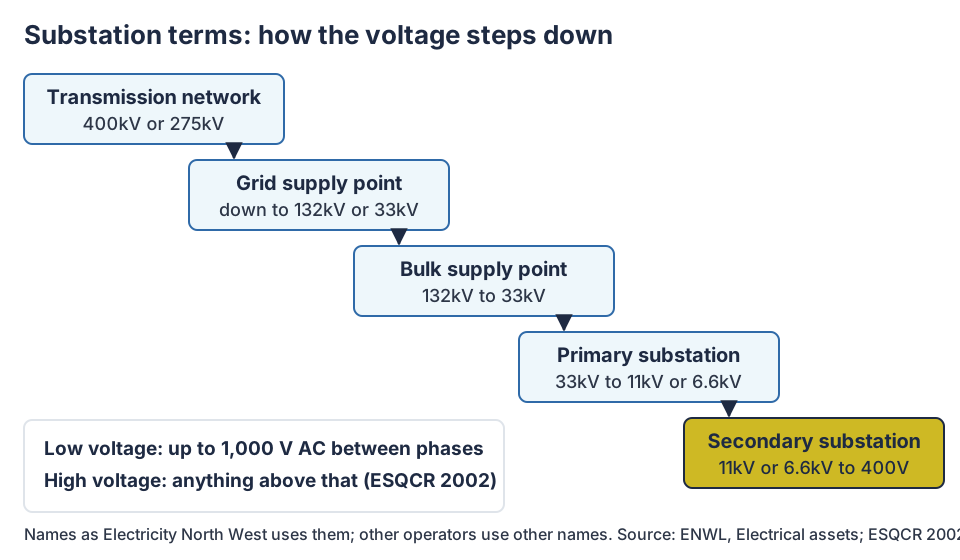
- Bulk supply point (BSP): A bulk supply point, in Electricity North West's terms, is a substation where 132kV is transformed down to 33kV to feed primary substations; other operators use other names (see substation types).
C
- Cable avoidance tool (CAT): A cable avoidance tool is a handheld receiver that detects electromagnetic signals from buried metallic cables and pipes. It cannot find most plastic pipes, or cables carrying little or no current (see CAT and Genny).
- Cable chamber: A cable chamber is an underground chamber with a removable cover that gives access to ducts and cables, for example to pull in or joint fibre (see cable troughing, draw pits and cable chambers).
- Cable pulling: Cable pulling is drawing cable off a drum and through a duct with a winch at the far end. The pulling tension must stay inside the cable maker's limit and be displayed throughout the pull (see cable ducting).
- Cable stocking: A cable stocking is a woven grip fitted over the end of a cable so the winch rope can pull it through a duct (see cable ducting).
- Cable trough: A cable trough is a concrete or plastic channel with removable lids that carries cables close to the surface, for example across a substation compound (see cable troughing, draw pits and cable chambers).
- CDM 2015: CDM 2015 is the Construction (Design and Management) Regulations 2015, which set health and safety duties for clients, designers and contractors on construction work, including excavation (see trench support and deep excavations).
- Chapter 8: Chapter 8 is the part of the Department for Transport's Traffic Signs Manual that is the code of practice for temporary traffic management at road works, street works and other temporary situations. A 2026 edition was added to GOV.UK on 4 November 2026 (see street works traffic management).
- Class 1, 2 and 3 ducts: Classes 1, 2 and 3 are classes of plastic power duct made to ENA TS 12-24. Electricity North West uses Class 1 for rigid mains duct, Class 2 for small rigid service duct and Class 3 for coilable duct (see cable ducting).
- Confined space: A confined space, under the Confined Spaces Regulations 1997, is an enclosed place such as a pit, trench, chamber or sewer with a foreseeable specified risk, such as asphyxiation, drowning, fire or explosion (see trench support and deep excavations).
- Contestable works: Contestable works are the parts of a new electricity connection that an accredited company other than the network operator may build, such as trenching, cable laying and reinstatement (see NERS, ICPs and IDNOs and how a new HV connection gets built).
- Cover: Depth of cover is the distance from the finished surface to the top of the highest cable, duct or joint. Each operator sets its own minimums, and UK Power Networks asks for 900 mm at 33kV in footways and carriageways (see UKPN G81).
- Cross-bonding: Cross-bonding is swapping the metallic screens of a single-core circuit between phases at the joints, through link boxes, to reduce sheath losses on long, high-rated circuits (see cable jointing and joint bays).
- CSCS: CSCS is the Construction Skills Certification Scheme, whose cards show the holder has the training and qualifications for their job. CSCS says a card is not a legal requirement, and the principal contractor or client decides whether a site needs one (see utility site cards).
D
- De-rating: De-rating is a cut in the current a cable may safely carry, for example because it is deeper, in a duct or near another circuit. Electricity North West applies 10% for two LV circuits side by side where spacing cannot be met (see cable ducting).
- Deep opening: A deep opening, in the SROH, is an excavation with more than 1.5 m of cover over the apparatus. Its reinstatement carries a three-year guarantee period instead of two (see road reinstatement).
- Deemed permit: A deemed permit is a street works permit treated as granted because the highway authority did not answer a complete application in time, and no fee is payable for it (see permit and section 50 lead times).
- Direct buried: Direct buried cable is laid on bedding in an open trench and covered over, without a duct (see cable ducting).
- DNO: A distribution network operator (DNO) is a company licensed by Ofgem to run the electricity distribution network in its region. Ofgem sets price controls for fourteen DNOs in Great Britain, held by six operator groups (see NERS, ICPs and IDNOs).
- Double-stacking: Double-stacking is laying one tier of ducts above another so the trench stays narrow, at the cost of a deeper dig and some cable rating (see cable ducting).
- Draw pit: A draw pit is a small chamber on a duct route, often at a change of direction, where cable can be drawn through and reached later (see cable troughing, draw pits and cable chambers).
- Draw rope: A draw rope is a non-corrosive rope left inside each proved duct, used later to pull the winch rope and cable through (see cable ducting).
- Duct: A duct is a tube laid to carry cables or pipes so they can be pulled in later without digging the route up again. Its colour shows what it was laid for, but a duct may now hold something else (see cable ducting).
- Duct proving: Duct proving is pulling a mandrel, and sometimes a test length of cable, through a duct to check it is clear before the cable pull. UK Power Networks uses a 3 metre length of the cable to be installed (see cable ducting).
- Duct seal: A duct seal is fitted where ducts enter a substation or building to keep water out, even when the duct is empty. Electricity North West names external cable entries as a main source of water getting into substations (see cable ducting).
E
- Earthing grid: An earthing grid is a network of buried bare conductors and rods that connects equipment to earth at a substation or BESS site. Network-side earthing is designed to ENA TS 41-24, and the grid is usually laid before surfacing (see BESS site groundworks).
- Easement: An easement is a legal right over land, such as the right to keep a cable in it and reach it for repairs, and it passes with the land when the land is sold. UK Power Networks uses a consent matrix to decide whether a job needs a wayleave, an easement or a lease (see cable routes across your land).
- ECS 02-0019: ECS 02-0019 is UK Power Networks' standard for installing underground cables from LV to 132kV, setting depths, ducts, bedding, joint bays and reinstatement for work it will adopt (see UKPN G81).
- Edge protection: Edge protection is barriers at the edge of an excavation, such as guard rails and toeboards, that stop people and materials falling in. HSE also says plant and vehicles should not be parked close to excavation sides (see trench support and deep excavations).
- EHV: Extra high voltage (EHV) is the term network operators use for their higher distribution voltages; Electricity North West uses it for the 33kV network that feeds its primary substations. The UK safety regulations define only low and high voltage (see 11kV, 33kV and 132kV cables).
- Emergency works: Emergency works, under section 52 of NRSWA, are works needed at once to end or prevent circumstances likely to cause danger to people or property. They can start straight away, with a notice or permit application within 2 hours (see permit and section 50 lead times).
- Energisation: Energisation is making a new circuit or substation live for the first time, which on adopted work follows the network operator's inspections and records checks (see how a new HV connection gets built).
- ENA TS 12-24: ENA TS 12-24 is the Energy Networks Association's technical specification for plastic ducts for buried electric cables, now at Issue 4 (2021) (see cable ducting).
- EREC G81: EREC G81 is the Energy Networks Association's seven-part framework of engineering documents for building new connections that a network operator will adopt, with each operator adding its own detail (see UKPN G81).
- ESQCR: The ESQCR are the Electricity Safety, Quality and Continuity Regulations 2002. Regulation 14 requires underground cables to be kept deep enough, or protected, to avoid damage, and marked by a duct, tiles, tape or similar (see 11kV, 33kV and 132kV cables).
- EUSR: EUSR is the Energy and Utility Skills Register, which records utility sector training such as SHEA Power and the Utility Excavations categories. It is the CSCS Alliance Partner for utilities (see utility site cards).
- Excavation inspection: Excavation inspection, under CDM 2015 regulation 22, is a competent person's check of a supported or battered excavation at the start of each shift. It is repeated after any event that may affect its stability, and after any accidental fall of material (see trench support and deep excavations).
F
- Feeder pillar: A feeder pillar is a free-standing, lockable cabinet that houses low voltage fuses or switchgear. It splits one incoming supply into several outgoing circuits, for example for street lighting or EV chargers (see feeder pillars and EV charging hub civils).
- Fixed penalty notice (FPN): A fixed penalty notice settles a street works offence without prosecution. In England, working without a permit has carried a £1,000 penalty since 5 January 2026, or £600 if paid early (see NRSWA and street works).
- Foamed concrete for reinstatements (FCR): FCR is a lightweight cement-based backfill that the SROH permits in street reinstatements, where it counts as Class A material for sub-base design (see road reinstatement).
- Frac-out: A frac-out, also called a breakout or inadvertent return, is drilling fluid escaping through the ground to the surface or into a watercourse during horizontal directional drilling (see horizontal directional drilling).
G
- G81: G81 is the shorthand for the Energy Networks Association's EREC G81 framework for networks built for adoption. UK Power Networks keeps its own G81 requirements in its G81 Technical Library (see UKPN G81).
- Gate 2: Gate 2, in the reformed connections process in Great Britain, is the point where an eligible project gets a confirmed connection date, connection point and queue position. A project must meet the readiness criteria, largely evidence of secured land rights, and one strategic alignment criterion (see Gate 2 offers).
- Genny: A Genny is a signal generator that puts a known signal onto a buried service, by direct connection, clamp or induction, so a cable avoidance tool can trace it (see CAT and Genny).
- GPR: Ground penetrating radar (GPR) is a survey method that sends radar pulses into the ground to detect buried objects, including some plastic pipes. HSG47 says it cannot identify a service on its own (see PAS 128 surveys).
- Grid supply point (GSP): A grid supply point is the substation where a DNO takes over from the transmission network. Electricity North West says its GSPs take in 400kV or 275kV and bring it down to 132kV or 33kV (see substation types).
- Ground investigation: Ground investigation is exploring and testing the ground to inform design, for example with boreholes, trial pits and laboratory tests, and BS 5930 is the UK code of practice for it (see BESS site groundworks).
- Groundworker: A groundworker is a site operative who prepares the ground and builds what sits below and at ground level, such as trenches, ducts, drainage, foundations and reinstatement (see careers at Ground Utilities).
- Guarantee period: The guarantee period is the time an undertaker stays responsible for a permanent reinstatement under the SROH: two years, or three years for deep openings (see road reinstatement).
H
- Hand digging: Hand digging is exposing services with hand tools once the line has been located. HSG47 says a cable is positively located only when it has been safely exposed (see trial holes and trial pits).
- HDD: Horizontal directional drilling (HDD) is a trenchless method in which a rig drills a steered pilot bore along a planned curve, reams it larger, then pulls a duct or pipe back through (see horizontal directional drilling).
- High voltage (HV): High voltage, under the ESQCR, is any voltage above low voltage, so above 1,000 volts AC between phases. On distribution cable routes that means 6.6kV, 11kV, 20kV, 33kV, 66kV and 132kV (see 11kV, 33kV and 132kV cables).
- HSG47: HSG47 is HSE's guidance "Avoiding danger from underground services", third edition, 2014. It sets a safe system of work: plan the work, locate and mark services, and dig safely (see avoiding utility strikes).
I
- ICP: An independent connection provider (ICP) is a company accredited under NERS to build new electricity network to a network operator's specification, for adoption. Ofgem describes ICPs as companies that complete and develop local networks but cannot operate or maintain them (see NERS, ICPs and IDNOs).
- IDNO: An independent distribution network operator (IDNO) is a company licensed by Ofgem to own, operate and maintain local electricity networks connected to a DNO's network (see NERS, ICPs and IDNOs).
- Immediate activity: An immediate activity is the permit scheme term for emergency and urgent works, which can start without a permit if an application follows within 2 hours of starting (see permit and section 50 lead times).
- Inspection categories A, B and C: Categories A, B and C are the highway authority's sample inspections of street works. A is while works are in progress, B within six months after reinstatement, and C in the three months before the guarantee ends (see road reinstatement).
- Interim reinstatement: An interim reinstatement is a safe, temporary finish to an excavation in a street. Under section 70 of NRSWA, the permanent reinstatement must follow within 6 months (see road reinstatement).
J
- Joint: A cable joint is a connection between two lengths of cable that restores the conductor, insulation, screens and outer seal. Types include straight, transition and branch joints, with terminations at equipment (see cable jointing and joint bays).
- Joint bay: A joint bay is a temporary excavation, sized to the joints it will hold, where cable lengths are pulled in, jointed and tested. Afterwards it is backfilled and reinstated, with the joints left in the ground (see cable jointing and joint bays and joint bay construction).
- Jointer: A jointer is a trained and authorised person who makes cable joints and terminations. NERS treats cable jointing as a separate scope from cable laying (see cable jointing and joint bays).
K
- kV: A kilovolt (kV) is 1,000 volts, so an 11kV cable runs at 11,000 volts (see 11kV, 33kV and 132kV cables).
L
- Lane rental: Lane rental is a scheme that lets an approved highway authority charge undertakers by the day for occupying the streets it covers. Under the 2012 England regulations the charge is up to £2,500 a day, and it does not apply in verges (see street works traffic management).
- Link box: A link box is a sealed underground box that gives access to cable connections. On LV networks it lets engineers connect or isolate sections, and on single-core HV circuits it houses the sheath bonding connections (see cable jointing and joint bays).
- LSBUD: LinesearchbeforeUdig (LSBUD) is a free online search of the buried asset records held by its member asset owners, though it does not cover every owner (see avoiding utility strikes).
- Low voltage (LV): Low voltage, under the ESQCR, is an AC voltage above 50 volts and up to 1,000 volts between phases (600 volts phase to earth). Distribution substations step 11kV or 6.6kV down to 400V for LV networks (see 11kV, 33kV and 132kV cables).
M
- Major activity: A major activity is street works lasting 11 working days or more, or needing a temporary traffic regulation order. Its permit needs provisional advance authorisation at least 3 months ahead (see permit and section 50 lead times).
- Mandrel: A mandrel is a cylindrical tool pulled through a duct to prove it is clear of obstructions before cable is pulled (see cable ducting).
- Minor activity: A minor activity is street works planned to last 3 working days or less, with the permit application due at least 3 working days before the start (see permit and section 50 lead times).
- Moling: Impact moling drives an air or hydraulic piston mole through compressible soil to form a short bore. UKSTT gives lengths up to about 30 m (see horizontal directional drilling).
- msa: Million standard axles (msa) is the measure the SROH uses to group roads into types 0 to 4 by the commercial traffic they will carry over 20 years (see road reinstatement).
- Multi-utility: Multi-utility work installs the routes for several utilities, such as power and fibre ducts and water, on one site or in shared trenches (see multi utility services).
N
- Narrow trench: A narrow trench, in the SROH, is a trench over 60 mm and up to 300 mm wide, and over 1 m long (see road reinstatement).
- NERS: NERS is the National Electricity Registration Scheme, run by LRQA on behalf of the UK DNOs. It accredits companies to carry out contestable connection work, scope by scope and voltage by voltage (see NERS, ICPs and IDNOs and the NERS register in numbers).
- NESO: NESO is the National Energy System Operator, which took over from National Grid ESO on 1 October 2024 and runs the reformed connections process (see Gate 2 offers).
- Non-contestable works: Non-contestable works are the parts of a new connection only the network operator may do, such as connecting to its existing network and adopting the new assets. The list varies by operator (see NERS, ICPs and IDNOs).
- Noticing: Noticing is the system used where no permit scheme runs, in which the undertaker gives the street authority advance and start-date notices under sections 54 and 55 of NRSWA (see permit and section 50 lead times).
- NRSWA: NRSWA is the New Roads and Street Works Act 1991, whose Part III sets the rules for street works in England and Wales (see NRSWA and street works).
- NUAR: The National Underground Asset Register (NUAR) is a government map of buried pipes and cables in England, Wales and Northern Ireland, run by Ordnance Survey (see avoiding utility strikes).
O
- Operative and supervisor units: Operative and supervisor units are the street works qualification units, such as O2 (excavation in the highway) for operatives and S2 for supervisors, listed in the 2016 England qualification regulations (see utility site cards).
- Overrun charge: An overrun charge is a daily charge under section 74 of NRSWA when works stay in the street beyond the reasonable period. In England it reaches £10,000 a day on traffic-sensitive main roads (see NRSWA and street works).
P
- Package substation: A package substation is a secondary substation supplied as a factory-built unit in an enclosure, often glass reinforced plastic (GRP), set on a prepared base (see substation types).
- PAA: Provisional advance authorisation (PAA) is the first stage of a permit for major works, applied for at least 3 months ahead. It provisionally reserves the road space, and the dates are confirmed in the permit application (see permit and section 50 lead times).
- PAS 128: PAS 128 is the BSI specification for underground utility detection, verification and location. PAS 128:2022 sets four survey types: D (desktop), C (site reconnaissance), B (detection) and A (verification) (see PAS 128 surveys).
- Permit scheme: A permit scheme is a highway authority scheme under Part 3 of the Traffic Management Act 2004 that requires a works promoter to hold a permit before working in the street. Almost every highway authority in England runs one (see NRSWA and street works).
- Permit to dig: A permit to dig is a site's own written authorisation to excavate, recording the records search, the locate results, the digging method and the controls. It is separate from a street works permit (see avoiding utility strikes).
- PILC: PILC is paper insulated lead covered cable, the older type of power cable still found on existing networks, which new circuits meet through transition joints (see cable jointing and joint bays).
- Point of connection (POC): The point of connection is where a new connection joins the existing network. The network operator sets it, unless an accredited provider is allowed to self-determine it (see how a new HV connection gets built).
- Primary substation: A primary substation, in Electricity North West's terms, transforms 33kV down to 11kV or 6.6kV (see substation types and substation civils).
- Principal contractor and principal designer: Under CDM 2015 regulation 5, the client must appoint a principal designer and a principal contractor in writing, before the construction phase, wherever a project has more than one contractor. The principal designer leads the pre-construction phase, and the principal contractor holds the construction phase duties in regulations 12 to 14 (see trench support and deep excavations).
- Private wire: A private wire is a privately owned electricity cable outside the public distribution network, for example from a solar farm to a substation. Laying one in a public road needs a section 50 licence.
- Protected street: A protected street is a street designated under section 61 of NRSWA, where an undertaker needs the street authority's consent to place apparatus (see permit and section 50 lead times).
R
- Red Book: The Red Book is "Safety at Street Works and Road Works: A Code of Practice", the code for signing, lighting and guarding works on roads and footways, in its 2013 edition (see street works traffic management).
- Reinstatement: Reinstatement is putting a road, footway, verge or field back after excavation. In England the highway standard is the SROH, and off the highway the landowner agreement governs (see road reinstatement).
- RIDDOR: RIDDOR is the Reporting of Injuries, Diseases and Dangerous Occurrences Regulations 2013, under which some utility strikes must be reported to HSE (see avoiding utility strikes).
- Road category: Road category is the SROH grading of roads from type 0, the heaviest traffic, to type 4, which also affects permit fees and how permit dates work (see road reinstatement).
- Road works: Road works are works for road purposes, such as resurfacing, highway drainage and signs, carried out by or for the highway authority. They differ from street works, which place or maintain apparatus (see NRSWA and street works).
S
- Second tier (NERS): Second tier is a NERS accreditation covering only excavation, cable laying at all voltages and backfill to tile tape level. Second tier providers work only as subcontractors, supervised by a NERS provider accredited for that activity or for managing it (see NERS, ICPs and IDNOs).
- Secondary substation: A secondary substation, also called a distribution substation, transforms 11kV or 6.6kV down to 400V (see substation types).
- Section 38 agreement: A section 38 agreement is an agreement under the Highways Act 1980 for the highway authority to adopt new roads built by a developer (see section 38, 104 and 278 agreements).
- Section 50 licence: A section 50 licence is a street works licence under section 50 of NRSWA that lets someone who is not a statutory undertaker place apparatus, such as a private cable, in a street (see section 50 licences and permit and section 50 lead times).
- Section 58 restriction: A section 58 restriction limits new street works after substantial road works, for up to 5 years after reconstruction or 3 years after resurfacing. Immediate works and some other works are exempt (see permit and section 50 lead times).
- Section 104 agreement: A section 104 agreement is an agreement under the Water Industry Act 1991 for a sewerage company to adopt new sewers (see section 38, 104 and 278 agreements).
- Section 171 consent: A section 171 consent is Highways Act 1980 permission to make a temporary excavation in, or deposit materials on, a publicly maintained highway. Placing apparatus in a street needs a statutory right or a section 50 licence instead (see NRSWA and street works).
- Section 184: Section 184 of the Highways Act 1980 is the power for a highway authority to build a vehicle crossing over a footway or verge, or to set conditions on its use (see section 50 licences).
- Section 185: Section 185 of the Water Industry Act 1991 lets a person with an interest in land require a water company to alter or remove its pipes to allow an improvement, at that person's cost. It does not apply to pipes in a street (see build-over agreements and sewer diversions).
- Section 278 agreement: A section 278 agreement is a Highways Act 1980 agreement for a developer to pay for works to an existing public road, such as a new junction (see section 38, 104 and 278 agreements).
- SHEA Power: SHEA Power is EUSR's one-day Safety, Health and Environmental Awareness scheme for anyone working on operational power sites, with registration lasting three years (see utility site cards).
- Sheath bonding: Sheath bonding is how the metallic screens of single-core cables are earthed to control induced voltages and losses, using methods such as single point bonding and cross-bonding (see cable jointing and joint bays).
- Single-core cable: A single-core cable has one conductor, so a three-phase circuit uses three, often laid in trefoil (see 11kV, 33kV and 132kV cables).
- Slit trench: A slit trench is a narrow trench dug across the line of a planned route to find any services crossing it (see trial holes and trial pits).
- SMSTS: SMSTS is CITB's Site Management Safety Training Scheme, a five-day course for site managers and supervisors. Certification lasts five years, and holders retake it or pass the refresher before it expires (see utility site cards).
- Sonde: A sonde is a small transmitter in a drill head, or pushed along a plastic pipe or duct, so a receiver can trace its position and depth (see horizontal directional drilling and CAT and Genny).
- Special engineering difficulties (SED): Special engineering difficulties is a street designation under section 63 of NRSWA, which means a plan and section of the works must be settled before work starts there (see permit and section 50 lead times).
- SROH: The SROH is the Specification for the Reinstatement of Openings in Highways, fourth edition, which became statutory guidance in England on 10 May 2021 (see road reinstatement).
- SSSTS: SSSTS is CITB's Site Supervision Safety Training Scheme, a two-day course for supervisors whose certification lasts five years (see utility site cards).
- Standard activity: A standard activity is street works planned to last 4 to 10 working days, with the permit application due at least 10 working days before the start (see permit and section 50 lead times).
- Statutory undertaker: A statutory undertaker is a person entitled by a statutory right to carry out street works, such as an electricity distributor or a water company (see NRSWA and street works).
- Street: A street, under section 48 of NRSWA, is any highway, road, lane, footway, alley or passage, any square or court, and any land laid out as a way, whether or not it is a thoroughfare (see NRSWA and street works).
- Street authority: The street authority is the body responsible for a street under NRSWA. For most public roads it is the local highway authority, which grants section 50 licences and runs the permit or noticing system (see section 50 licences).
- Street Manager: Street Manager is the Department for Transport's digital service for planning and managing street and road works in England, through which permit applications are made and which acts as the permit register (see NRSWA and street works).
- Street works: Street works are works under a statutory right or a street works licence to place, inspect, repair, move or remove apparatus in a street, including breaking up the street and reinstating it (see NRSWA and street works).
- Street works card: A street works card is the photo card issued when a person's NRSWA qualifications are entered on the SWQR, listing their units, with registration lasting five years (see utility site cards).
- Substation: A substation, under the ESQCR, is premises containing equipment to transform or convert energy to or from high voltage, or to switch or control it (see substation types).
- SuDS: Sustainable drainage systems (SuDS), such as swales, basins, filter drains, attenuation and flow controls, manage run-off close to where it falls. The CIRIA SuDS Manual (C753) is the usual design reference (see BESS site groundworks).
- Surround: Surround is the material placed under, around and over ducts or cables inside the trench (see cable ducting).
- Switch room: A switch room is a building that houses HV or LV switchgear, for example at a substation or a customer's site (see substation civils).
- SWQR: The SWQR is the Street Works Qualifications Register, and NRSWA qualifications count only once they are registered on it (see NRSWA and street works).
T
- Temporary traffic regulation order (TTRO): A TTRO is an order under section 14 of the Road Traffic Regulation Act 1984 that temporarily closes or restricts a road. Any planned street works that need one count as major works (see permit and section 50 lead times).
- Temporary works: Temporary works are the parts of a job, such as trench support, props and ground protection, that let the permanent works be built safely and are usually removed afterwards (see trench support and deep excavations).
- Tile tape: Tile tape is plastic warning tape laid above a cable or duct so anyone digging finds it first. The ESQCR allow a duct, tiles, tape or similar device to give that warning (see underground utility colour codes).
- Traffic management: Traffic management is the signs, cones, barriers, signals and lane arrangements that keep road users and workers safe around works (see street works traffic management).
- Traffic-sensitive street: A traffic-sensitive street is one designated under section 64 of NRSWA, where special timing rules apply and permit start and end dates are fixed (see permit and section 50 lead times).
- Transformer bund: A transformer bund is a wall or tank around an oil-filled transformer that holds any leak. GOV.UK oil storage guidance sets a bund for a single container at 110% of its capacity (see substation types).
- Transition joint: A transition joint connects two different cable types, typically modern XLPE and older PILC cable (see cable jointing and joint bays).
- Trefoil: Trefoil is three single-core cables laid in a tight triangle. Electricity North West requires trefoil groups to be bound at intervals of no more than one metre (see cable ducting).
- Trench box: A trench box is a prefabricated steel support system with two side panels held apart by struts, placed in a trench to protect the people working in it (see trench support and deep excavations).
- Trench sheets: Trench sheets are steel sheets placed against the sides of a trench and held by props or frames to support the ground. HSE notes that sheets longer than the trench is deep also give edge protection (see trench support and deep excavations).
- Trial hole: A trial hole is a small excavation, dug by hand or vacuum, to expose a located service and confirm its position, depth and identity. On utility jobs a trial pit usually means the same thing (see trial holes and trial pits).
- Trial pit: In ground investigation, a trial pit is an excavation to inspect and sample the soil, though on utility work the term is often used for a trial hole (see trial holes and trial pits).
U
- UK Power Networks (UKPN): UK Power Networks is the DNO for London, the South East and the East of England, through three licence areas: Eastern, London and South Eastern Power Networks (see UKPN G81).
- Undertaker: An undertaker, under NRSWA, is the person carrying out street works under a statutory right, or the holder of a street works licence. A section 50 licence holder takes on the same duties as a utility (see NRSWA and street works).
- Urgent works: Urgent works are works, other than emergency works, needed to end or prevent an unplanned loss of supply or a substantial loss, or to reconnect a supply where delay would bring liability. Permit schemes treat them with emergency works as immediate activities (see permit and section 50 lead times).
- USAG: USAG is the Utility Strike Avoidance Group, a group of asset owners, industry bodies and contractors working to prevent strikes on underground utilities (see avoiding utility strikes).
- USRN: A Unique Street Reference Number (USRN) identifies a street. A permit application is limited to one street, which the DfT guidance treats as one USRN (see permit and section 50 lead times).
- Utility strike: A utility strike is damage to a buried or overhead service during work. HSE says electrical strikes typically cause severe, potentially fatal burns (see avoiding utility strikes).
V
- Vacuum excavation: Vacuum excavation is digging with high-velocity air or water jetting to loosen the soil and a vacuum to remove it. HSG47 lists it as a safe digging method, though it does not work in all ground or on concrete (see trial holes and trial pits).
- Variation: A variation is a request to change an issued street works permit, including extending it. An extension must be applied for at least 2 days or 20% of the original duration before expiry, whichever is longer (see permit and section 50 lead times).
- VLF test: A very low frequency (VLF) test is an AC withstand test, often at 0.1 Hz, used on XLPE cables after installation. Test voltages and durations come from the network operator's commissioning specification (see cable jointing and joint bays).
W
- Wayleave: A wayleave is consent from a landowner or occupier for an electricity licence holder to install and keep a line on, under or over land, with access to maintain it. If the owner refuses, the licence holder can apply for a necessary wayleave under Schedule 4 to the Electricity Act 1989 (see cable routes across your land).
- Working day: A working day, under section 98(2) of NRSWA, is any day except a Saturday, Sunday, Christmas Day, Good Friday or bank holiday. A notice given after 4.30pm counts as given on the next working day (see permit and section 50 lead times).
- Works promoter: A works promoter is the organisation applying for a permit to work in the street, such as a utility, its contractor or a section 50 licence holder (see permit and section 50 lead times).
X
- XLPE: XLPE is cross-linked polyethylene, the insulation on modern power cables, as distinct from older paper insulated cable (see 11kV, 33kV and 132kV cables).
How do the street works permit types compare?
In England, the notice a street works permit needs depends on the activity type: 3 working days for minor works, 10 working days for standard works, and provisional advance authorisation at least 3 months ahead for major works. Emergency and urgent works are immediate activities.
| Activity | When it applies | When to apply |
|---|---|---|
| Minor activity | Works planned to last 3 working days or less | At least 3 working days before the start |
| Standard activity | Works planned to last 4 to 10 working days | At least 10 working days before the start |
| Major activity | Works lasting 11 working days or more, or needing a TTRO | Provisional advance authorisation at least 3 months ahead |
| Immediate activity | Emergency works and urgent works | Work can start at once; the application follows within 2 hours |
Our guide to permit and section 50 lead times covers each type in depth.
How do the substation terms fit together?
Each substation type steps the voltage down a stage, from the transmission network to the 400V low voltage network. The names below are the ones Electricity North West uses; other operators use other names.
Where Ground Utilities fits
Ground Utilities Ltd is a civil engineering and utility contractor that builds cable routes from 240V to 132kV, working across England and Wales from Highdrove Farm, Cottenham, Cambridgeshire, since 2015. On a route we carry out site investigations, trenching, ducts, joint bays, cable pulling and installation, and reinstatement. We also build substation civils, such as transformer bunds, switch rooms, troughs, ducting and drawpits.
We hold full NERS approval for civil works and for cable laying at LV, 11kV, 20kV, 33kV, 66kV and 132kV, with all six distribution network operators. Our supervisors and operatives hold NRSWA street works cards. Where a client needs it, we have applied for and managed the section 50 licence ourselves.
We do no gas work. We do not joint or terminate cables, make final live connections, make connection applications to the network companies, or do design. We work for ICPs, EPCs, utility contractors and principal contractors, alongside the designers, jointers and network operators who do those parts.
Frequently asked questions
What is the difference between street works and road works?
Street works are works by a utility or section 50 licence holder to place or maintain apparatus in a street. Road works are works for road purposes, such as resurfacing or signs, by or for the highway authority. The New Roads and Street Works Act 1991 defines both.
What voltage is HV in the UK?
High voltage in the UK is anything above 1,000 volts AC between phases, under the Electricity Safety, Quality and Continuity Regulations 2002. Low voltage is above 50 volts and up to 1,000 volts. Distribution cable routes run at 11kV, 33kV and up to 132kV.
What is the difference between a wayleave and an easement?
A wayleave is a consent for an electric line on, under or over land, with access to maintain it. An easement is a property right that passes with the land when it is sold. Which one a cable route needs depends on the network operator's policy and the landowner.
Is a trial hole the same as a trial pit?
On utility jobs a trial hole and a trial pit usually mean the same thing: a small hand-dug or vacuum-dug hole to expose and confirm a service. In ground investigation, a trial pit is dug to inspect and sample the soil.
What is the difference between a joint bay and a draw pit?
A joint bay is a temporary excavation where cable lengths are jointed, then backfilled with the joints left in the ground. A draw pit is a permanent small chamber on a duct route where cable can be drawn through and reached later.
Does a section 50 licence replace a street works permit?
No. A section 50 licence gives the right to place apparatus in the street, but each set of works still needs a permit from the highway authority, or a notice where no permit scheme runs.
Need a cable route built?
If you have a cable route, substation or multi-utility package to build, see our HV and LV cable installation service or contact us.
Sources
- New Roads and Street Works Act 1991, section 48: Streets, street works and undertakers (legislation.gov.uk, 1991)
- New Roads and Street Works Act 1991, section 50: Street works licences (legislation.gov.uk, 1991)
- New Roads and Street Works Act 1991, section 52: Emergency works (legislation.gov.uk, 1991)
- New Roads and Street Works Act 1991, section 58: Restriction on works following substantial road works (legislation.gov.uk, 1991)
- New Roads and Street Works Act 1991, section 61: Protected streets (legislation.gov.uk, 1991)
- New Roads and Street Works Act 1991, section 63: Streets with special engineering difficulties (legislation.gov.uk, 1991)
- New Roads and Street Works Act 1991, section 64: Traffic-sensitive streets (legislation.gov.uk, 1991)
- New Roads and Street Works Act 1991, section 70: Duty of undertaker to reinstate (legislation.gov.uk, 1991)
- New Roads and Street Works Act 1991, section 98: Interpretation of Part III (legislation.gov.uk, 1991)
- The Street Works (Registers, Notices, Directions and Designations) (England) Regulations 2007, regulation 11 (legislation.gov.uk, 2007)
- The Street Works (Charges for Occupation of the Highway) (England) Regulations 2012, regulation 4 (legislation.gov.uk, 2012)
- Permit schemes: statutory guidance for highway authorities (Department for Transport, 2026)
- Traffic signs manual (Department for Transport, 2026)
- Highways Act 1980, section 171: Control of deposit of building materials and making of excavations in streets (legislation.gov.uk, 1980)
- Highways Act 1980, section 184: Vehicle crossings over footways and verges (legislation.gov.uk, 1980)
- Water Industry Act 1991, section 185: Duty to move pipes etc. in certain cases (legislation.gov.uk, 1991)
- Drainage and waste disposal: Approved Document H, 2015 edition (Ministry of Housing, Communities and Local Government, 2015)
- Electricity Act 1989, Schedule 4, paragraph 6: necessary wayleaves (legislation.gov.uk, 1989)
- The Electricity Safety, Quality and Continuity Regulations 2002, regulation 1 (legislation.gov.uk, 2002)
- The Electricity Safety, Quality and Continuity Regulations 2002, regulation 14: Precautions against damage to underground cables (legislation.gov.uk, 2002)
- The Construction (Design and Management) Regulations 2015, regulation 5: Appointment of the principal designer and the principal contractor (legislation.gov.uk, 2015)
- The Construction (Design and Management) Regulations 2015, regulation 22: Excavations (legislation.gov.uk, 2015)
- The Confined Spaces Regulations 1997, regulation 1 (legislation.gov.uk, 1997)
- Excavations (Health and Safety Executive)
- Avoiding danger from underground services (HSG47) (Health and Safety Executive, 2014)
- Specification for the reinstatement of openings in highways (Department for Transport, 2020)
- Decision: Gate 2 Criteria Methodology (Ofgem, 2025)
- Electrical assets (Electricity North West)
- ES400E4 Installation and Repair of LV and 6.6/11kV Underground Cables and the Restoration of Excavated Areas (Electricity North West, 2024)
- ES400D5 Duct Seal (Electricity North West, 2021)
- ECS 02-0019 Installation of Underground Cables, LV to 132kV (UK Power Networks, 2026)
- EOS 09-0100 Site Recording of Cables, Plant and Equipment (UK Power Networks, 2024)
- New connections: Mains trenching and cable laying guide (SSEN)
- Auger Boring (UK Society for Trenchless Technology)
- Impact Moling (UK Society for Trenchless Technology)
- National Electricity Registration Scheme (NERS) (LRQA)
- About CSCS (CSCS)
- SHEA Power (EUSR)
- Site Management Safety Training Scheme (SMSTS) (CITB)
- Site Supervision Safety Training Scheme (SSSTS) (CITB)