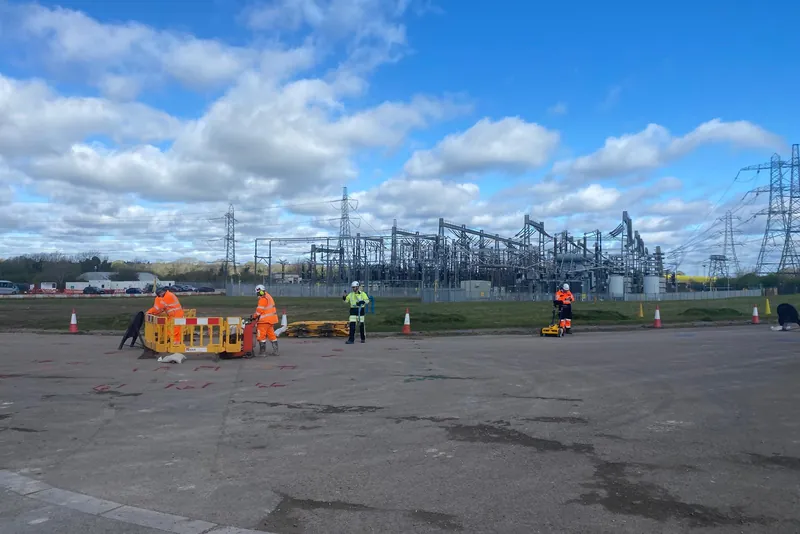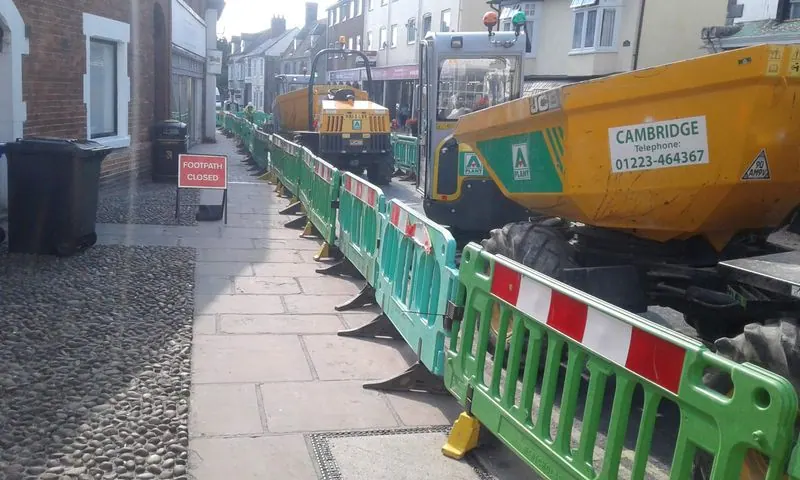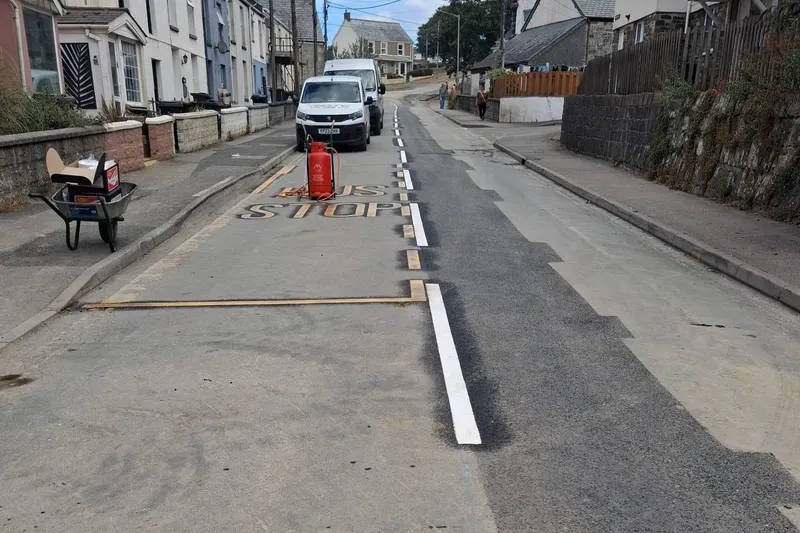
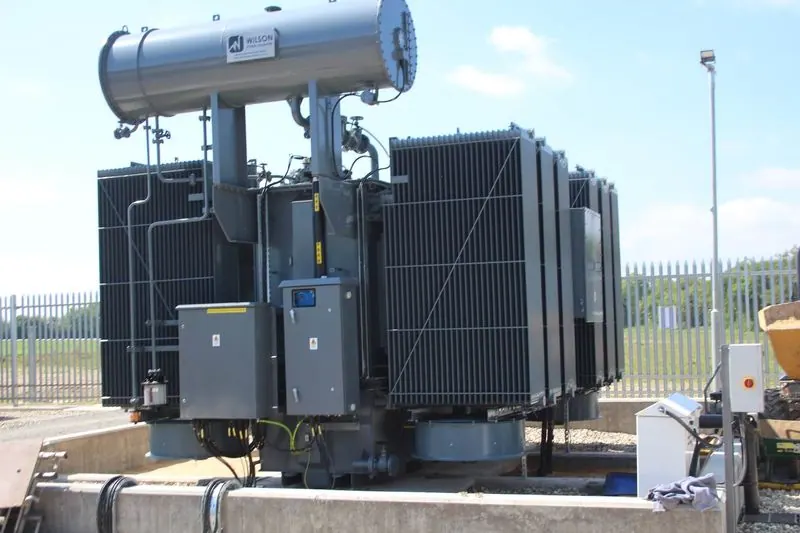
A substation is a site that transforms or switches electricity at high voltage. In Great Britain power reaches customers through a chain of substations, each stepping the voltage down a stage, from the transmission network to the 400V supply in a street.
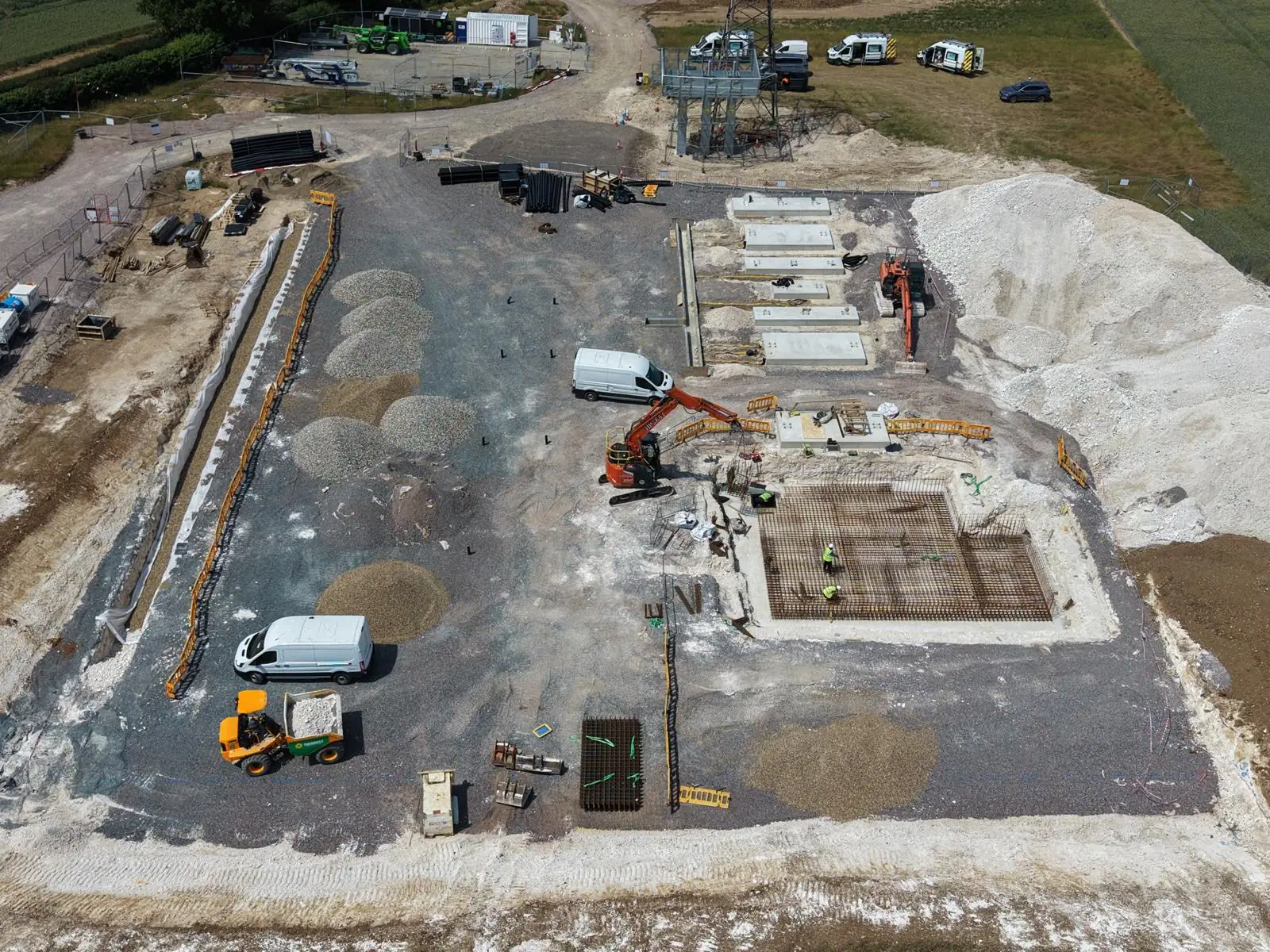
The type of substation decides the civils. A small secondary substation needs a reinforced concrete base, a cable trench and an access route for a crane lorry. A primary substation needs transformer bunds, a switch room, drainage, roads and a security fence.
This guide explains each type, what its civils involve, and who builds what. The figures come from the regulations and from UK Power Networks' published standards, which cover much of East Anglia, London and the South East.
Key points
- In law, a substation is any premises that transforms, converts, switches or controls energy at high voltage, meaning above 1,000V AC (ESQCR 2002, regulation 1).
- Open-air live equipment must be fenced or walled to at least 2.4 metres (ESQCR 2002, regulation 11).
- A primary substation steps 33kV down to 11kV or 6.6kV. A secondary substation steps 11kV or 6.6kV down to 400V.
- UK Power Networks' EDS 07-3102 asks for secondary substation bases that carry 5,500kg in any position, with at least 7 days' curing before equipment is landed.
- The access route must take a crane lorry of up to 32 tonnes and 12.5m long, on a gradient no steeper than 1:10 (EDS 07-3102).
- UK Power Networks will not energise a substation until all its civil works are complete.
In this guide
- What is a substation?
- What are the main types of substation in the UK?
- What is the difference between a primary and a secondary substation?
- What civils does a secondary substation need?
- What civils does a primary or grid substation need?
- What is a transformer bund?
- What does the law require of a substation site?
- Do substations need planning permission?
- Who designs, builds and connects a new substation?
- Where Ground Utilities fits
- Frequently asked questions
- Sources
What is a substation?
In law, a substation is any premises that contain equipment for transforming or converting energy to or from high voltage. It also covers premises that switch, control or regulate energy at high voltage. That is the definition in regulation 1(5) of the Electricity Safety, Quality and Continuity Regulations 2002 (ESQCR).
Two points follow from that definition:
- High voltage means anything above low voltage. For alternating current, low voltage tops out at 1,000V between phase conductors. So in practice a substation is any site handling the 6.6kV, 11kV, 33kV, 132kV and higher voltages used across Great Britain's networks.
- The ESQCR definition excludes equipment mounted on a support to an overhead line. A pole-mounted transformer is not a substation in law, even though it does a similar job.
What are the main types of substation in the UK?
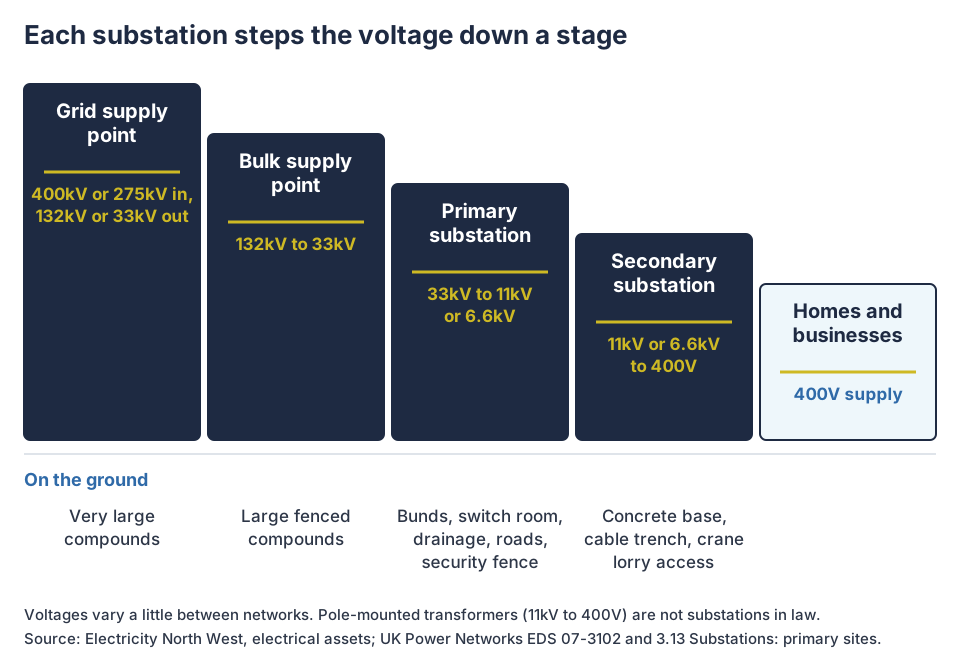
The main types on the distribution network are grid supply points, bulk supply points, primary substations and secondary substations, with pole-mounted transformers on rural lines. Large transmission substations sit above them. Electricity North West, one of the six distribution network operators (DNOs), describes the chain like this:
| Type | What it does | Typical voltages | What it looks like |
|---|---|---|---|
| Grid supply point (GSP) | Where the DNO takes over from National Grid | 400kV or 275kV in, 132kV or 33kV out | Very large compounds with big transformers |
| Bulk supply point (BSP) | Links the 132kV network to the 33kV network | 132kV to 33kV | Large fenced compounds |
| Primary substation | Feeds the 11kV or 6.6kV network | 33kV to 11kV or 6.6kV | A compound or a building, often with outdoor transformers |
| Secondary (distribution) substation | Feeds homes and businesses | 11kV or 6.6kV to 400V | A small building, a GRP kiosk or a fenced area |
| Pole-mounted transformer | Feeds rural overhead networks | 11kV to 400V | A transformer on a wooden pole |
Voltages vary a little between networks, so check the local DNO's arrangement for any given site.
Solar farms and battery sites often have their own customer substation where the site meets the network. Our guide to battery storage site groundworks covers that civils package.
What is the difference between a primary and a secondary substation?
A primary substation takes power at 33kV and steps it down to 11kV or 6.6kV. A secondary substation takes 11kV or 6.6kV and steps it down to 400V for customers.
| Feature | Primary substation | Secondary substation |
|---|---|---|
| Steps down | 33kV to 11kV or 6.6kV | 11kV or 6.6kV to 400V |
| Serves | The 11kV network across an area | Customers close by, often near or between houses |
| Looks like | A compound or a building, often with outdoor transformers | A small building, a GRP kiosk or a fenced area |
| Typical civils | Transformer bunds, a switch room, drainage, roads and a security fence | A reinforced concrete base, a cable trench and an access route for a crane lorry |
UK Power Networks lists six kinds of secondary substation in its civil design standard, EDS 07-3102:
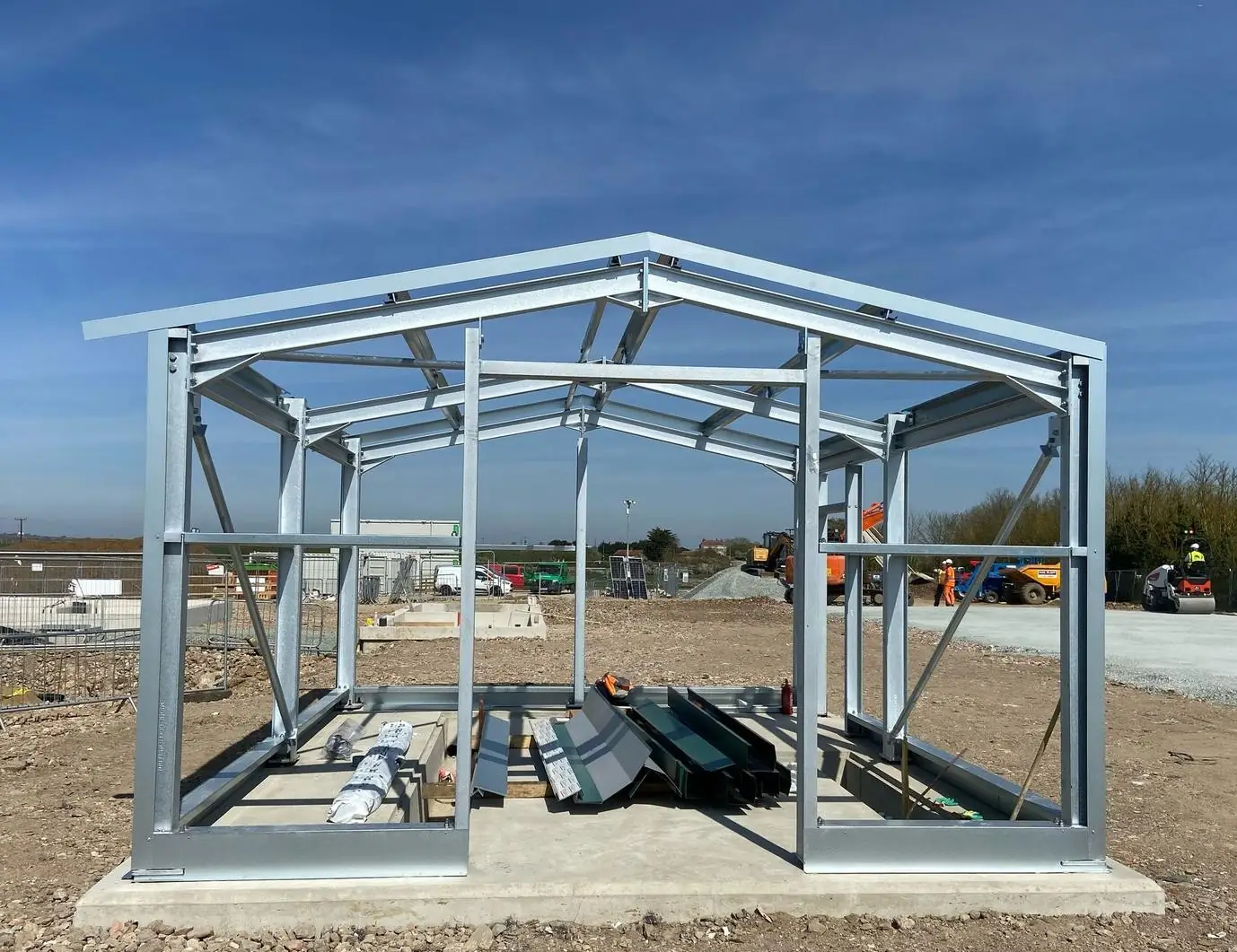
- freestanding brick-built, which is its preferred type;
- GRP (glass reinforced plastic) enclosure;
- integral, inside another building;
- basement;
- outdoor padmount, micro or compact;
- fenced or open walled, with restrictions on use.
A UK Power Networks secondary substation holds at most two transformers. If the load needs three or more, the design uses a combination of single and two-transformer substations.
What civils does a secondary substation need?
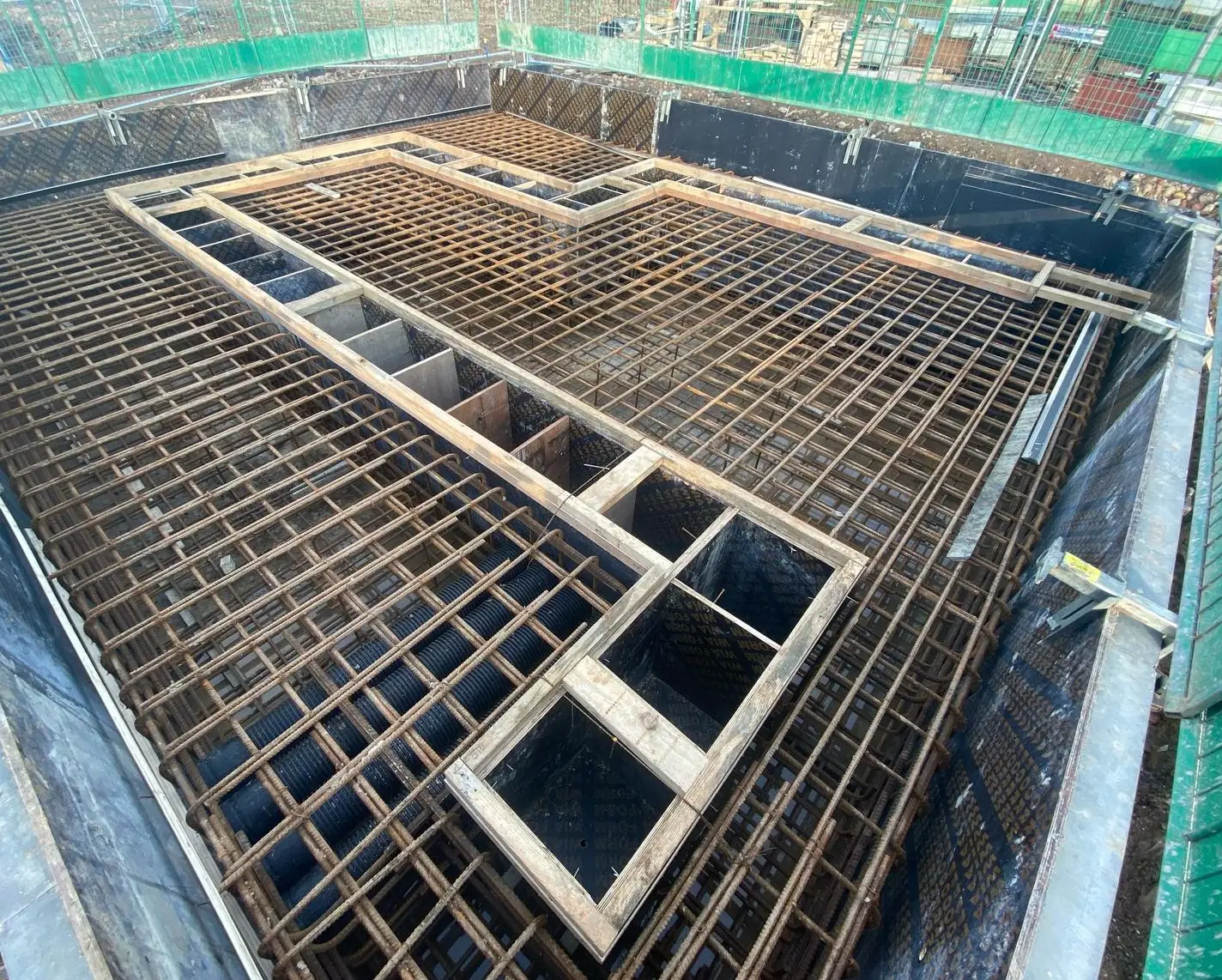
A secondary substation needs a reinforced concrete base, cable trenches and ducts, an access route for a crane lorry, oil and flood measures, and fencing where it is open walled. The footprint is small but tightly specified.
These figures come from UK Power Networks' EDS 07-3102, Version 6.0 (27/11/2025). Other DNOs publish their own versions, so check the right one for your area.
Foundations
- Cast in situ reinforced concrete, designed to suit the ground, or an approved precast base.
- RC32/40 concrete with a maximum 20mm aggregate, unless the designer says otherwise.
- The base must carry equipment of up to 5,500kg in any position.
- At least 7 days' curing before any equipment is landed.
- Waterproof sealer on below-ground concrete, and a hydrophilic water seal at the kicker joint on fully bunded substations.
Cable trenches and ducts
- Cable trenches inside the substation at least 1,000mm deep and 600mm wide.
- Open mesh GRP gratings over the trenches at all times.
- Ducts of 125mm internal diameter, twin-walled HDPE, unless UK Power Networks specifies otherwise.
Our cable ducting guide covers duct colours, classes and cover depths on the route outside.
Access for delivery
Large equipment arrives on a lorry loader with a hydraulic crane. EDS 07-3102 sets the access route around that vehicle:
| Requirement | Figure |
|---|---|
| Fully loaded lorry | Up to 32 tonnes |
| Single item of equipment | Up to 5,000kg |
| Lorry size | Up to 12.5m long, 2.6m wide, 4.7m high |
| Width with outriggers out | 6.2m |
| Steepest access gradient | 1:10 |
| Clear headroom for the crane | 6.5m, plus the height of any fence or obstacle lifted over |
UK Power Networks also says the customer must provide hard standing from the public highway that will support a 32 tonne crane lorry. Plant can only be delivered once that surface is in place.
Oil, fire and flood
- Fire-rated door sets stand on a 150mm cast in situ concrete upstand, which also acts as a bund for oil spills.
- GRP substations at risk of flooding should be elevated, on a foundation no more than 1,500mm above ground.
- GRP substations must not go inside other buildings.
Fencing and design life
- For a fenced secondary substation, the top of the fence is normally 1,800mm above ground.
- Low-risk sites get timber fencing. High-risk sites get steel palisade or security mesh to a separate standard.
- Civil structures are designed for at least 40 years. Where UK Power Networks adopts them, the life to first maintenance must be at least 20 years.
One rule matters more than any other on programme. UK Power Networks says the substation cannot be energised until all the civil works are complete. They must be finished before the agreed high voltage shutdown date.
What civils does a primary or grid substation need?
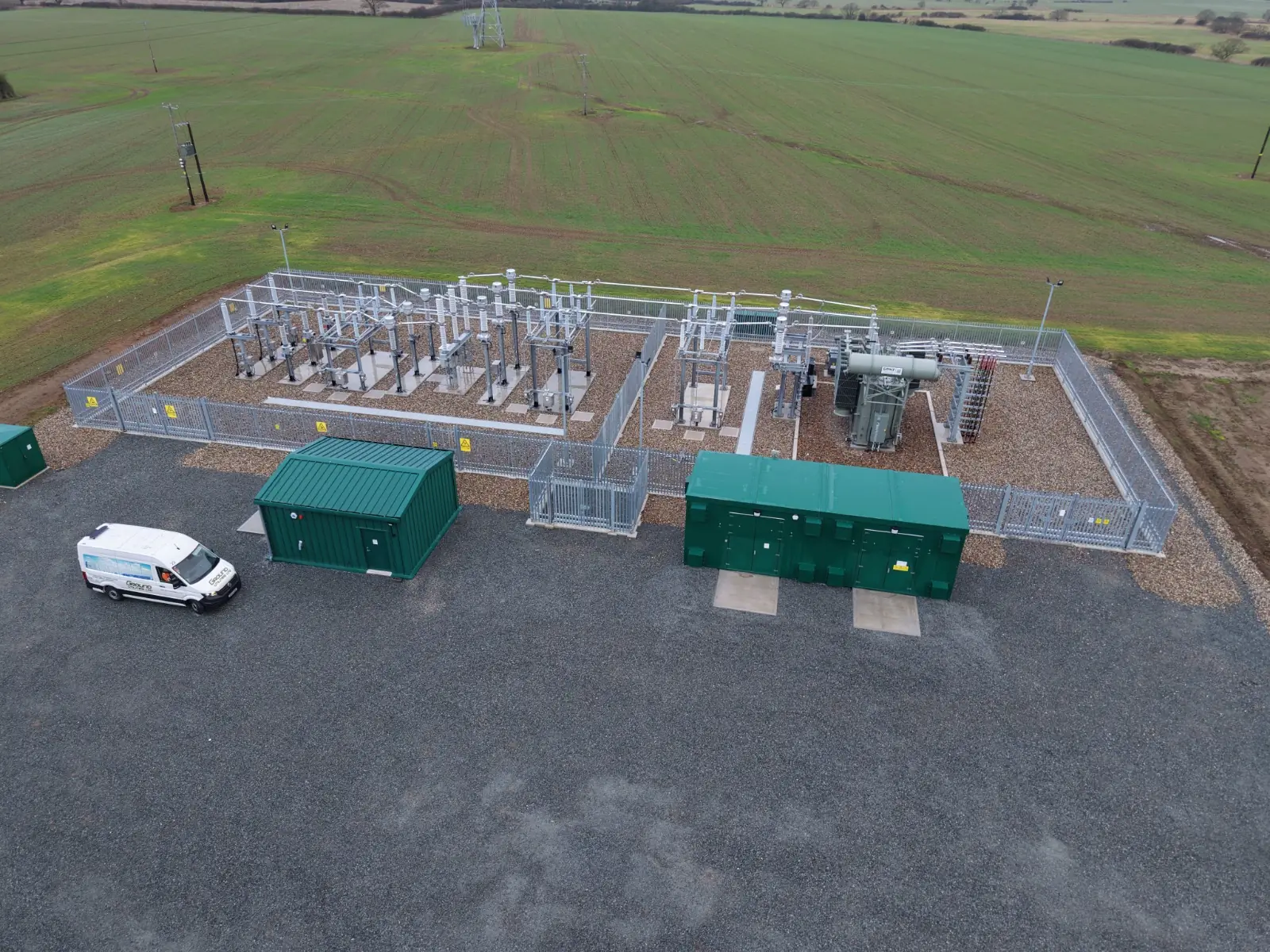
A primary or grid substation needs a full civils package: plant bases, transformer bunds, a switch house, earthing, drainage, roads and fencing. In UK Power Networks' area the customer usually builds the whole civil structure, and the DNO approves the design first.
UK Power Networks lists the customer's substation works for a primary site as:
- civil design of the substation, submitted for UK Power Networks' approval;
- excavation and reinstatement within the substation;
- excavation and installation of the substation earth nest;
- bases for substation plant;
- a building to house the switchgear and associated plant;
- lighting and small power for that building;
- site drainage;
- fencing;
- roads and footpaths for safe access and egress;
- diversion of any existing service crossing the site.
The list for grid sites is the same in outline. In both cases the designs must be approved before construction starts, and UK Power Networks may inspect and test the works before commissioning.
UK Power Networks keeps separate standards for each part of a grid or primary site. Its G81 Technical Library index lists, among others:
| Standard | Covers |
|---|---|
| EDS 07-4000 | Grid and primary substation civil design, with drawings for a primary substation compound |
| EDS 07-4030 | Grid and primary substation fencing: palisade and mesh |
| EDS 07-4050 | Grid and primary switch house buildings |
| EDS 07-4055 | Customer switchrooms for indoor switchgear |
| EDS 07-4070 | Grid and primary transformer bunds and enclosures |
| ECS 06-0022 | Grid and primary substation earthing construction |
These documents change often. Our UKPN G81 guide explains how the library works.
A typical primary substation civils package
| Element | What it involves |
|---|---|
| Site preparation | Clearance, levelling, setting out, diverting existing services |
| Access | Bellmouth, access road and hard standing for heavy deliveries |
| Transformer bases and bunds | Reinforced concrete bases inside an oil-tight bund |
| Switch room | Foundations and a building for the switchgear, or a customer switch room |
| Cable routes | Trenches, troughs, ducts and draw pits in and out of the site |
| Earthing | The earth nest beneath the site, to the DNO's design |
| Drainage | Surface water drainage and manholes |
| Security | Palisade fencing, gates and bases for CCTV |
What is a transformer bund?
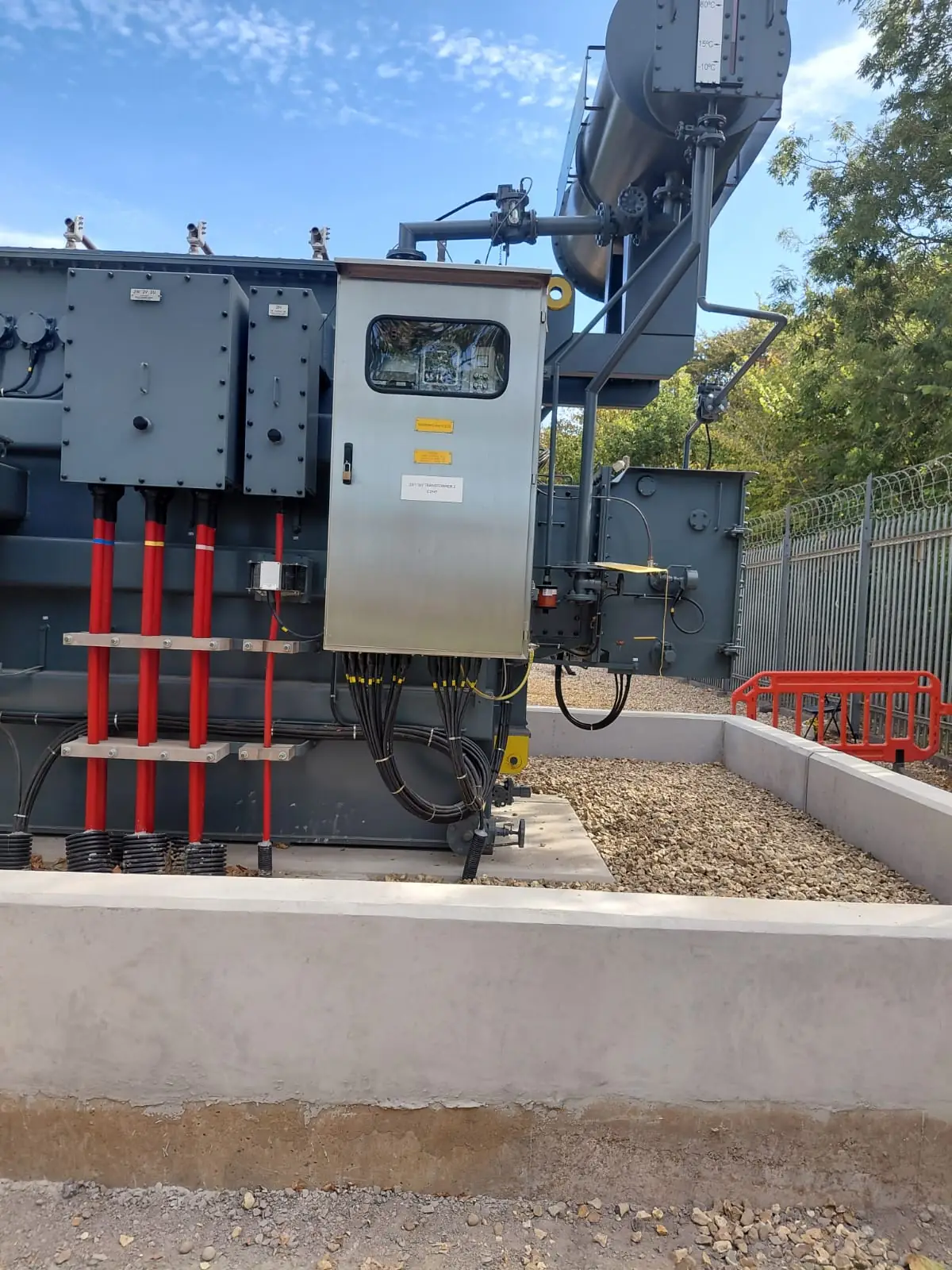
A transformer bund is an oil-tight enclosure, usually reinforced concrete, around an oil-filled transformer. If the transformer leaks or fails, the bund holds the oil so it cannot reach the ground or the drains.
UK Power Networks' index shows how varied bunds are. It lists details for:
- on-tank and off-tank transformer bunds;
- an off-tank bund with an acoustic enclosure;
- a retrospective bund;
- a plastic bund;
- retrospective oil containment, in a separate standard with its own drainage detail.
How big does a bund need to be?
The bund capacity comes from the DNO's standard and the designer, not from the contractor. For UK Power Networks' grid and primary sites, transformer bunds and enclosures are covered by EDS 07-4070. Build to the approved drawing, and do not change a wall height or drainage detail on site without the designer's agreement.
What makes a bund hard to build?
Bunds are open to the weather, so they fill with rainwater. They are also crossed by cables. On site that means three things to get right:
- watertight construction joints, with water bars or hydrophilic seals where the design calls for them;
- sealed cable and duct entries through the bund wall;
- a drainage detail that lets clean water out without letting oil out.
What does the law require of a substation site?
Regulation 11 of the ESQCR places duties on every generator and distributor that owns or operates a substation. They must:
- enclose the substation where necessary to prevent danger or unauthorised access;
- surround any open-air part with uncased live equipment with a fence or wall at least 2.4 metres high;
- display safety signs, and a notice giving the substation's location or name, its owner and a phone number that is always staffed;
- take all reasonable precautions to minimise the risk of fire.
That 2.4 metre rule is why outdoor compounds with open-air equipment have tall fences. A secondary substation inside a building or kiosk has its live equipment enclosed, so its fence can be lower.
Do substations need planning permission?
Smaller substation chambers built by electricity undertakers are often permitted development. Larger chambers, and most private customer substations, are dealt with through planning. Electricity undertakers have permitted development rights under Part 15, Class B of the Town and Country Planning (General Permitted Development) (England) Order 2015.
Those rights cover transforming or switching stations or chambers needed for an electric line. From 21 October 2026 the limits are:
| Chamber size | Permitted development? |
|---|---|
| Up to 29 cubic metres | Generally yes |
| 29 to 45 cubic metres | Only if it is no more than 3 metres high, at least 5 metres from a house, and not on an SSSI or European site |
| Over 45 cubic metres | No |
Two conditions change the answer:
- If the site is in certain designated areas and the chamber is over 29 cubic metres, it needs a prior approval application to the council for siting and appearance. Work cannot start until the council decides or 56 days pass.
- If it is a customer substation on a private development, remember these rights belong to electricity undertakers. It is usually part of that development's own planning consent, so check with the local planning authority early.
Who designs, builds and connects a new substation?
The network operator or an ICP designs and connects the electrical side, a civil designer prepares the civil design, and a civils contractor builds it. In UK Power Networks' area, the customer builds the civil structure for a primary or grid substation. UK Power Networks approves the design and inspects the work.
A typical sequence for a new primary or customer substation is below. Our guide to how a new HV connection gets built covers the wider connection process.
- The customer accepts a connection offer from the DNO, or appoints an independent connection provider (ICP).
- The DNO or the ICP designs the electrical connection.
- A civil designer prepares the substation civil design. The DNO approves it before work starts.
- The land rights are agreed. For UK Power Networks this can mean a freehold or lease of the substation site.
- The civils contractor prepares the site and diverts any existing services.
- The civils contractor builds the bases, bunds, switch room, trenches, ducts, drainage, roads and fencing.
- The DNO inspects the civils against the approved design.
- Plant is delivered over the finished hard standing.
- The DNO or ICP installs, joints, terminates, tests and commissions the electrical equipment.
- The substation is energised once every civil work is complete.
Steps 5 and 6 are the civils contractor's work. Steps 1 to 4 and 7 to 10 belong to the network operator, the ICP and the designers.
Where Ground Utilities fits
Ground Utilities builds substation civils and the cable routes that feed them, from Highdrove Farm in Cottenham, north of Cambridge. We work across East Anglia and the rest of England and Wales: see our substation civils service.
| Project | What we built |
|---|---|
| Thetford cable route and civil build, Norfolk | First a 6 km cable route carrying dual 33kV circuits and fibre from UK Power Networks' Barnham substation. Then, after winning the tender, the civils for a new primary substation: two transformer bunds, a customer switch room, CCTV bases, ground engineering works, ducting and drawpits, drainage and manholes, and palisade fencing |
| Wanlip 11kV substation build, Severn Trent's Wanlip Sewage Treatment Works, for Kier Services | Enabling and civil works for a new 11kV substation and Severn Trent's new 11kV switch room, November 2025 to February 2026 |
| 49.9MW battery storage facility, Cambridgeshire | Equipment foundations, bunds and walls, and the ducting and cable installation for the 132kV and 33kV cables |
We do the work in-house with our own plant, with a dedicated contract manager as the one point of contact. We can take a full turnkey civils contract or supply skilled labour. We hold full NERS approval for civil works, and for cable laying from LV to 132kV, with all six DNOs.
What we do not do: we do not design substations or connections, or make connection applications. We do not joint or terminate cables, or make the final live connection.
The network operator, the ICP or the client's connection provider does that work. We do no gas work.
Frequently asked questions
What is a substation?
A substation is a site with equipment that transforms, converts or switches electricity at high voltage, meaning above 1,000V. That is the legal definition in the Electricity Safety, Quality and Continuity Regulations 2002. Pole-mounted transformers on overhead lines are excluded.
What are the main types of substation?
On the distribution network there are four main types: grid supply points, bulk supply points, primary substations and secondary (distribution) substations. Each steps the voltage down a stage, from 400kV or 275kV to the 400V supply to customers.
What is a primary substation?
A primary substation steps 33kV down to 11kV or 6.6kV to feed the local high voltage network. It can be an outdoor compound or a building, and usually has transformer bunds, a switch room and a security fence.
How high does a substation fence need to be?
Where live equipment is open to the air and not encased, the ESQCR require a fence or wall at least 2.4 metres high. UK Power Networks' fenced secondary substations, where the equipment is enclosed, normally have a 1,800mm fence.
What is a transformer bund for?
It holds the oil if an oil-filled transformer leaks or fails, so the oil cannot reach the ground or drains. It is usually a reinforced concrete enclosure with impermeable walls and floor, sized by the designer to the DNO's standard.
Do substations need planning permission?
Electricity undertakers can build smaller substation chambers under permitted development rights. Chambers over 45 cubic metres are not covered. Private customer substations are usually part of the development's own planning consent.
How long must concrete cure before a transformer goes on it?
For UK Power Networks secondary substations, at least 7 days before equipment is landed. Check the DNO's standard and the structural designer's specification for primary and grid sites.
Who builds the civils for a new substation?
At a primary or grid site in UK Power Networks' area, the customer builds the civil structure. UK Power Networks approves the design. Most customers appoint a civils contractor for that work.
Does Ground Utilities build substation civils in East Anglia?
Yes. We are based in Cottenham, Cambridgeshire. Our substation civils include the new primary substation at Thetford, Norfolk. We build the civils and cable routes, and others do the jointing, terminating and final connection.
Sources
- The Electricity Safety, Quality and Continuity Regulations 2002, regulation 1 (interpretation) (legislation.gov.uk, 2002)
- The Electricity Safety, Quality and Continuity Regulations 2002, regulation 11 (Substation safety) (legislation.gov.uk, 2002)
- Electricity North West electrical assets (Electricity North West)
- EDS 07-3102 Secondary Substation Civil Design, Version 6.0 (UK Power Networks, 2025)
- 3.11 Substations: associated with LV connections (UK Power Networks Document Library)
- 3.13 Substations: primary sites (UK Power Networks Document Library)
- 3.14 Substations: grid sites (UK Power Networks Document Library)
- Customer responsibilities index, including 3.20 Land rights required from You (freehold/leasehold of the substation site) (UK Power Networks Document Library)
- G81 Index spreadsheet (UK Power Networks, checked November 2026)
- ENA EREC G81, Parts 1 to 7, document catalogue (Energy Networks Association)
- The Town and Country Planning (General Permitted Development) (England) Order 2015, Schedule 2, Part 15 (legislation.gov.uk, as amended 2026)
- LRQA NERS register search: Ground Utilities (LRQA, checked November 2026)