Cable ducting is the plastic pipe laid in a trench so that power cables can be pulled through it, now or later, without digging the route up again. On LV, 11kV and 33kV routes the duct sets the trench width, the depth, the bends and how hard the cable must be pulled. The figures below come from the network operators' own specifications.
Key points
- Streetworks UK (NJUG) guidance allows black or red electricity ducts. Electricity North West specifies red, SSEN black.
- Plastic power ducts are made to ENA TS 12-24, now at Issue 4 (2021).
- Electricity North West asks for 0.75 m of cover over a 33kV duct in footways and carriageways.
- Two 33kV circuits need 450 mm between them in Electricity North West's specification, or they lose rating.
- Ducts are cleared with a mandrel, fitted with a non-corrosive draw rope and sealed before cable is pulled.
- Pulling tension must stay inside the cable maker's limit.
- As-constructed records go to the network operator before the circuit is made live.
In this guide
- Why are cable routes ducted instead of direct buried?
- What colour are electricity cable ducts?
- What standards and sizes apply to power cable ducts?
- How deep should cable ducts be laid?
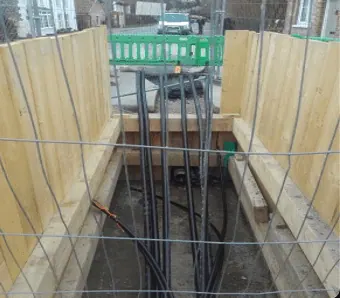
- How are ducts laid out in the trench?
- How are ducts proved and sealed before cable is pulled?
- How is cable pulled through a duct?
- How are ducts taken under roads, rivers and railways?
- What records are needed for a ducted cable route?
- Where Ground Utilities fits
- Frequently asked questions
- Planning a ducted cable route?
Why are cable routes ducted instead of direct buried?
A direct buried cable is laid on bedding in an open trench and covered over. A ducted cable sits inside a plastic pipe, so the civils team can lay the ducts first and the cable can be pulled in when it arrives, joint bay to joint bay.
Streetworks UK guidance says that "where practicable" pipes and cables crossing the carriageway should be laid in ducts, for ease of future maintenance and to avoid congestion.
A duct affects how much current the cable can carry, so the designer allows for it. Electricity North West's ES400E4 (Issue 12, June 2024) requires appropriate allowances for any cable installed in a duct.
What colour are electricity cable ducts?
Colour identifies what a duct carries. Table 1 of the Streetworks UK "Guidelines on the Positioning and Colour Coding of Underground Utilities' Apparatus" (Volume 1, Issue 9, 2018) gives these recommended colours. Streetworks UK's publications page lists Issue 10 as an overall update that has been in consultation since October 2023.
| Utility | Duct colour | Marker system |
|---|---|---|
| Electricity HV | Black or red | Yellow with black and red legend, or concrete tiles |
| Electricity LV | Black or red | Yellow with black legend |
| Telecoms | Grey, white, green, black or purple | Various |
| Water | Blue or grey | Blue with black legend |
Because the guidance allows black or red, each network operator picks one. Electricity North West's duct specification, ES400D4 (Issue 9, February 2026), says its cable ducts and accessories shall be red. SSEN's mains trenching and cable laying guide for new connections permits black electric ducts only. Check the operator's specification before you order.
Streetworks UK warns that older apparatus may not follow the scheme and an old duct may hold something its colour does not suggest. Our guide to underground utility colour codes covers the other services, and avoiding utility strikes covers safe digging near them.
What standards and sizes apply to power cable ducts?
Plastic ducts for buried power cables in Great Britain are made to ENA TS 12-24, "Plastic ducts for buried electric cables". The standards retailer listing shows Issue 3 (2014) superseded on 6 December 2021 by ENA TS 12-24 Issue 4:2021.
What are Class 1, Class 2 and Class 3 ducts?
ENA TS 12-24 groups ducts into classes. Electricity North West's ES400D4 uses them like this:
| Duct | ES400D4 requirement | Notes |
|---|---|---|
| Class 1 | Rigid uPVC or HDPE, 5% deflection limit at 450 N at 75°C | Approved sizes 110 to 200 mm OD |
| Class 1 high strength | 5% deflection limit at 1500 N at 23°C, marked along its length | Shallow trenches that cannot reach normal laying depth |
| Class 1+ (SDR11) | Polyethylene, smooth inner surface | Horizontal directional drilling only |
| Class 2 | Rigid uPVC, 38/32 mm OD/ID | Single-phase services and hockey sticks |
| Class 3 | Coilable HDPE, 38/32 mm and 63/52 mm, 50 m coils | Supplied in coils |
ES400D4 also asks for a 60-year minimum life and a smooth, low-friction bore.
Buried conduit for wiring installations was covered by BS EN 61386-24:2010, which BSI lists as withdrawn on 22 July 2026. The Swiss standards body lists EN 50626-1:2023 as its replacement.
Which duct sizes are used?
Electricity North West's approved Class 1 range is 110/103 mm, 160/150 mm and 200/188 mm OD/ID, with preformed bends of 11.25° to 90° at 1200 mm or 3900 mm bending radius. Its SDR11 drilling duct runs from 110/89 mm to 225/183 mm.
The operator matches the duct to the cable. At 33kV, Electricity North West's ES400E5 (Issue 9, November 2024) shows two ducted arrangements: three single-core cables in one duct, or each core in its own duct laid in trefoil. UK Power Networks approves duct size and type for the cable, voltage and environment, and asks for steel tube to BS EN 10255, at least 150 mm bore, where cable is encased in concrete or passes through a void.
How deep should cable ducts be laid?
Depth of cover is measured from the surface to the top of the uppermost cable, joint or duct. Each operator sets its own minimum. These are the figures in the documents we checked:
| Voltage | Footway | Carriageway | Agricultural land | Source |
|---|---|---|---|---|
| LV | 0.45 m | 0.60 m | 0.90 m (good agricultural land) | ENWL ES400E4, Table 2 |
| 6.6kV / 11kV | 0.60 m | 0.75 m | 0.90 m (good agricultural land) | ENWL ES400E4, Table 2 |
| 33kV | 0.75 m (footway or verge) | 0.75 m | 0.91 m (good agricultural land) | ENWL ES400E5, Table 5.4.1 |
| LV | 450 mm | 600 mm | 1000 mm | SSEN trenching guide |
| 11kV | 600 mm | 750 mm | 1000 mm | SSEN trenching guide |
| 33kV | 800 mm | 900 mm | 1100 mm | SSEN trenching guide |
Streetworks UK recommends 450 to 1200 mm for HV in footways and verges and 750 to 1200 mm in carriageways. On site:
- Electricity North West allows a tolerance of up to 0.3 m deeper than the minimum, never shallower.
- It lets 33kV cover in footways, verges and carriageways drop to 600 mm if approved high-strength (1500 N) PVC duct is used.
- On railway land it asks for 1.25 m from the top of the rail to the top of a 33kV cable, with no cable within 2 m horizontally of a rail.
- SSEN adds the duct diameter and 75 mm of sand bedding to the minimum depth to get the dig depth. Where the surface changes, for example footway to carriageway, it digs to the greater depth.
- LV cables go above higher voltage cables, never at the same depth (ES400E4).
In roads, apparatus sits below the carriageway construction layers unless the highway authority agrees otherwise. Our guides to NRSWA and street works and road reinstatement cover the highway side.
How are ducts laid out in the trench?
Trefoil or flat formation?
A three-phase circuit of single-core cables is usually laid in trefoil, a tight triangle, or flat, side by side. ES400E4 recommends triplexed cable and says trefoil groups must be bound with cable ties at intervals of no more than one metre. Where trefoil cannot be used, the sheath bonding changes, which our guide to cable jointing and joint bays explains.
How far apart do circuits need to be?
| System | Spacing for full rating | If spacing cannot be met | Source |
|---|---|---|---|
| LV | 0.15 m (plus or minus 10%) | 10% de-rating for 2 circuits side by side, 15% for 4 circuits placed 2 on 2 | ENWL ES400E4 |
| 6.6kV / 11kV | 0.23 m (plus or minus 10%) | Same factors | ENWL ES400E4 |
| 33kV, ducted or direct | 450 mm between outer sheaths or ducts | 10% for 2 circuits, agreed with the engineer in advance | ENWL ES400E5 |
What is double-stacking?
Double-stacking puts one tier of ducts above another. It keeps the trench narrow, at the cost of a deeper dig and some rating. Electricity North West's LV multi-duct drawing shows two rows of three ducts with 150 mm between ducts, 50 mm from the trench sides and base, and 100 mm of surround above the top row. Its 15% de-rating factor for four circuits placed 2 on 2 shows the cost.
What goes above the ducts?
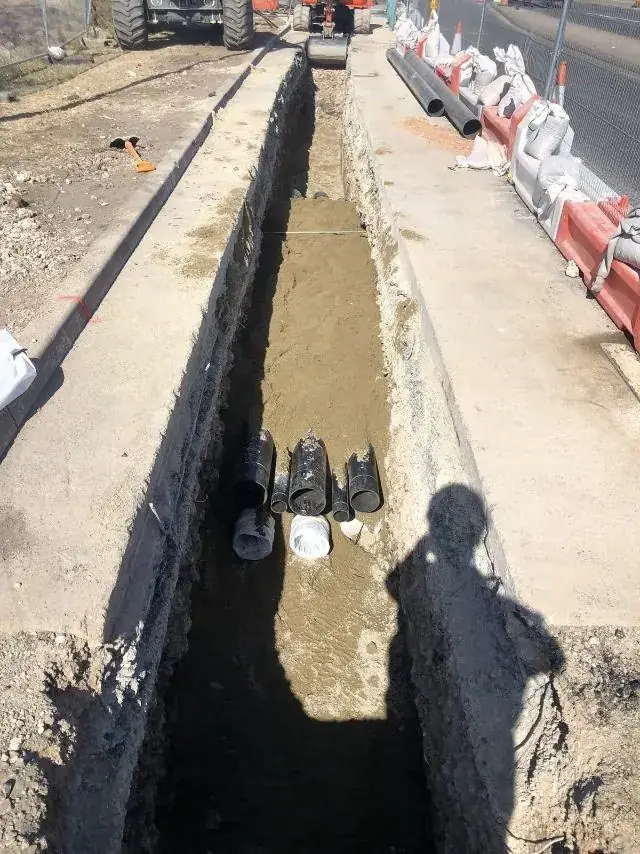
Surround material goes under, around and over the ducts. ES400E5 shows 75 mm at the sides and base for 33kV and 100 mm above. Then comes protection:
- ES400E4: warning tape no more than 100 mm above each LV or 11kV cable.
- ES400E5: at 33kV, tiles over direct buried cable and tape over ducts, at least 100 mm above and overlapping by 50 mm.
- SSEN: tape or tiles 150 mm above the apparatus, carrying SSEN branding.
- Streetworks UK: warning tape directly above all pipes, ducts and cables.
On private land, ES400E4 calls for route marker posts where needed to protect the cable from third-party damage.
How are ducts proved and sealed before cable is pulled?
Proving checks the bore before the cable crew arrives.
- Clear the duct. UK Power Networks asks for all obstructions to be checked and cleared with duct-clearing mandrels before it pulls cable.
- Prove long sections. UK Power Networks may ask for a short test length of cable to be drawn through a long section and then inspected for damage.
- Leave a draw rope. A suitable non-corrosive draw cord or rope goes in each duct for pulling in the cable.
- Seal the ends. UK Power Networks asks for ducts to be sealed as appropriate after laying. Electricity North West lists spigot end caps for its 103 mm, 150 mm and 188 mm ducts.
- Mark and record. UK Power Networks wants the precise location of every duct recorded and permanently marked on site.
Ducts that enter a substation get a permanent seal. Electricity North West's duct seal specification, ES400D5 (Issue 3, October 2021), names external cable entries as one of the main sources of water ingress to substations.
Bends need care at the laying stage. SSEN warns that bends placed too close together can push pulling tension above the cable maker's guidelines, so bend positions belong in the pulling calculation.
How is cable pulled through a duct?
Cable pulling runs from a drum at one access point, through the duct, to a winch at the next. SSEN's guide lists the equipment for every pull:
- a winch with a calibrated display of pulling tension
- a free-moving swivel between the winch rope and the cable
- rollers every 4 m, and wherever the cable would touch the ground
- a cable stocking (a woven grip) for a good hold on the cable
- for ducted routes, a bell mouth roller at the duct entry, lubricant and a drum trailer for each drum
SSEN also asks for the drum and winch to be anchored at each end.
How much tension can a cable take?
The cable maker's figure governs. ES400E4 says mechanical pulling tension must not exceed the value recommended by the manufacturer and must be shown automatically throughout the pull. Its own table gives, for example, 2000 kg for 400 mm² single-core 11kV cable. A rule of thumb attributed to Nexans is 30 N/mm² of conductor for aluminium and 50 N/mm² for copper. Bends add tension, and they press the cable against the inside of the curve as it moves (side-wall pressure), so check both with the cable maker for each section.
Bending radius, lubricant and cold weather
- Bending radius: ES400E4 gives 15 times the cable diameter fixed and 20 times while pulling for its 400 mm² single-core 11kV cables.
- Lubricant: Nexans says cable lubricants can be used if they do not harm the sheath or the duct. Electricity North West lists an approved cable lube.
- Cold: if the working or storage area has been below 1°C in the previous 24 hours, ES400E4 applies the maker's low temperature guidance.
- Ends: ES400E4 requires every cut end, including drum ends, to be capped against moisture.
Pull lengths set joint bay positions: see our joint bays guide.
How are ducts taken under roads, rivers and railways?
Where open cut is not possible, the duct goes in by a trenchless method such as horizontal directional drilling (HDD). ES400E4 asks installers to weigh its benefits, after a full risk assessment of nearby services.
- Duct type: Electricity North West uses SDR11 polyethylene duct only for HDD sections, with HDPE transition couplers to join it to standard PVC duct.
- Marking: the Electricity Safety, Quality and Continuity Regulations require cables to be marked. Electricity North West treats the markings on a compliant duct as meeting that requirement for cable installed by trenchless methods.
- Protection: ES400E5 needs no tiles or tape over a drilled HDPE duct.
- Railways: rail and tramway land follows the railway's reasonable requirements and ENA ER G56, plus the 1.25 m depth noted above.
See our horizontal directional drilling guide.
What records are needed for a ducted cable route?
ES400E4 and ES400E5 ask for plans and cross sections showing the exact position of every cable, joint and earth electrode, the route and depth, existing cables and joints, major obstructions and any unidentified apparatus found. Cable details include year and month of manufacture and batch number.
Electricity North West wants the drawings completed while everything is still visible, before blinding and backfill. It expects them within 48 hours of the works (72 hours in Lakeland) and always before the circuit is made live. UK Power Networks asks for the precise location of all ducts to be recorded and permanently marked on site.
Where Ground Utilities fits
Ground Utilities Ltd is a civils and cable laying contractor based at Highdrove Farm, Cottenham, Cambridgeshire, founded in 2015 and working across England and Wales. We build the route and install the cable: trenching, duct installation, joint bays and their reinstatement after jointing, cable installation and reinstatement of the highway, footpath, verge or field. Where the trench must stay narrow, we lay double-stacked ducts.
We hold full NERS approval for cable laying at LV, 11kV, 20kV, 33kV, 66kV and 132kV, and for civil works, with all six distribution network operators, including UK Power Networks (LRQA NERS register). Our approval does not include cable jointing or design, and we do not make final live connections to the network. We work for ICPs, EPCs, utility contractors and principal contractors (see NERS and ICPs explained).
Ducted routes we have built include:
- HV cable installations, Cambridgeshire: two 33kV circuits and fibre over about 25 km, fully ducted, with 45 joint bays, each reinstated after jointing.
- 5 x 33kV with fibre optic, North London: about 53,000 m of cable in a fully ducted, double-stacked duct route along main roads, worked 24 hours a day.
- Thetford cable route: 6 km of dual 33kV and fibre from UK Power Networks' Barnham substation.
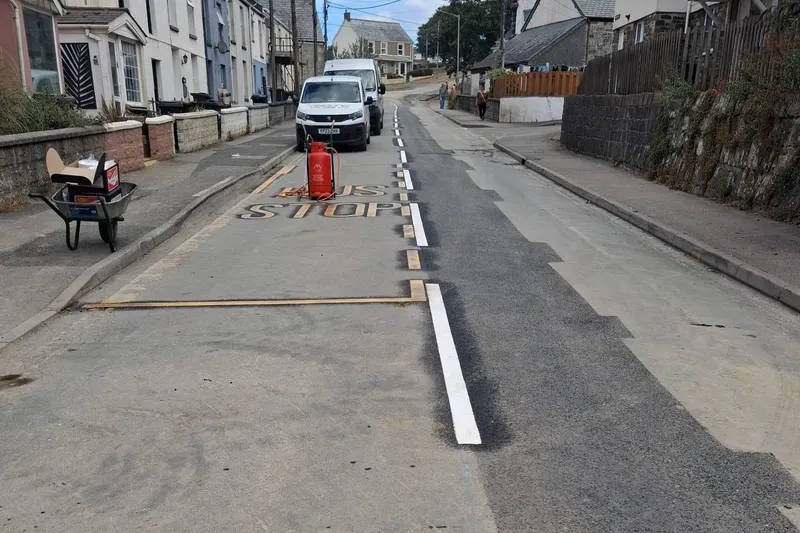
- Indian Queens private wire: a 7.8 km 33kV route in Cornwall, with about 4 km of trench in the highway, where we managed the Section 50 licence, traffic management and council liaison.
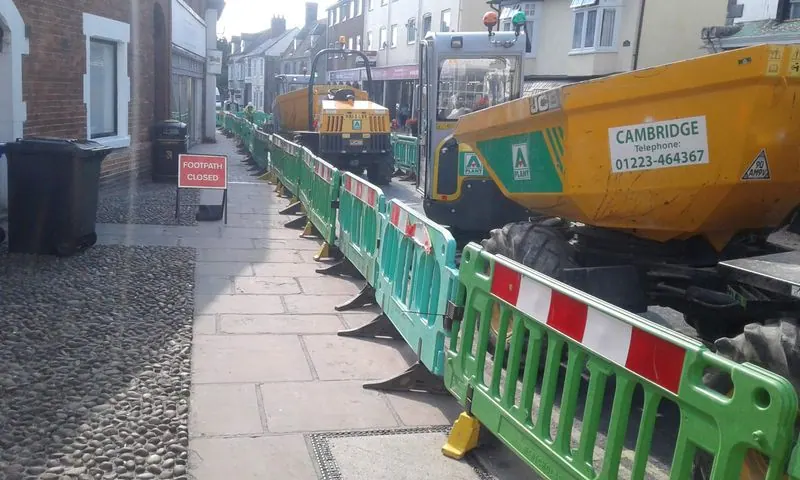
Our supervisors and operatives hold NRSWA street works cards. See our HV and LV cable installation, Section 50 licence and civil construction services, and our accreditations.
Frequently asked questions
What colour is electricity cable duct?
Streetworks UK guidance lists electricity ducts as black or red. Each network operator chooses: Electricity North West specifies red ducts and SSEN permits black ducts only, so check the operator's specification before ordering.
What standard do power cable ducts follow?
Network operators buy plastic ducts for buried power cables to ENA TS 12-24, which is at Issue 4 (2021). It divides ducts into classes, such as Class 1 for mains and Class 2 for services.
How deep should 11kV cable ducts be?
It depends on the operator and the surface. Electricity North West asks for 0.60 m in footways, 0.75 m in carriageways and 0.90 m in good agricultural land. SSEN asks for 600 mm, 750 mm and 1000 mm. Depth is measured to the top of the duct.
What size duct is used for 33kV cable?
The network operator decides from the cable size. Electricity North West's standard Class 1 ducts are 110/103 mm, 160/150 mm and 200/188 mm OD/ID.
How are ducts proved before cable pulling?
A mandrel is pulled through each duct to clear obstructions and check the bore, a non-corrosive draw rope is left in, and the ends are sealed.
What equipment is needed for cable pulling?
SSEN lists a winch with a calibrated tension display, a free-moving swivel, rollers every 4 m, a cable stocking, and for ducted routes a bell mouth roller, lubricant and a drum trailer.
Planning a ducted cable route?
If you are planning an 11kV or 33kV route for a solar farm, battery site or development, bring the civils contractor in while the duct route, crossings and joint bay positions are still being drawn. Call +44 1223 423918, email info@ground-utilities.co.uk, or use our contact page.
Sources
- Electricity North West, "ES400E4 Installation and Repair of LV and 6.6/11kV Underground Cables and the Restoration of Excavated Areas", Issue 12, June 2024: enwl.co.uk
- Electricity North West, "ES400E5 Installation and Repair of Underground Cables Operating at 33kV and 132kV", Issue 9, November 2024: enwl.co.uk
- Electricity North West, "ES400D4 Plastic Ducts, Conduit and Accessories", Issue 9, February 2026: enwl.co.uk
- Electricity North West, "ES400D5 Duct Seal", Issue 3, October 2021: enwl.co.uk
- UK Power Networks, Connections library, "3.2 Ducts", V2 April 2024: library.ukpowernetworks.co.uk
- SSEN, "New connections: Mains trenching and cable laying guide": ssen.co.uk
- Streetworks UK (NJUG), "Guidelines on the Positioning and Colour Coding of Underground Utilities' Apparatus", Volume 1, Issue 9, 2018: powerandcables.com
- Streetworks UK, Publications (Volume 1 issue status): streetworks.org.uk
- Standards retailer listing, ENA TS 12-24 Issue 3 2014, superseded by Issue 4:2021: shop.standards.ie
- BSI Knowledge, BS EN 61386-24:2010 (withdrawn 22 July 2026): knowledge.bsigroup.com
- SNV, SN EN 50626-1:2023 (replaces EN 61386-24:2010): connect.snv.ch
- Thorne & Derrick, "11kV Cable Pulling" (pulling force and lubricant guidance attributed to Nexans): powerandcables.com
- LRQA, NERS register entry for Ground Utilities Ltd: lrqa.com