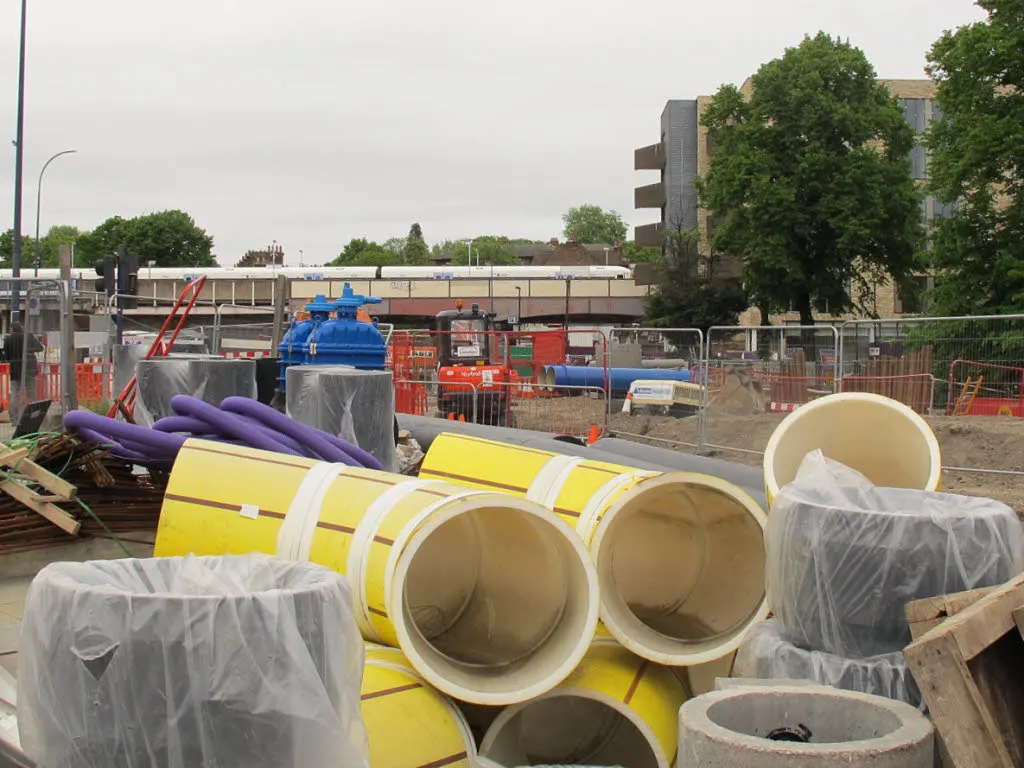
In the UK, buried services follow the Street Works UK (formerly NJUG) colour code. Electricity cables and ducts are black or red. Gas pipes are yellow, with orange used at higher pressures. Clean water is blue. Telecoms ducts are grey, white, green, black or purple. Old and private services often break the code, so colour never proves what a pipe carries.
Key points
- The scheme is Volume 1 of the Street Works UK guidelines, formerly published as NJUG (National Joint Utilities Group) guidance. The latest edition is Issue 10 (2023).
- Yellow means gas. Treat any yellow pipe or yellow perforated duct as a live gas service.
- Blue means drinking water. Blue with brown stripes is barrier pipe for contaminated ground.
- Black or red means electricity, and HSE says any black plastic service should be treated as a live cable.
- The scheme is a recommendation for new work with no force of law.
- Colour, tape and tiles help you spot a service. Plans, a locator survey and hand digging tell you where it is and what it is.
In this guide
- Who sets the colour code for underground services in the UK?
- UK underground utility colour chart
- What colour is a gas pipe underground?
- What is a yellow pipe underground? (What do yellow service pipes carry?)
- What colour pipe is water in the UK?
- What colour are electric cables underground in the UK?
- What colour is fibre broadband duct?
- What colour are sewer and drainage pipes?
- What colours are used for street lighting, traffic signals and highway ducts?
- What is the difference between a pipe and a duct?
- What do warning tapes and marker tiles tell you?
- What do spray-paint marks on the ground mean in the UK?
- Why can you not rely on colour alone?
- What should you do when you find an unidentified pipe or cable?
- Where Ground Utilities fits
- Frequently asked questions
- Talk to us about your next utilities package
Who sets the colour code for underground services in the UK?
The code is Street Works UK's Guidelines on the Positioning and Colour Coding of Underground Utilities' Apparatus (Volume 1). The Health and Safety Executive (HSE) points to it in HSG47, its guidance on avoiding danger from underground services.
It is guidance: Issue 9 says there are no statutory obligations on the position or depth of apparatus in the highway. Colour follows the service, whoever owns it, so a gas pipe laid by an electricity company is still yellow. HSG47 warns against confusing it with BS 1710, the standard for pipes above ground in buildings.
Issue 10 dropped the marker tape column, so tape colours and the non-potable and firefighting water rows below come from Issue 9.
UK underground utility colour chart
Depths are the Issue 10 recommended minimum cover to the top (crown) of the apparatus in a footway unless stated. "Issue 9" and "Issue 10" refer to Street Works UK Volume 1.
| Service | Pipe, cable or duct colour | Marker tape (Issue 9) | Notes | Source |
|---|---|---|---|---|
| Electricity, low voltage (LV, up to 1,000 volts) | Black or red cable in black or red duct. LV house services and street furniture supplies: black cable | Yellow with black legend | Cover 450mm in footway and verge, 520mm in carriageway | Issue 10 Table 1; Issue 9 Table 1 |
| Electricity, high voltage (HV, over 1,000 volts) | Black or red cable in black or red duct (to Energy Networks Association specification ENA TS 12-24) | Yellow with black and red legend, or concrete tiles | Cover 450mm at 11kV, 750mm at 33kV, 900mm at 66kV and above | Issue 10 Table 1; Issue 9 Table 1 |
| Gas, low and medium pressure | Yellow polyethylene (PE). Issue 9 also lists yellow with brown stripes, a peelable skin over a white or black core | Yellow with black legend | Ducts: yellow twin-walled perforated polyvinyl chloride (PVC), concrete or steel. Older mains may be iron, steel or asbestos | Issue 10 Table 1; Issue 9 Table 1 |
| Gas, intermediate pressure | PE100: orange, or yellow with brown stripes. PE80: yellow, or black with yellow stripes | Yellow with black legend | Issue 9 gives orange for PE between 2 and 7 bar | Issue 10 Table 1; Issue 9 Table 1 |
| Gas, high pressure | Steel with yellow coating, black wrapping, epoxy, coal tar or bitumen. Reinforced thermoplastic: orange with silver stripes | Yellow with black legend | Cover 1,100mm to 1,500mm | Issue 10 Table 1; Issue 9 Scope |
| Clean (drinking) water | Blue PE. Older mains may be iron, steel, PVC, concrete or lead | Blue with black legend | Issue 9 lists water ducts as blue or grey. Cover 750mm | Issue 10 Table 1; Issue 9 Table 1 |
| Water through contaminated ground | Blue with brown stripes (barrier pipe) | Blue with brown stripes | Stops soil contaminants passing into the supply | Issue 9 Table 1; Affinity Water |
| Non-potable and grey water | Black with green stripes | None listed | Issue 9 only | Issue 9 Table 1 |
| Firefighting water | Black with red stripes or bands | None listed | Issue 9 only | Issue 9 Table 1 |
| Sewers and rising mains | No standard colour | None listed | Ducts may be orange, grey, black or blue. Cover 900mm | Issue 10 Table 1; Issue 9 Table 1 |
| Telecoms (copper, fibre and cable TV) | Ducts grey, white, green, black or purple. Issue 9: cable black or light grey | Various | Cover 250mm in footway, 450mm in carriageway | Issue 10 Table 1; Issue 9 Table 1 and Figure 1 |
| Oil and fuel pipelines | Steel; Issue 9 lists the pipe as black | Tape or tiles above red concrete, plus surface markers | Cover 900mm. Work within 3 metres needs the owner's prior approval (Issue 9) | Issue 10 Table 1; Issue 9 Table 1 |
| District heating | No set colour; commonly grey or black | None listed | Insulated steel or PE flow and return pipes | Issue 10 Table 1 |
| Street lighting, England and Wales | Black cable in black or orange duct | Yellow with black legend | Consult the electricity network owner first. Scotland: purple. Northern Ireland: orange duct | Issue 10 Table 2; Issue 9 Table 2 |
| Traffic signals | Orange cable, orange duct | Yellow with black legend | All regions | Issue 10 Table 2; Issue 9 Table 2 |
| Motorway and trunk road communications | Purple duct | Yellow with black legend | Motorway lighting: orange duct in England and Wales, purple in Scotland | Issue 10 Table 2; Issue 9 Table 2 |
What colour is a gas pipe underground?
Gas pipes are yellow. Low and medium pressure PE is yellow, intermediate pressure pipe may be orange or striped, and high pressure steel is usually identified by its coating or wrapping.
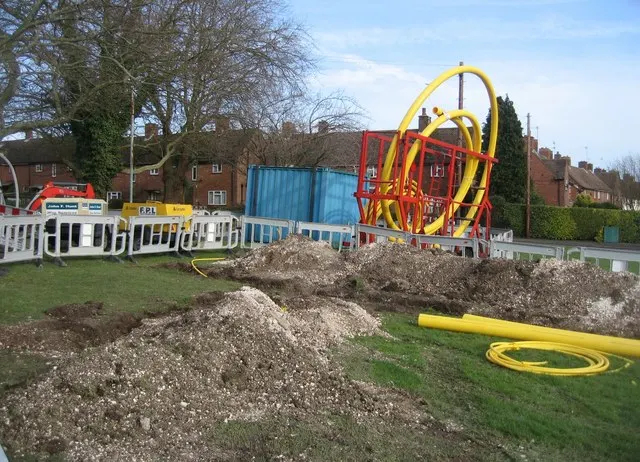
Older mains are the trap. Steel, iron, asbestos, copper and lead gas pipes are still in the ground, and Issue 9 says asbestos and cast iron have no distinguishing colour. HSE adds that iron and steel water pipes look very like gas pipes, so treat any such pipe as gas.
HSG47 gives typical cover of about 750mm for mains in a road and 450mm for services, falling to about 375mm where a service enters a building. Keep mechanical excavators at least 500mm from a gas pipe. If you damage one or smell gas, clear the area, keep ignition sources at least 5 metres away and call the National Gas Emergency number, 0800 111 999.
What is a yellow pipe underground? (What do yellow service pipes carry?)
A yellow service pipe carries gas. On new housing estates the yellow PE gas service is often pulled through a separate yellow ribbed duct, which is perforated so a leak can vent.
So yellow in a trench is usually a smooth yellow PE gas pipe or a yellow ribbed duct with the gas pipe inside. Treat both as live gas.
HSE also warns that on some building sites electricity cables have been put in yellow service pipes or blue water pipes, so confirm what is inside.
What colour pipe is water in the UK?
Clean water pipes are blue. Blue PE is standard in normal ground, and blue with brown stripes is barrier pipe for contaminated land.
Barrier pipe has a PE core wrapped in aluminium and an outer plastic layer, which stops hydrocarbons such as petrol and diesel passing into the water. Affinity Water identifies it by black or brown stripes and requires it to meet BS 8588. Affinity Water decides where it is needed from the site's past use and any soil report, and can refuse to connect plain PE where it specified barrier pipe.
SES Water asks for 750mm to 1,350mm of cover over a new supply pipe, and says the duct into the building must not carry markings for other utilities. Older water mains in iron, steel, asbestos cement or lead will not be blue at all.
What colour are electric cables underground in the UK?
Underground electricity cables are black or red, laid direct in the ground or in black or red ducts. LV services to houses and street furniture are black.
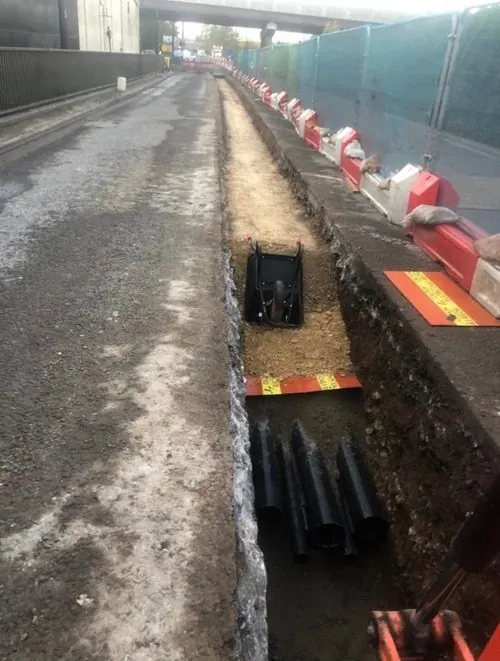
Water pipes and telecoms cables can also be sheathed in black plastic, so HSE says to assume any black plastic service is a live electricity cable. Most cables sit 450mm to 1 metre deep, but any cable can be shallower than the records say. Some circuits of 11kV and above are laid as separate single-phase cables spread up to 600mm across, especially near joints, so one cable found is not the whole circuit.
Tape is yellow with a black legend over LV and yellow with black and red legend, or concrete tiles, over HV (Issue 9).
What colour is fibre broadband duct?
There is no single colour. Street Works UK lists telecoms ducts as grey, white, green, black or purple, and each network operator picks its own.
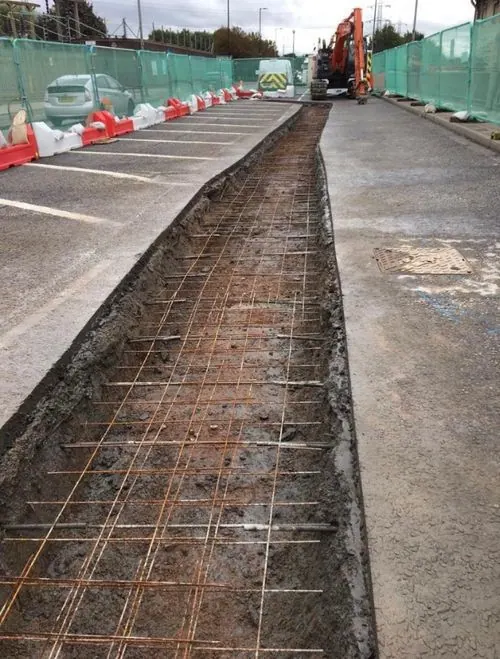
A black telecoms duct looks like an electricity duct, and purple is also used for highway communications. Telecoms is the shallowest footway service, with recommended cover of only 250mm, and armoured fibre can be buried without a duct in rural verges (Issue 10).
Openreach asks for warning tape with a traceable wire 75mm to 125mm above its new site ducts. The quickest check is the owner's name printed along the duct.
What colour are sewer and drainage pipes?
Sewers have no standard colour. Street Works UK lists vitrified clay, concrete, iron, GRP (glass reinforced plastic), PVC, PE, pitch fibre and asbestos cement, and Issue 9 notes ductile iron may be red and PVC may be brown.
Identify sewers from manholes and the sewerage company's records. If a pipe could be asbestos cement, stop and have it assessed before anyone cuts or breaks it.
What colours are used for street lighting, traffic signals and highway ducts?
These belong to highway authorities and are listed separately in Table 2 of the guidance (see the chart above). Consult the electricity network owner before treating any street lighting cable as dead.
Orange catches people out: it can mean street lighting, traffic signals, intermediate pressure gas or a sewer duct.
What is the difference between a pipe and a duct?
A pipe carries gas, water or sewage. A duct is a tube laid to carry cables or pipes, so they can be pulled in later without digging up the road.
The duct colour tells you what it was laid for, and nothing about what was pulled in afterwards. Street Works UK allows other utilities to reuse abandoned apparatus, and Issue 10 notes that electricity cables are sometimes found in ducts that do not match the code. Treat every duct as holding a live service until the owner confirms otherwise.
What do warning tapes and marker tiles tell you?
Tape and tiles warn that something is below. They do not reliably show its exact position or what it is.
Markers get disturbed or were never laid, and anything installed by directional drilling or another trenchless method has no tape above it (Issue 10). Some tapes carry a tracer wire so a locator can find plastic pipes, though HSE notes few older plastic gas and water pipes have one.
When backfilling, put tapes and tiles back above the service they belong to, and never use warning tape to fence off an excavation (HSG47).
What do spray-paint marks on the ground mean in the UK?
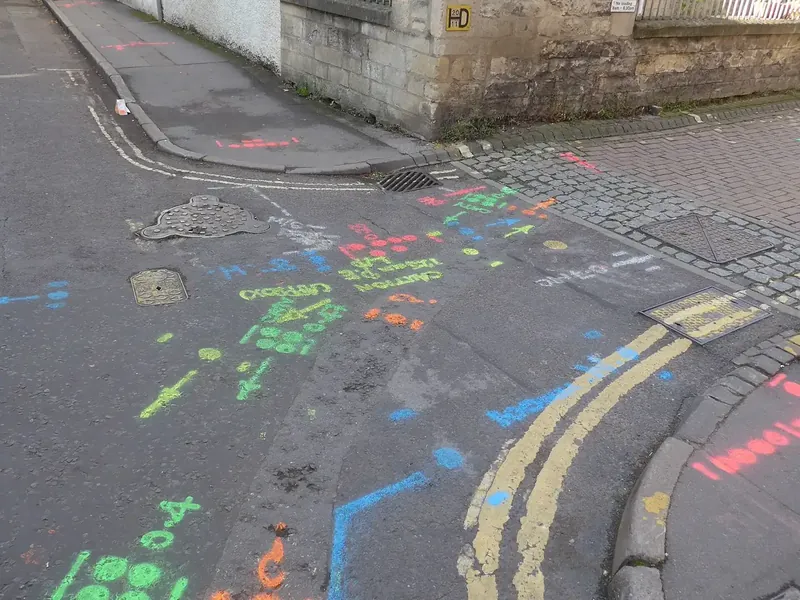
There is no separate statutory paint code. HSE says the marking system must be agreed and understood by everyone on site, and where colours are used they should follow the national underground colour code.
Ask the marker for their key. Be wary of online charts from the United States, where the American Public Works Association code uses orange for communications and green for sewers; those meanings do not carry over to UK pipes and ducts. HSG47 also says not to drive stakes or pins directly over a marked service.
Why can you not rely on colour alone?
Much of what is underground predates the code. Street Works UK and HSE list the problems:
- Colours look different under poor or artificial light, and aggressive soils discolour pipes and cables.
- An old pipe or duct may now contain something else.
- Asbestos cement, pitch fibre and cast iron carry no colour code.
- Near collieries, some electricity cables are yellow or blue.
HSE's rule: if in doubt about an exposed service, treat it as a live electricity cable or gas pipe until proved otherwise.
What should you do when you find an unidentified pipe or cable?
Stop work at that spot, then:
- Keep machines at least 500mm clear, the margin HSE gives for gas pipes.
- Check the plans again, using a free search such as LinesearchbeforeUdig (LSBUD) and asking every asset owner in the area.
- Scan with a cable avoidance tool and signal generator. Most locators cannot find plastic pipes without a tracer wire or an inserted sonde.
- Expose the service by hand and look for the owner's name and contact details printed on it.
- Treat it as live until the owner confirms its status, and record it on the site drawings.
- Report any damage to the owner, however slight.
Where Ground Utilities fits
Ground Utilities Ltd is a utilities, civils and groundworks contractor in Cottenham, Cambridgeshire, working across the UK. Our work includes electrical ducting and cabling from 240V to 132kV, fibre duct and cabling, mains sewers and irrigation systems. See our multi-utility services, civil construction and waste water pages.
In Essex we dug deep excavations so existing HV and LV cables, drainage, gas and water could be lowered and diverted with the asset owners (multiple utility services in Essex). See also our HV cable installations project.
We are accredited under the National Electricity Registration Scheme (NERS), a member of the Utility Strike Avoidance Group (USAG), and our team took part in National Safe Digging Week 2024. See our accreditations.
Related guides: avoiding utility strikes, section 38, 104 and 278 agreements, horizontal directional drilling, cable jointing and joint bays, UKPN G81, battery storage site groundworks and what ICP (independent connection provider) and NERS mean for a new connection.
Frequently asked questions
What colour is a gas pipe underground?
Gas pipes in the UK are yellow. Intermediate pressure pipes can be orange or striped, and older iron or steel gas mains may have no colour at all.
What colour pipe is water in the UK?
Drinking water pipes are blue. Blue with brown stripes is barrier pipe for contaminated ground. Older mains may be iron or lead.
What is a yellow pipe underground?
A yellow pipe underground is a gas pipe. On new housing estates the yellow gas service often runs inside a yellow perforated duct. Treat both as live gas until the owner confirms otherwise.
What do yellow service pipes carry?
Yellow service pipes carry gas from the main in the street to the property. HSE warns that on some building sites electricity cables have been put in yellow pipes, so check before you cut.
What colour are electric cables underground in the UK?
Underground electricity cables are black or red, in black or red ducts. HSE advises treating any black plastic service as a live electricity cable until it is proved otherwise.
What colour is fibre broadband duct?
Fibre and other telecoms ducts can be grey, white, green, black or purple, depending on the network operator. Look for the owner's name printed on the duct.
What colour are sewer pipes?
Sewers have no standard colour. They may be clay, concrete, iron, plastic, pitch fibre or asbestos cement.
What colour is street lighting duct?
In England and Wales street lighting cables are black, in black or orange ducts. Scotland uses purple and Northern Ireland uses orange. Traffic signal ducts are orange.
Can I identify a pipe by its colour alone?
No. Older and private services often break the code. Confirm every service with plans, a locator survey and hand digging.
Talk to us about your next utilities package
If you are planning a development, cable route or new connection, call Ground Utilities on +44 1223 423918 or email info@ground-utilities.co.uk. You can also send us your project details.
Sources
- Street Works UK, Guidelines on the Positioning and Colour Coding of Underground Utilities' Apparatus, Volume 1, Issue 10 (2023). streetworks.org.uk
- Street Works UK (NJUG), Guidelines on the Positioning and Colour Coding of Underground Utilities' Apparatus, Volume 1, Issue 9 (2018). Copy hosted at powerandcables.com
- Street Works UK, publications list (Volume 1 issue status). streetworks.org.uk
- Health and Safety Executive, HSG47 Avoiding danger from underground services, third edition (2014). hse.gov.uk
- Openreach, New Sites Duct Laying Quick Guide, December 2024. openreach.com
- SES Water, Laying a New Supply Pipe fact sheet. seswater.co.uk
- Affinity Water, Why Barrier Pipe?, May 2024. affinitywater.co.uk
- LinesearchbeforeUdig (LSBUD). lsbud.co.uk
- Virginia 811, What do the markings mean? (American Public Works Association Uniform Color Code, United States). va811.com
- Ground Utilities Ltd, company pages: services/multi-utility-services, services/waste-water, accreditations, project/multiple-utility-services-in-essex, news/ground-utilities-takes-part-in-national-safe-digging-week. ground-utilities.co.uk