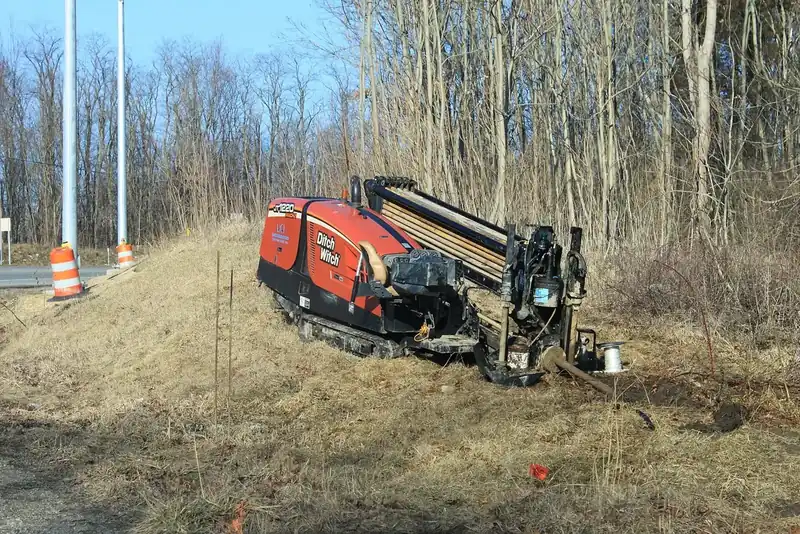
Horizontal directional drilling (HDD) installs a duct or pipe under an obstacle without opening a trench. A rig steers a pilot hole along a planned curve, reams it larger, then pulls the product back through. It suits river, road, rail and hedgerow crossings. It costs more per metre than open-cut, needs room for compounds at both ends, and struggles in gravel and cobbles.
Key points
- HDD is a three-stage process: pilot bore, reaming, pullback.
- The UK Society for Trenchless Technology (UKSTT) gives bore lengths from a few metres to over 1 km.
- The finished bore is normally 30% to 50% larger than the product pipe or cable.
- Bentonite drilling fluid carries out cuttings and holds the bore open.
- Ground with a high share of gravel and cobbles is best avoided.
- Work within 8 metres of a main river (16 metres if tidal) needs an Environment Agency flood risk activity permit unless excluded or exempt.
- The main environmental risk is a frac-out: drilling fluid escaping to the surface.
In this guide
- What is horizontal directional drilling?
- How does HDD work, step by step?
- When is HDD better than an open-cut trench?
- When is HDD the wrong choice?
- What is the maximum distance for horizontal directional drilling?
- How does HDD compare with open-cut, moling and auger boring?
- What permissions does an HDD crossing need?
- What is a frac-out, and how is it controlled?
- What duct goes into an HDD bore?
- What surveys are needed before drilling?
- How does HDD fit into a cable route programme?
- What are the disadvantages of horizontal directional drilling?
- Where Ground Utilities fits
- Frequently asked questions
- Planning a crossing?
What is horizontal directional drilling?
HDD is a steerable trenchless method for laying pipes, cables and ducts under something you cannot or should not dig through. UKSTT lists its uses as gas, water, cable ducts and rising mains, plus crossings under highways, rail tracks, watercourses, runways and landfill sites.
On a cable route the product is usually a high density polyethylene (HDPE) duct that the cable is later pulled through, with the trench either side tying into it.
How does HDD work, step by step?
A rig drills a steered pilot hole between two points, opens it up with reamers, then pulls the duct back through.
- Design the profile. The engineer sets entry and exit points, the depth under the obstacle and the curve between them, using the survey and ground investigation results.
- Set up the launch. UKSTT describes surface-launched rigs set at an angle of 8° to 16° for longer bores, and smaller pit-launched rigs for short, small-diameter bores. Pits at each end capture returning fluid.
- Drill the pilot bore. The rig pushes and rotates drill rods along the planned line while drilling fluid is pumped through them.
- Track and steer. For most bores a sonde in the drill head sends a signal to a handheld walkover receiver, which shows position, depth and heading. Very deep bores use a wireline system instead. UKSTT notes that overhead power lines can interfere with walkover readings.
- Ream. Once the pilot is accepted, back-reamers enlarge the hole. Large bores take several passes with progressively bigger reamers.
- Pull back. The duct is fixed to the final reamer through a swivel and pulled into the bore. The pulling load should be calculated against what the pipe can take and recorded with a load link, according to the PE100+ Association.
- Prove and reinstate. The duct is checked, the pits are backfilled and the cable is pulled in with the rest of the route.
What does the drilling fluid do?
Drilling fluid flushes out cuttings, lubricates the bore, cools the drill head and forms a filter cake on the bore wall that holds it open. UKSTT says it may be plain water on short bores but is usually a bentonite-based mud with polymer additives. The outline HDD method statement for the North Falls offshore wind farm describes bentonite as a non-toxic, inert natural clay, mixed at 30 kg to 80 kg per cubic metre of water depending on the ground.
When is HDD better than an open-cut trench?
HDD wins when digging through the obstacle is impossible, prohibited, or would cost more in disruption than the drill. The usual cases:
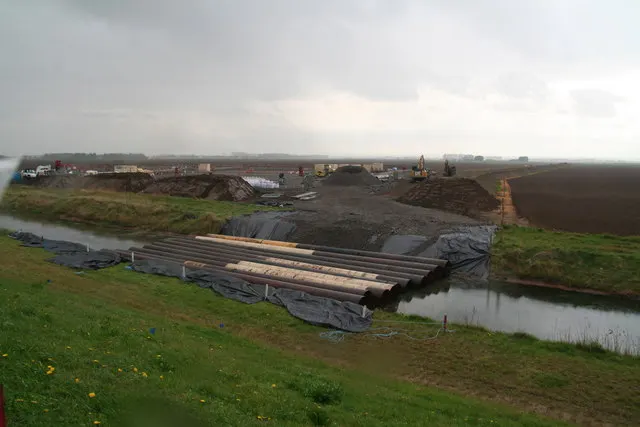
- Rivers, drains and other watercourses, where a trench would mean damming or over-pumping the channel.
- Railways, where open-cut would need possessions of the line.
- Main roads, where open-cut would mean lane closures and heavy traffic management.
- Hedgerows, tree lines and protected habitats such as Sites of Special Scientific Interest (SSSIs), where the surface must stay untouched.
- Landowners who will accept a short-term drilling compound in a corner of a field but not a trench across it.
- Existing buried services that are cheaper to go under than to divert.
When is HDD the wrong choice?
HDD is the wrong choice when the ground, the space or the length works against it.
- Coarse ground: The PE100+ Association advises that soils with a high proportion of gravel and cobbles are best avoided unless the contractor is very experienced in them.
- No room: Larger bores need significant working space and logistics at both launch and reception ends.
- Shallow, short runs: On a short crossing in open ground, a trench is usually quicker and cheaper.
- Tight gradient tolerance: UKSTT says precise gradients are harder to achieve with HDD, which matters for gravity drainage more than for cable ducts.
- Geometry: A rig enters at a shallow angle and the duct cannot bend sharply, so the bore needs a run-in distance before it reaches depth under the obstacle.
What is the maximum distance for horizontal directional drilling?
There is no single maximum. Length depends on the rig, the ground and the pull load the duct can take. Published ranges:
| Source | Length | Diameter |
|---|---|---|
| UKSTT (industry body) | A few metres to over 1 km | About 50 mm to several hundred millimetres |
| PE100+ Association (PE pipe manufacturers) | Typically 30 m and greater; well over 1,000 m possible, often limited by pipe axial load | PE100 pipe up to around 1,200 mm |
| VolkerTrenchless Solutions (contractor capability) | 10 m to over 2,500 m | 40 mm to 3,000 mm, depending on technique |
Most distribution cable crossings sit well inside these ranges. The longest and largest figures belong to major pipeline and landfall drills.
How does HDD compare with open-cut, moling and auger boring?
Open-cut is the default. The trenchless options earn their place where the surface cannot be disturbed.
| Method | How it works | Typical length | Typical diameter | Steerable | Best suited to |
|---|---|---|---|---|---|
| Open-cut trench | Excavate, lay duct, backfill, reinstate | Any | Any | Not applicable | Open land and routes where disturbance is acceptable |
| Impact moling | Air or hydraulic piston drives a mole that displaces soil | Up to about 30 m | 45 mm to 300 mm | Usually not | Short service crossings in compressible soil |
| Auger boring | Rotating auger inside a steel casing, between launch and reception pits | Usually under 100 m, up to about 200 m | About 102 mm to 1,830 mm casing | Limited | Short, straight crossings in softer ground such as clay |
| HDD | Steered pilot bore, reaming, pullback | A few metres to over 1 km | About 50 mm to several hundred millimetres (larger on big rigs) | Yes | Rivers, roads, railways, hedgerows and longer crossings |
Moling and auger boring figures are from UKSTT, which also notes that a mole needs cover of at least ten times its casing diameter to avoid surface heave.
What permissions does an HDD crossing need?
It depends on what you are crossing. Each regulator or asset owner runs its own process.
| Crossing | Who | What applies |
|---|---|---|
| Main river | Environment Agency | A flood risk activity permit for work within 8 m of the bank (16 m on a tidal main river), and for pipe crossings under a main river, unless the activity is excluded or registered as exempt |
| Ordinary watercourse (ditches, streams) | Internal Drainage Board (IDB) or local council | Contact them to check whether land drainage consent is needed; section 23 of the Land Drainage Act 1991 requires consent for culverts and obstructions in ordinary watercourses |
| Railway | Network Rail Asset Protection and Optimisation (ASPRO) | Engagement with the local ASPRO team for work on or near the railway, usually under a Basic Asset Protection Agreement (BAPA), which lets Network Rail recover its assurance costs |
| Public highway | Highway authority | Statutory undertakers give notice or apply for a permit under the New Roads and Street Works Act 1991 (NRSWA) and the local permit scheme; anyone else needs a Section 50 street works licence |
| SSSI | Natural England | Owners and occupiers need written consent for listed operations; public bodies follow separate assent guidance |
| Private land | Landowner | Agreement for the compounds, access and the line of the bore |
Plan the time. Natural England aims to decide consent applications within 28 working days but can take up to four months. The Environment Agency has also asked, on large projects, to see HDD designs and drilling fluid loss procedures before work starts.
What is a frac-out, and how is it controlled?
A frac-out (also called a breakout or inadvertent return) is drilling fluid escaping through the ground to the surface or into a watercourse. Bentonite is non-toxic, but a release can temporarily smother aquatic and bankside plants.
The North Falls method statement says breakouts are most likely in roughly the first 30 m, before the drill reaches its working depth, and where it passes through permeable ground such as peat or ground with voids such as chalk. The mitigation it sets out is typical of UK practice:
- Ground investigation along the alignment, and hydrofracture modelling by a specialist for longer or more complex drills.
- Removing cuttings properly so drilling pressure stays low.
- Constant monitoring of fluid levels in the tanks and of downhole pressure, treating any sudden pressure loss as a possible fracture.
- Regular walkovers along the line to look for surface leaks.
- Silt fencing, straw bales, sandbags, a suction pump and other spill materials kept on site, some put up before drilling starts near sensitive areas.
If a breakout happens, drilling stops, the release is located and contained, and the fluid is removed or, where removal would do more harm, left to disperse. The bore can then be sealed with a loss control additive, or grouted and re-drilled.
What duct goes into an HDD bore?
Cable crossings normally use HDPE duct, joined into a continuous string before pullback. The PE100+ Association notes that HDD usually needs a thicker pipe wall than the operating pressure alone would require, because the pipe must survive the pullback load. It also warns that the string must be kept to a suitable bending radius as it enters the bore to avoid kinking.
Duct size, number and spacing come from the cable design and the network operator's specification.
What surveys are needed before drilling?
You need to know what is in the ground and what the ground is.
- A buried utility survey to PAS 128:2022, the British Standards Institution (BSI) specification for detecting, verifying and locating underground utilities.
- Statutory records and a safe system of work following the Health and Safety Executive (HSE) guidance HSG47, Avoiding danger from underground services.
- Ground investigation along the alignment, which UKSTT treats as the basis for choosing rig and tooling.
- Topographic and bed-level survey of the watercourse, road or railway being crossed, so the profile clears it with margin.
- Environmental constraints: designated sites, protected habitats and the receptors that a frac-out could reach.
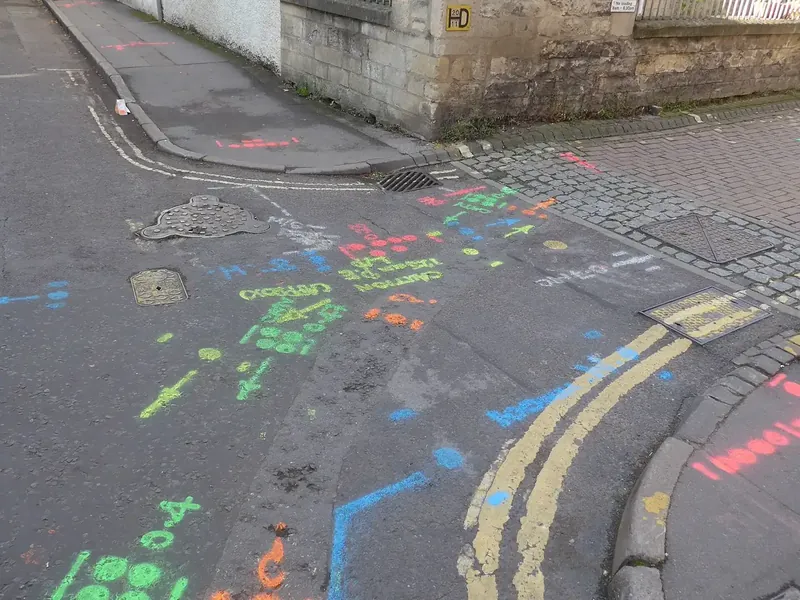
Our guide to avoiding utility strikes covers the survey side in more detail, and underground utility colour codes explains what you will find when the pits are opened.
How does HDD fit into a cable route programme?
Treat each crossing as a small project with a long lead time and a short build.
- Identify crossings at route selection and decide early which are trenchless.
- Commission utility and ground surveys at each crossing.
- Fix the drill profile and compounds, agree access with the landowner, then apply for permits and asset owner agreements.
- Drill and pull back ahead of the main cable pull, so the crossing never holds up the trench gangs.
- Tie the trench into the duct ends, often with a joint bay nearby (see cable jointing and joint bays).
Compound size scales with the drill. The North Falls landfall drill, a large example, allows a 150 m by 75 m temporary compound and an entry pit of about 4.0 m by 5.0 m by 1.2 m deep. Distribution crossings need far less.
On new developments, crossings also interact with adoption agreements; see section 38, 104 and 278 agreements. For connections in UK Power Networks areas, the civils standard is covered in our UKPN G81 guide.
What are the disadvantages of horizontal directional drilling?
HDD trades surface disruption for cost, risk and planning effort. The main drawbacks:
- Higher cost per metre than open-cut on short, easy runs.
- Ground risk: gravel, cobbles, voids and running sand can stall a bore or cause collapse.
- Frac-out risk near watercourses and sensitive habitats.
- Space needed at both ends for the rig, fluid plant and duct string.
- Drilling fluid and cuttings to handle and dispose of.
- Less control of exact gradient than an open trench.
- A failed bore may need grouting and a fresh drill on a new line.
- More permissions and survey work before the rig arrives.
None of these rule HDD out. They mean the decision should be made on surveyed ground and a costed comparison with the trench option.
Where Ground Utilities fits
Ground Utilities is a utilities, high voltage (HV) cable, civils and groundworks contractor based in Cottenham, Cambridgeshire. On the Thetford cable route, a 6 km route carrying dual 33kV circuits and fibre from UK Power Networks' Barnham substation to the Kingsfleet development, the work included bringing a horizontal directional drill crossing beneath a local river into the cable route.
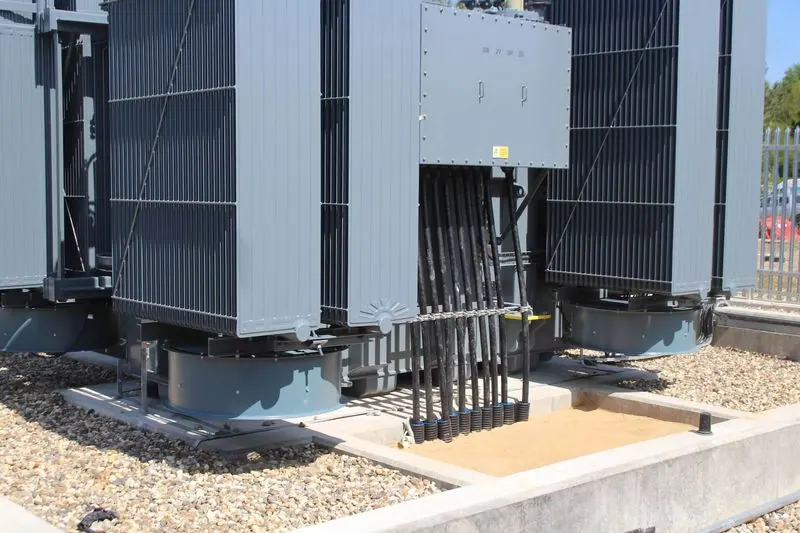
Around the drill, we build the cable route: trenching, ducting, joint bays, drainage and reinstatement. See our multi-utility services, civil construction and BESS and solar farm work, and projects including HV cable installations, Dunmow and Burwell Solar Farm. For battery sites, read our battery storage site groundworks guide. Our accreditations page lists our memberships, and what ICP and NERS mean for a new connection explains how contestable connection work is organised.
Frequently asked questions
What is horizontal directional drilling used for?
HDD installs pipes, cables and ducts under obstacles without digging a trench. Common uses are crossings under rivers, roads, railways, hedgerows and protected habitats, and service connections where the surface must stay intact.
What is the maximum distance for horizontal directional drilling?
There is no fixed maximum. UKSTT gives typical bore lengths from a few metres to over 1 km, and specialist contractors quote capability beyond 2,500 m. The limit on a given job is set by the rig, the ground and the pull load the pipe can take.
What are the disadvantages of horizontal directional drilling?
HDD costs more per metre than a trench on short runs, needs space for compounds at both ends, struggles in gravel and cobbles, carries a risk of drilling fluid escaping to the surface, and gives less precise gradient control than open-cut.
Do I need a permit to drill under a river in England?
For a main river, yes, unless the work is excluded or registered as exempt. The Environment Agency requires a flood risk activity permit for work within 8 metres of the bank, or 16 metres on a tidal main river. For ordinary watercourses, check with the internal drainage board or local council.
What is a frac-out in directional drilling?
A frac-out is drilling fluid, usually bentonite mud, escaping through the ground to the surface or into water. It is most likely where the bore is still shallow and in permeable or fissured ground. Monitoring fluid levels and pressure, and keeping spill kits on site, are the standard controls.
Is bentonite drilling fluid harmful?
Bentonite is a natural clay and is described in UK project documents as non-toxic and inert. A large release into a watercourse can still temporarily smother plants and habitats, so releases are contained and cleaned up.
What is the difference between HDD and moling?
An impact mole is usually unsteerable and works by pushing soil aside. UKSTT gives lengths up to about 30 m. HDD is steered, uses drilling fluid, and can run from a few metres to over 1 km.
Planning a crossing?
If your cable or pipe route has a river, road, railway or hedgerow in the way, talk to us early, before the route is fixed and before permits are applied for. Call +44 1223 423918, email info@ground-utilities.co.uk, or use our contact page.
Sources
- UK Society for Trenchless Technology (UKSTT), "Horizontal Directional Drilling (HDD)": ukstt.org.uk
- UKSTT, "Impact Moling": ukstt.org.uk
- UKSTT, "Auger Boring": ukstt.org.uk
- PE100+ Association, "Horizontal Directional Drilling" (technical guidance): pe100plus.com
- VolkerTrenchless Solutions, "Engineering": volkerwessels.co.uk
- GOV.UK, "Flood risk activities: environmental permits": gov.uk
- Land Drainage Act 1991, section 23: legislation.gov.uk
- Network Rail, "Streamlining asset protection and optimisation": networkrail.co.uk
- Network Rail, "Outside Party Basic Asset Protection Agreement": networkrail.co.uk
- GOV.UK, "Co-ordinating street works" (Code of practice for the co-ordination of street works and works for road purposes and related matters, March 2026): gov.uk
- West Sussex County Council, "Section 50 street works licence" (example highway authority guidance): westsussex.gov.uk
- GOV.UK, "Protected areas: sites of special scientific interest": gov.uk
- North Falls Offshore Wind Farm, "Outline Horizontal Directional Drill Method Statement and Contingency Plan", document 7.15, July 2025 (Planning Inspectorate, EN010119): nsip-documents.planninginspectorate.gov.uk
- Environment Agency, submission to the Planning Inspectorate on project EN020027: nsip-documents.planninginspectorate.gov.uk
- BSI, "PAS 128:2022 Underground utility detection, verification and location. Specification": knowledge.bsigroup.com
- Health and Safety Executive, "HSG47 Avoiding danger from underground services" (third edition, 2014): hse.gov.uk
- Ground Utilities, "Thetford Cable Route & Civil Build": ground-utilities.co.uk