UKPN G81 is UK Power Networks' technical library of design, materials, installation, testing and records standards for contestable connection work. It is the company's version of the Energy Networks Association's G81 framework. Anything an Independent Connection Provider builds for UK Power Networks to adopt must meet these standards. UK Power Networks approves the design and audits the work.
Key points
- EREC G81 is a seven-part ENA framework for competition in new connections.
- Each network operator adds its own requirements. UK Power Networks keeps them in its G81 Technical Library.
- All work by an accredited ICP or IDNO must comply with the current G81 requirements.
- UK Power Networks must approve the ICP's design before work starts on site.
- Cover depths, ducts, bedding and joint bays for UKPN cables are set by ECS 02-0019.
- UK Power Networks inspects ICP work, and a failed inspection holds the connection until defects are fixed.
- Where land rights are needed, energisation waits until as-laid drawings match the legal drawings.
In this guide
- What is G81?
- How does UKPN G81 relate to the ENA G81 framework?
- What is in the UKPN G81 Technical Library?
- What is contestable and non-contestable work in UKPN's area?
- Who is allowed to build to G81 for UKPN?
- How does the adoption process work, step by step?
- How does UKPN inspect and audit ICP work?
- What does G81 mean for the civils?
- Who arranges easements and wayleaves for UKPN adoption?
- What as-laid records does UKPN need?
- Which G81 details vary by DNO?
- Where Ground Utilities fits
- Frequently asked questions
- Talk to Ground Utilities
What is G81?
G81 is the rulebook for building new electricity network that a distribution network operator (DNO) will take over and own, so that firms other than the DNO can build it.
The Energy Networks Association (ENA) describes EREC G81 as "a suite of engineering documents that sets out a national framework to facilitate competition in new connections". It is written for Independent Connection Providers (ICPs) and Independent Distribution Network Operators (IDNOs) under Ofgem's Competition in Connections regime, and is a qualifying standard in the Distribution Code.
The ENA catalogue lists seven parts in three groups:
| Parts | Framework | Scope |
|---|---|---|
| 1 to 3 | Framework for new low voltage housing development installations | LV housing sites and their HV/LV substations |
| 4 to 6 | Framework for new industrial and commercial underground connections | LV and HV, generally up to and including 20 kV |
| 7 | Framework for contestable diversionary and reinforcement works not exceeding 33 kV | Diversions and reinforcement |
Within each of the first two groups, the parts cover design and planning, materials specification, and installation and records. The suite applies only to new installations.
How does UKPN G81 relate to the ENA G81 framework?
The ENA framework sets the common structure, and each DNO fills in the detail. UK Power Networks publishes its detail in its G81 Technical Library.
EREC G81 Part 1 says the framework "is subject to some local variation" between distribution licence holders, for example in substation specification, fault levels and compatibility with existing equipment, and that deviations are stated in each operator's appendices. UK Power Networks' own audit procedure defines G81 as its "technical library providing the Engineering Standards information for third parties".
So for an ICP in London, the South East or the East of England, "building to G81" means building to UK Power Networks' standards for its three licence areas: Eastern Power Networks (EPN), London Power Networks (LPN) and South Eastern Power Networks (SPN).
What is in the UKPN G81 Technical Library?
The library's categories are Index, Alerts and Bulletins, Design and Planning, Materials, Installation, Testing and Commissioning, Operational, Records, Legal, ICP, Reference and Documents for Review.
The documents a civils or cable contractor will use most:
| Reference | Title | Why it matters on site |
|---|---|---|
| ECS 02-0019 | Installation of Underground Cables - LV to 132kV | Depths, ducts, bedding, joint bays, reinstatement |
| EDS 07-3102 | Secondary Substation Civil Design Standard | Bases, ducts, cable trenches, access, records |
| EAS 07-0000 | Approved Equipment List - Civils and Substations | Approved civils materials |
| EOS 09-0100 | Site Recording of Cables, Plant and Equipment | As-built records and deadlines |
| CON 08 111 | Competition in Connections ICP Consents Policy | Wayleaves, easements, leases |
| HSS 02 004 | Audit, Inspection and Monitoring of Networks Connections Providers | How UKPN inspects ICP work |
| HSS 02 004g | 10 Steps to Compliance | Guide to a compliant GRP package substation |
An index spreadsheet lists every document with its current version. Documents change often, so download them fresh for each job.
What is contestable and non-contestable work in UKPN's area?
Contestable work can be done by an accredited ICP or by UK Power Networks. Non-contestable work can only be done by UK Power Networks.
UK Power Networks' table "What work can I go elsewhere for?" (v2 April 2022) splits a typical connection like this:
| Task | ICP | UK Power Networks |
|---|---|---|
| Design of the connection, including new network back to the existing network | Yes, with UKPN approval | Yes |
| Trenching and backfill on your property | Yes | Yes |
| Trenching and backfill in the public highway | Yes | Yes |
| Installing and jointing cables and service lines | Yes | Yes |
| Building substations (physical building work is normally by the customer) | Yes | Yes |
| Installing switches and transformers | Yes | Yes |
| Some diversions of existing cables on your land | Yes | Yes |
| Design of alterations to the existing network | No | Yes |
| Live jointing of the new network onto the existing network | Yes | Yes |
UK Power Networks also decides the point of connection (POC), specifies materials, enters legal agreements with landowners, approves ICP designs and inspects ICP work. Procedures such as CON 08 116 ICP Self-Determination of Point of Connection let experienced ICPs take on more.
Our guide to ICPs and NERS for a new connection covers the commercial side of this choice.
Who is allowed to build to G81 for UKPN?
An ICP accredited under the National Electricity Registration Scheme (NERS) for the right scope of work and voltage. LRQA runs NERS on behalf of the UK DNOs.
UK Power Networks' audit procedure, HSS 02 004, says ICPs need NERS accreditation "for each relevant category of work to be undertaken". HSS 41 006 then covers how UK Power Networks assesses the ICP's authorised persons and craftspersons.
How does the adoption process work, step by step?
The ICP designs and builds, and UK Power Networks approves, inspects and adopts the assets once they meet its requirements. In outline:
- The customer or ICP applies to UK Power Networks for a point of connection (POC), which UK Power Networks decides.
- The ICP produces the design, and UK Power Networks approves it before work starts. CON 08 114 ICP Design Fast-track and Approved Designer Scheme explains how ICPs can reach self-approval.
- The ICP or customer secures land rights using UK Power Networks' templates under CON 08 111.
- The ICP builds to the G81 standards using approved materials, and sends the design drawings with the cable route to UK Power Networks' records team at least two weeks before work starts (EOS 09-0100).
- UK Power Networks carries out interim and final inspections under HSS 02 004.
- As-built records go in before the Notice of Energisation comes into force, and final as-built records within five working days of energisation.
- UK Power Networks checks that the as-laid drawings match the legal drawings, then releases the connection for energisation.
How does UKPN inspect and audit ICP work?
UK Power Networks' Technical Assurance team inspects ICP work, with more attention on higher-risk activities. HSS 02 004 (Version 8.0, published 30/09/2025) sets the rules.
Cable laying from LV to 132kV is rated medium risk. Substations and the commissioning of HV and EHV assets are high risk. Inspections can be interim (for example when the civils are done but the electrical work is not), final, or post-energisation.
Each inspection ends in a Pass, Conditional Pass or Failed Inspection. A conditional pass covers minor defects, such as minor civil issues or missing signage, fixed before energisation. A fail covers unsafe working, work not built to the accepted design or standards, or plant failing insulation tests, and can cancel the planned connection. Photographic evidence of the fix, received by close of business the day before the connection date, may avoid a revisit.
ICPs with a strong audit record can apply to self-audit substation work. Their reports must include photos of what will be hidden after energisation, including cable depths and tile tape.
What does G81 mean for the civils?
Most of the civils detail comes from ECS 02-0019 for cable routes and EDS 07-3102 for secondary substations. The figures below are from the versions current in November 2026 and apply to UK Power Networks only.
Cover depths for UKPN cables
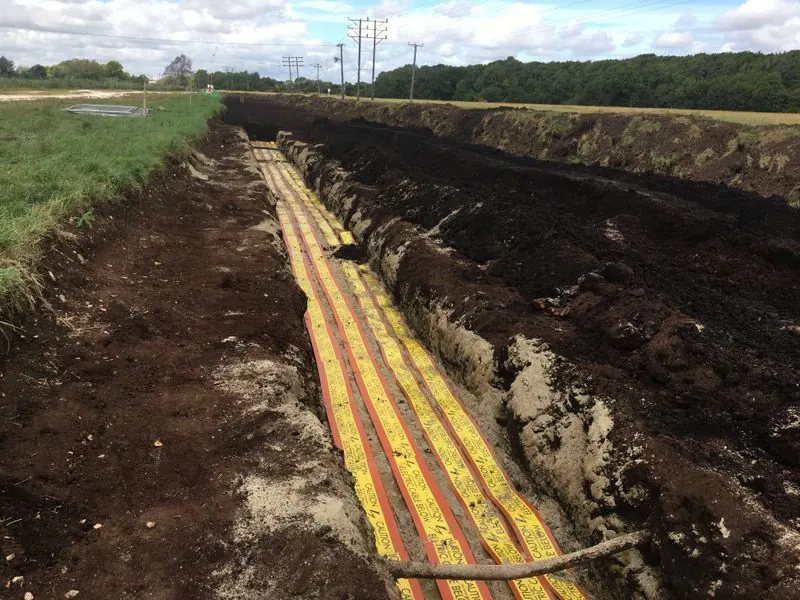
ECS 02-0019 (Version 15.0, 21/07/2026) gives minimum depths of cover, measured to the top of the cable or duct. For ducted cables it is measured from the final finished ground level.
| Cable | Footways, verges, private property | Carriageways and road crossings | Normal agricultural land | Land subject to deep ploughing |
|---|---|---|---|---|
| LV mains and services | 450mm | 600mm | 1050mm | 1200mm |
| 11kV and 20kV | 600mm | 750mm | 1050mm | 1200mm |
| 33kV | 900mm | 900mm | 1050mm | 1200mm |
| 66kV and 132kV | 900mm | 900mm | 1050mm | 1200mm |
Extra depth reduces the cable rating, so cables go deeper only when there is no alternative. Where minimum depth cannot be reached, the cable needs steel plates or steel ducts as extra protection.
Ducts, bedding and cable protection
- Ducts must be electricity cable ducts from the approved list, black, and marked "Electric Cable Duct" on two opposite sides.
- Before pulling, a 3 metre length of the cable to be installed is pulled through the whole duct and checked for damage.
- LV and 11kV trenches get a sand bed. 33kV, 66kV and 132kV cables and ducts go in cement bound sand or compacted crushed limestone to ENA TS 97-01, unless rating calculations show stabilised backfill is not needed.
- Cables are blinded to a compacted 100mm above the cable or joint.
- Tile tape goes over LV, 11kV and 20/22kV cables. Stokbord goes over 33kV, 66kV and 132kV cables. Either must cover the full width of the cables or ducts below.
- Duct entries into substations and buildings are sealed with the approved Rayflate duct seal, even when empty.
- On construction sites, cables should not go in until site groundworks are complete. If that is not possible, mitigating measures are needed.
Joint bays
ECS 02-0019 requires joint bays large enough for the joint being made, preferably outside the carriageway. Bays for 66kV and above need a 100mm thick concrete floor. Exposed cables and joints should be blinded with sand or covered with sandbags before energisation where reasonably practicable. See our guide to cable jointing and joint bays.
Public highway and private land
In streets, work must conform to the New Roads and Street Works Act 1991 and the HAUC codes of practice, with reinstatement to the HAUC Specification for the Reinstatement of Openings in Highways. Under motorways, trunk roads and watercourses, cables go in ducts. In agricultural land the standard calls up ENA EREC G29 and G57, and drains, fences and gates must be promptly reinstated. Horizontal directional drilling is outside ECS 02-0019 and needs site-specific studies and method statements (see our horizontal directional drilling guide).
Substation bases and plinths
EDS 07-3102 (Version 6.0, 27/11/2025, applicable from 1 March 2026) covers the civil design of new 11kV and 6.6kV secondary substations. For the groundworks contractor:
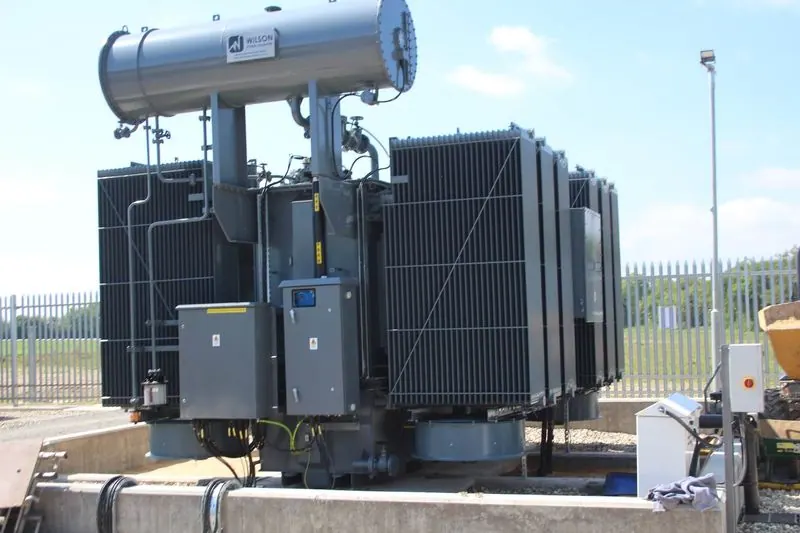
- Foundations are cast in situ reinforced concrete or approved precast bases (ECS 07-3005). Cast bases use RC32/40 concrete and cure for at least 7 days before equipment is landed.
- Approved plastic cable ducts are 125mm internal diameter twin-walled HDPE unless UK Power Networks specifies otherwise. Cables passing through or under a building go in steel ducts.
- Cable trenches inside the substation are at least 1000mm deep and 600mm wide, under open mesh GRP gratings.
- Where UK Power Networks adopts the civil structures, life to first maintenance must be at least 20 years.
Plinth and base drawings sit in the EDS 07-3102 series. UK Power Networks wrote its 10 Steps to Compliance guide (HSS 02 004g) after audits kept finding the same faults in GRP package substations.
Who arranges easements and wayleaves for UKPN adoption?
The ICP or customer negotiates with the landowner using UK Power Networks' templates. UK Power Networks' solicitor completes the legal documents.
Under CON 08 111 (Version 6.0, 19/01/2024), a consent matrix decides whether the job needs a wayleave, an easement or a lease. For easements and leases, the ICP agrees Heads of Terms with the landowner, prepares a Land Registry compliant legal plan and sends a Legal Instruction Form (CON 08 111a) to UK Power Networks' Property and Consents team.
After the works, UK Power Networks checks the as-laid drawings against the legal drawings. If they do not match, a Deed of Variation or revised wayleave is needed before energisation. Accurate setting out protects the programme.
What as-laid records does UKPN need?
Accurate as-built drawings of everything installed, submitted to fixed deadlines. EOS 09-0100 (Version 14.0, 01/07/2024) applies in full to ICPs and IDNOs.
ECS 02-0019 asks for an absolute location accuracy of less than 100mm against permanent and immovable features. EOS 09-0100 sets the timing: route drawings at least two weeks before work starts, as-built records before the Notice of Energisation comes into force, and final as-built records within five working days of energisation. For substations, EDS 07-3102 adds duct sizes, depths and positions, earth rod locations and earthing test certificates.
Which G81 details vary by DNO?
Much of the detail. ENA G81 Part 1 gives substation specification, network design, fault levels, ratings and compatibility with existing equipment as reasons for local variation, and Part 3 leaves even the colour of service ducts (black or red) to the host operator. Treat depths, ducts, materials, substation designs, consent templates and record formats as operator-specific until you have checked them.
Do not reuse another DNO's specification on a UK Power Networks job, or the other way round. Check the current UK Power Networks document for each job in the G81 Technical Library, and confirm anything unusual with the UK Power Networks designer before you build.
Where Ground Utilities fits
Ground Utilities is a NERS accredited power and civils contractor based at Highdrove Farm, Cottenham, Cambridgeshire, inside UK Power Networks' Eastern area. Our HV work includes about 25 km of fully ducted 2 x 33kV cable route between a DNO substation and a client substation, with 45 joint bays (HV cable installations). It also includes a 6 km dual 33kV and fibre route from UK Power Networks' Barnham substation to the Kingsfleet development at Thetford, with an HDD crossing under a river (Thetford cable route and civil build). Other HV projects are the 33kV route at Dunmow and the 11kV route at Whittle Laboratory.
Ground Utilities holds full NERS approval for cable laying at LV, 11kV, 20kV, 33kV, 66kV and 132kV, and for civil works, with all six distribution network operators, including UK Power Networks (LRQA NERS register, checked November 2026). That means we can build contestable cable laying and civil works to UK Power Networks' G81 requirements ourselves. Jointing and design are outside our NERS scope.
See our multi-utility services, civil construction and accreditations pages. Related guides: section 38, 104 and 278 agreements, avoiding utility strikes, underground utility colour codes and battery storage site groundworks.
Frequently asked questions
What does G81 stand for?
G81 is the reference number of an Energy Networks Association Engineering Recommendation, EREC G81. The suite sets out a national framework for competition in new electricity connections.
Where do I find UKPN's G81 documents?
In UK Power Networks' G81 Technical Library at g81.ukpowernetworks.co.uk. It holds design, materials, installation, testing, operational, records, legal and ICP documents, plus an index spreadsheet showing the current version of each.
Is UKPN G81 the same as ENA G81?
No. ENA EREC G81 is the national framework. UK Power Networks adds its own standards for its three licence areas, and those decide whether ICP work is accepted for adoption in London, the South East and the East of England.
What is the minimum cover depth for an 11kV cable in UKPN's area?
ECS 02-0019 Version 15.0 sets 600mm in footways, verges and private property, 750mm in carriageways, 1050mm in normal agricultural land and 1200mm in land subject to deep ploughing. Check the current version before you dig.
Does UKPN have to approve an ICP's design?
Yes. UK Power Networks states that all ICP designs must be approved by it before work starts on site. CON 08 114 sets out the design approval arrangements, including how ICPs can reach self-approval.
Who negotiates wayleaves and easements for UKPN adoption?
The ICP or customer agrees terms with the landowner using UK Power Networks' templates under CON 08 111. UK Power Networks' Property and Consents team and solicitor then complete the legal documents.
What happens if a UKPN audit fails ICP work?
Connection cannot go ahead until the defects are fixed, and the planned connection may be cancelled. UK Power Networks may accept photographic evidence of the fix if it arrives by close of business the day before the connection date.
Talk to Ground Utilities
If you are planning contestable cable or substation civils in UK Power Networks' area, send us the drawings and the UK Power Networks design approval status and we will tell you what we can deliver and when. Call +44 1223 423918, email info@ground-utilities.co.uk or use our contact page.
Sources
- Energy Networks Association, Engineering Recommendation G81 Part 1 Issue 3 2016, "Framework for new low voltage housing development installations, Part 1 Design and planning" (Foreword, Clauses 1, 5 and 6.2). dcode.org.uk
- Energy Networks Association, Engineering Recommendation G81 Part 4 Issue 3 2016 (extract), Clause 1 Scope. ena-eng.org
- Energy Networks Association, Engineering Recommendation G81 Part 3 Issue 2 2016 (extract). ena-eng.org
- ENA document catalogue, EREC G81 Parts 1 to 7, titles and status. ena-eng.org
- UK Power Networks, G81 Technical Library (home page and categories). g81.ukpowernetworks.co.uk
- UK Power Networks, G81 Index spreadsheet (document list with versions, as of 02/11/2026). media.umbraco.io
- UK Power Networks Document Library, Connections quotation, 4.1.17 Engineering Recommendations G81. library.ukpowernetworks.co.uk
- UK Power Networks, ECS 02-0019 Installation of Underground Cables - LV to 132kV, Version 15.0, 21/07/2026. media.umbraco.io
- UK Power Networks, EDS 07-3102 Secondary Substation Civil Design, Version 6.0, 27/11/2025. media.umbraco.io
- UK Power Networks, ECS 07-3005 Precast Concrete Bases. media.umbraco.io
- UK Power Networks, HSS 02 004 Audit, Inspection and Monitoring of Networks Connections Providers, Version 8.0, published 30/09/2025. media.umbraco.io
- UK Power Networks, HSS 02 004g 10 Steps to Compliance, v2.0, September 2025. media.umbraco.io
- UK Power Networks, HSS 41 006 Assessment and Accreditation of Independent Connection Providers, Version 8.0, published 13/09/2023. media.umbraco.io
- UK Power Networks, CON 08 111 Competition in Connections ICP Consents Policy, Version 6.0, published 19/01/2024. media.umbraco.io
- UK Power Networks, CON 08 112 Competition in Connections - Exercise of existing UK Power Networks Easements by an ICP. media.umbraco.io
- UK Power Networks, CON 08 114 ICP Design Fast-track and Approved Designer Scheme, V6.0. media.umbraco.io
- UK Power Networks, EOS 09-0100 Site Recording of Cables, Plant and Equipment, Version 14.0, 01/07/2024. media.umbraco.io
- UK Power Networks, "What work can I go elsewhere for?", v2 April 2022. media.umbraco.io
- UK Power Networks, "Did you know you have a choice?" ukpowernetworks.co.uk
- UK Power Networks, "Are you an ICP or IDNO?" ukpowernetworks.co.uk
- LRQA, National Electricity Registration Scheme (NERS). lrqa.com
- Ground Utilities, HV Cable Installations project page. ground-utilities.co.uk
- Ground Utilities, Thetford Cable Route and Civil Build project page. ground-utilities.co.uk
- Ground Utilities, Accreditations page. ground-utilities.co.uk
- LRQA, NERS register entry for Ground Utilities Ltd, checked 3 November 2026. lrqa.com