To avoid a utility strike in the UK, follow HSE guidance HSG47: plan the work using up-to-date utility records, sweep the area with a cable avoidance tool (CAT) and signal generator (Genny), mark what you find, then prove each service by hand-dug or vacuum-excavated trial holes before any machine digs nearby. Assume services are present until shown otherwise.
Key points
- HSG47 (third edition, 2014) is free from the Health and Safety Executive (HSE) and sets out a safe system of work for digging near buried services.
- The legal duty sits in regulation 25(4) of the Construction (Design and Management) Regulations 2015 (CDM 2015).
- HSE says not to rely on utility plans for distances or depths.
- A CAT cannot find most plastic pipes, cables carrying little or no current, or a service hidden directly below another.
- HSG47 advises keeping hand-held power tools 500 mm or more from the indicated line of a service, then finding it by hand.
- A University of Birmingham study of 16 UK strikes found indirect and social costs averaged 29 times the direct repair cost.
In this guide
- What does HSG47 require before you dig?
- Where do you get utility records?
- What can a CAT and Genny find, and what can't they?
- When should you use GPR or a PAS 128 survey?
- Why dig trial holes by hand, and what is the 500 mm rule?
- Is vacuum excavation safer than hand digging?
- Do you need a permit to dig?
- What should you do if you strike a cable or pipe?
- What does a utility strike cost?
- What training do CAT and Genny operators need?
- What is Safe Digging Week, and who are USAG?
- Where Ground Utilities fits
- Frequently asked questions
- Talk to us about your next dig
What does HSG47 require before you dig?
HSG47 asks for three things working together: plan the work, detect and mark the services, and dig safely. HSE says all three are essential.
| Element | What it means on site |
|---|---|
| Planning the work | Get records from every asset owner, design the dig to avoid services where possible, and brief the gang with drawings. |
| Detecting, identifying and marking | Survey the area with competent people and suitable equipment, confirm what each service is and whether it is live, and mark its line. |
| Safe excavation | Choose a digging method that suits the services and ground, expose services carefully, support them and backfill correctly. |
Some courses teach it as four parts, giving plans their own heading. The 2014 text keeps plans within planning.
HSG47 is guidance. HSE says following it is optional, and that if you do follow it you will normally be doing enough to comply with the law. The law itself is CDM 2015 regulation 25(4): work that could create a risk from an underground service must not go ahead until suitable and sufficient steps have been taken to prevent that risk, so far as is reasonably practicable.
Clients have duties as well. HSG47 says clients must make reasonable enquiries about underground services and pass the information to designers and contractors, or give the contractor enough time and resource to do it.
Where do you get utility records?
Search every asset owner in the area, then add any private records the site holds. HSE says this desktop study should be done for every project that involves excavating or penetrating the ground.
- LinesearchbeforeUdig (LSBUD), a free online search. LSBUD says it has over 160 asset owner members and protects over 60% of Great Britain's utility infrastructure, so some owners sit outside it.
- The National Underground Asset Register (NUAR), a government map of buried pipes and cables in England, Wales and Northern Ireland, run by Ordnance Survey. Gov.uk says utility providers and their contractors can now use it as their main source of asset data.
- Direct requests to statutory undertakers not covered above: the electricity network operator, gas network, water company and each telecoms operator.
- Private records, such as estate plans and as-builts on hospital, factory and campus sites.
The Survey Association's client guide to PAS 128 recommends allowing at least twenty working days for a full search.
HSG47 warns that plans are not always to scale and that cables get moved without the owner knowing. Use plans to know what to look for, then find each service on site.
What can a CAT and Genny find, and what can't they?
A CAT is a handheld receiver that picks up electromagnetic signals from buried metallic cables and pipes. A Genny puts a known signal onto a service, or into the ground above it, so the CAT can trace it. A CAT can be used without a Genny, but it will then miss anything not carrying a passive signal.
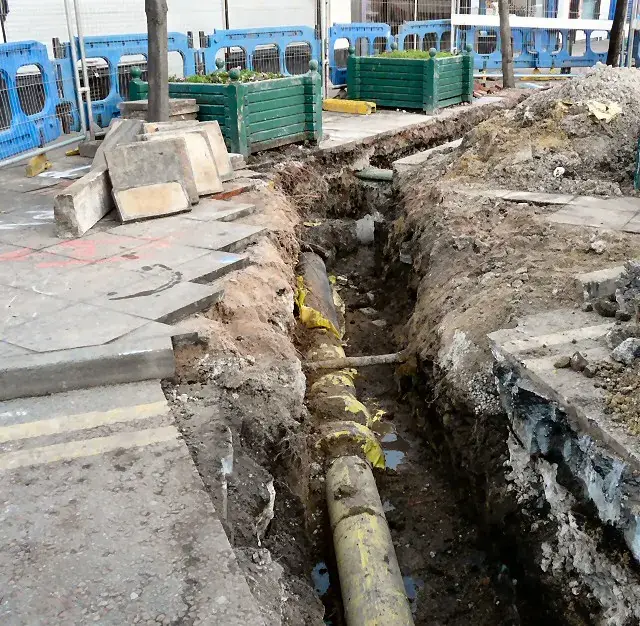
Radiodetection's C.A.T4 and Genny4 user guide describes four modes:
| Mode | What it detects | Main limitation |
|---|---|---|
| Power | Signals from the power network, which can appear on any pipe or cable | Some power cables give no detectable signal, and switched-off cables such as street lighting in daylight may not show |
| Radio | Signals from distant radio transmitters travelling along long metallic services | Radio signals are not always present |
| Genny | The signal applied by the Genny, by direct connection, clamp or induction | You need a rough idea where the service is to apply the signal well |
| Avoidance | All three at once, for a first sweep | Pinpointing may need a single mode |
The manufacturer advises sweeping in Avoidance mode first, then tracing in the individual modes, and always using a Genny before excavating.
What a CAT and Genny will not reliably detect
HSG47 lists the gaps:
- Plastic and other non-metallic services, unless they carry a tracer wire, have a sonde or tracing rod pushed through them, or carry radio frequency identification (RFID) markers. HSE notes that few plastic gas and water pipes were laid with tracer wire.
- Cables with little or no current, such as supplies to empty premises.
- Direct current cables, and some well-balanced high-voltage cables that give off little field.
- Services running close together, which can show as one signal, and a lower service directly below an upper one.
- Many telecoms and rail signalling cables, unless metal parts are earthed, tagged or in traceable ducts.
Treat depth readings with care. Radiodetection says not to use its depth estimates to decide whether mechanical digging is appropriate.
When should you use GPR or a PAS 128 survey?
Bring in ground penetrating radar (GPR) or a specified survey when the site is congested, records are poor or plastic services are likely.
HSG47 treats GPR as the possible exception for finding plastic pipes, but says it cannot identify a service on its own and can give false readings in disturbed ground.
PAS 128 is the British Standards Institution (BSI) specification for underground utility detection, verification and location. PAS 128:2022 replaced the 2014 version and sets four survey types:
| Survey type | What it involves | What you get |
|---|---|---|
| Type D, desktop | Records search from all asset owners | Where owners believe services are, with no positional accuracy |
| Type C, site reconnaissance | Type D plus a site visit tying records to covers, poles, cabinets and trench scars | Records checked against visible features |
| Type B, detection | At least two geophysical methods, usually electromagnetic location and GPR | Detected positions with quality levels |
| Type A, verification | Services exposed in chambers or trial holes | Verified position and depth |
The Survey Association's guide says a Type D survey must come before any other type, and that no technology can guarantee detection of every buried utility.
Why dig trial holes by hand, and what is the 500 mm rule?
A trial hole exposes a detected service to confirm its position, depth and identity. HSG47 says a cable is positively located only when it has been safely exposed. On utility jobs, trial holes and trial pits usually mean the same thing.
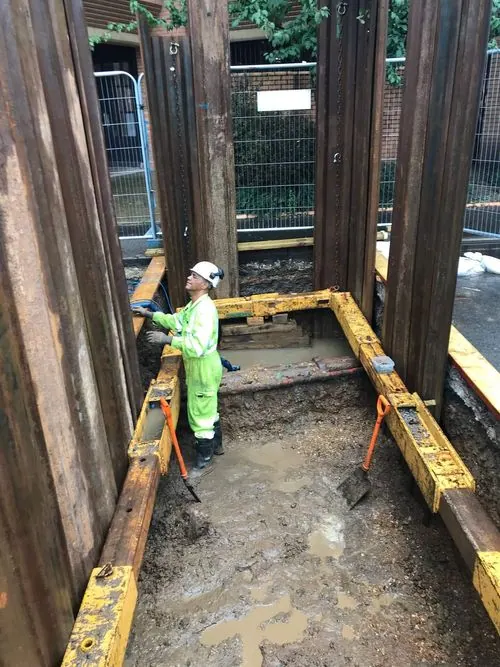
The HSG47 method:
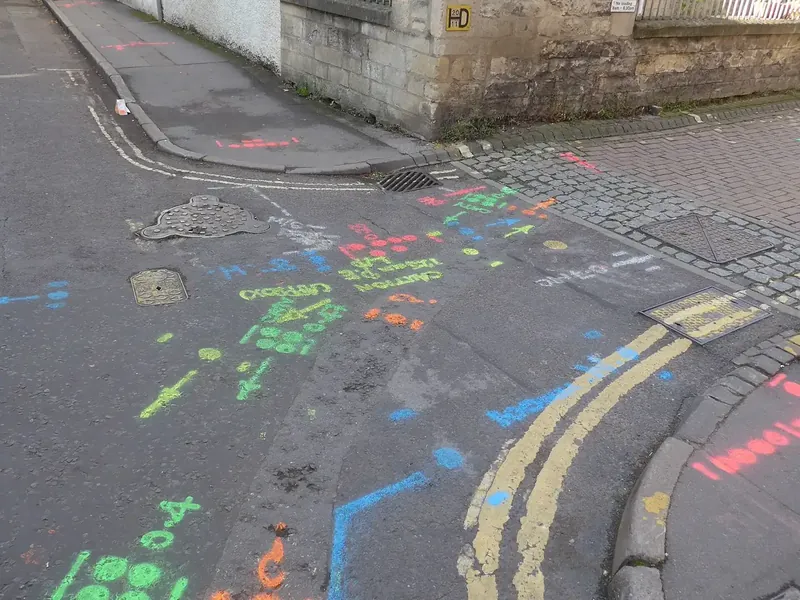
- Locate and mark the line with a CAT and Genny. Use crayon, chalk or paint on hard surfaces and wooden pegs beside the line on soft ground, never steel pins.
- Where practicable, break hard surfacing with hand-held power tools only 500 mm or more from the indicated line.
- Dig by hand under the surfacing to find the service. If you cannot find a cable, assume it is inside the surface layer.
- Dig alongside the service and finish exposing it by digging horizontally. Use insulated tools near cables and ease spades in with foot pressure.
- Re-check with the locator as you go down. Location gets more accurate as cover comes off.
- Support exposed services and never use them as steps or handholds.
The 500 mm margin can be reduced where services are congested or space is tight, but only when the line is shown on plans, confirmed by a locator and extra precautions are in place. HSG47 also says not to use mechanical excavators within 500 mm of a gas pipe or major hazard pipeline.
HSG47 also notes that most cables sit between 450 mm and 1 m deep, though depths should never be assumed, and that single-phase cables of 11 kV or more can be spread up to 600 mm apart near joints.
Is vacuum excavation safer than hand digging?
It can be, especially in congested ground. HSG47 lists vacuum excavation, which may use water jetting or high-velocity air, as a safe digging method that can be very effective where hand tools and machines struggle.
HSE notes it will not work in all ground or on concrete, and that jets can damage old, fragile cables. The PAS 128 client guide names hand-dug trial holes and vacuum excavation as the safest ways to confirm a service's position and depth.
Do you need a permit to dig?
Most principal contractors run one, and HSG47 says a permit system may be appropriate for particularly hazardous work. HSE defines a permit as written authorisation from a responsible person setting out the work, risks, duration and precautions.
A useful permit to dig records the records search, the locate results, the digging method and the 500 mm controls. Street works permits on a public highway are separate and come from the highway authority.
What should you do if you strike a cable or pipe?
Stop, keep everyone clear and call the asset owner. HSG47 says nobody should approach a damaged electricity cable until its owner has made it safe.
- If an excavator hits a cable, the driver stays in the cab. HSE warns that drivers who climb down may be electrocuted.
- Isolate and secure the area. No one enters the excavation or approaches the machine or cable.
- For gas, evacuate the immediate area, warn occupants of affected buildings, remove ignition sources within at least 5 m and call the National Gas Emergency number, 0800 111 999.
- For water, inform the water company and the owners of any nearby services that may be affected.
- Call 999 if anyone is hurt or in immediate danger, and the asset owner's emergency number from the plans. For a damaged electricity cable, the national power cut number 105 reaches the local network operator. Never attempt your own repair.
- Report under RIDDOR (the Reporting of Injuries, Diseases and Dangerous Occurrences Regulations 2013) where it applies. An electrical strike causing fire or explosion is reportable if it could have caused death or puts the cable out of action for more than 24 hours.
- Tell the owner if their plans were wrong, ideally before backfilling, so the records get corrected. The Utility Strike Avoidance Group (USAG) also runs a free, anonymous Strike Portal for logging strikes.
What does a utility strike cost?
Far more than the repair. A University of Birmingham study of 16 strikes in UK urban areas found that indirect and social costs, borne by third parties and the public, came to 29 times the direct repair cost.
| Figure | Source |
|---|---|
| £210,000 in fines and costs after a worker died following damage to a live 11,000-volt cable | HSE, HSG47 case study 1 |
| £15 million estimated cost of hitting a high-pressure fuel pipeline | LSBUD |
| 2,070 strikes reported across the UK in 2020 by 43 USAG members | USAG |
HSE says electrical strikes typically cause severe, potentially fatal burns to the hands, face and body.
What training do CAT and Genny operators need?
HSG47 says anyone using a locator should be thoroughly trained in its use and limitations. The usual qualification is Energy and Utility Skills Register (EUSR) registration under its Utility Excavations scheme:
- Category 1, Locate Utility Services (HSG47), the usual "CAT and Genny" course.
- Category 2, Implement Safe (Digging) Excavating Practices.
EUSR says registration is valid for three years for each category. EUSR is also the Construction Skills Certification Scheme (CSCS) Alliance Partner for the utilities sector. When booking a course, check the provider is EUSR-approved for that category.
What is Safe Digging Week, and who are USAG?
National Safe Digging Week is an annual campaign run by LSBUD. The 2026 week ran from 6 to 12 July under the theme "The Power of Collaboration".
USAG describes itself as a group of over 400 utility asset owners, industry groups and contractors working to prevent strikes on underground utilities.
Where Ground Utilities fits
Ground Utilities is a utilities, HV cable, civils and groundworks contractor based in Cottenham, Cambridgeshire. Our accreditations page records that we are a USAG member and NERS and CHAS accredited, that all operatives are CSCS/EUSR registered as a minimum and all supervisors SMSTS qualified. We coordinate with local highway authorities to secure permits. For National Safe Digging Week 2024 our operatives and management took a pipeline awareness course and webinar with Fisher German's Line Watch team (news post).
Related work: multi-utility services, civil construction, HV cable installations, Thetford cable route civil build, deep excavations for sewer and water, renewable energy projects and what ICP and NERS mean for a new connection.
Related guides: underground utility colour codes, horizontal directional drilling, cable jointing and joint bays, UKPN G81, section 38, 104 and 278 agreements and battery storage site groundworks.
Frequently asked questions
What can a CAT and Genny not detect?
Most plastic and other non-metallic pipes without a tracer wire, cables carrying little or no current, direct current cables, some balanced high-voltage cables, and services hidden directly below another. Closely spaced services can also appear as one signal. Trial holes are the only way to be certain.
Can you use a CAT without a Genny?
Yes. Power and Radio modes work without a Genny, but they rely on signals that may not be present. Radiodetection advises using a Genny before every excavation, and HSE says signal generators greatly increase locating accuracy.
What are the safe digging practices in the UK?
Get records from every asset owner, sweep and mark the area with a CAT and Genny, then expose services by hand or vacuum excavation before machine digging. Keep power tools at least 500 mm from a marked line where practicable, dig alongside services, and re-check with the locator as you go.
What is the 500 mm rule in HSG47?
HSG47 advises using hand-held power tools only 500 mm or more from the indicated line of a buried service, then locating it by hand digging. It also says not to use mechanical excavators within 500 mm of a gas pipe or major hazard pipeline.
Is HSG47 a legal requirement?
HSG47 is HSE guidance, so following it is optional. HSE says that if you do follow it you will normally be doing enough to comply with the law. The legal duty is in regulation 25(4) of CDM 2015.
How long is HSG47 valid for?
HSG47 itself does not expire. The current version is the third edition, published in 2014. People asking this usually mean an EUSR registration such as Category 1 Locate Utility Services, which EUSR says is valid for three years.
What is the difference between a CAT sweep and a PAS 128 survey?
A CAT and Genny sweep is a site locate done before digging. A PAS 128 survey is a specified survey with four types, from a desktop records search (Type D) to verification by excavation (Type A), with recorded quality levels for each service.
Talk to us about your next dig
If you are planning cable routes, utility connections or groundworks and want a contractor who works to HSG47 and is a USAG member, call Ground Utilities on +44 1223 423918, email info@ground-utilities.co.uk or use our contact page. If you are looking for a CAT and Genny training course, contact an EUSR-approved training provider for Category 1.
Sources
- Health and Safety Executive. HSG47 Avoiding danger from underground services, third edition, 2014. hse.gov.uk (PDF: hse.gov.uk. Used for: the three elements, client duties, limits of plans, detector types and limits, GPR, trial holes, the 500 mm guidance, cable depths, vacuum excavation, permits to work, strike response, the gas emergency number, the RIDDOR summary, the £210,000 case study and the legal status of the guidance.
- The Construction (Design and Management) Regulations 2015, regulation 25(4). legislation.gov.uk
- Radiodetection. C.A.T4 and Genny4 User Guide, 90/UG092ENG/07. radiodetection.com
- The Survey Association. Client Guide to BS: EN PAS 128:2022, Issue 3. gsa-uk.org.uk
- BSI. PAS 128:2014 product page (withdrawn 26 April 2022). knowledge.bsigroup.com
- LinesearchbeforeUdig (LSBUD), home page: free search, member numbers, coverage, £15 million estimate. lsbud.co.uk
- LSBUD, National Safe Digging Week: 2026 dates and theme. lsbud.co.uk
- GOV.UK, National Underground Asset Register (NUAR), updated 27 April 2026. gov.uk
- Utility Strike Avoidance Group (USAG), home page: membership, Strike Portal, 2020 strike report. utilitystrikeavoidancegroup.org
- Makana, L., Metje, N., Jefferson, I., Sackey, M. and Rogers, C. Cost estimation of utility strikes: towards proactive management of street works. Infrastructure Asset Management 7(2), 2019. research.birmingham.ac.uk
- EUSR, Utility Excavations Category 1: Locate Utility Services (HSG47). eusr.co.uk
- EUSR, Utility Excavations Category 2: Implement Safe (Digging) Excavating Practices. eusr.co.uk
- EUSR, CSCS Alliance Partner. eusr.co.uk
- Ground Utilities, Accreditations. ground-utilities.co.uk
- Ground Utilities, Ground Utilities takes part in National Safe Digging Week. ground-utilities.co.uk