The New Roads and Street Works Act 1991 (NRSWA) governs who may dig up a street in England and Wales, how those works are planned with the highway authority, who must be qualified to carry them out, and how the street is put back. If your project puts a cable, duct or pipe in a public road or footway, these rules set your lead times and penalties.
Key points
- Part III of NRSWA covers street works in England and Wales. Scotland has its own regime under Part IV of the Act.
- Only statutory undertakers, or people holding a section 50 street works licence, may place apparatus in a street.
- Almost every highway authority in England now runs a permit scheme, managed through the Department for Transport's Street Manager service.
- Where a street is broken open, a qualified supervisor must supervise and at least one qualified operative must be on site.
- Street works qualifications are recorded on the SWQR register and must be renewed every five years.
- Signing, lighting and guarding follow the 2013 Safety at Street Works and Road Works code, known as the Red Book.
- Since 5 January 2026, working without a permit in England carries a £1,000 fixed penalty, and overrun charges reach £10,000 a day on traffic-sensitive main roads.
In this guide
- What is the New Roads and Street Works Act 1991?
- Who has the right to dig in a street?
- What is the difference between street works and road works?
- How do permit schemes and Street Manager work?
- What qualifications does NRSWA require on site?
- What is the Red Book?
- How must the street be reinstated?
- What happens when works break the rules or overrun?
- What should a client check before hiring a contractor for highway work?
- Where Ground Utilities fits
- Frequently asked questions
What is the New Roads and Street Works Act 1991?
NRSWA is the Act of Parliament that sets the framework for works in streets. Part III, which extends to England and Wales, deals with street works: works by utilities and other undertakers to place, inspect, repair, move or remove apparatus in a street.
The Act defines a street widely. Under section 48 it includes any highway, road, lane, footway, alley or passage, any square or court, and land laid out as a way, whether or not it is a thoroughfare.
Does NRSWA apply in Scotland and Wales?
Wales is covered by Part III alongside England, though the Welsh Ministers make some of their own regulations, so details such as qualification rules can differ. Scotland is different: Part IV of NRSWA deals with road works in Scotland, with its own register and the Scottish Road Works Commissioner overseeing the planning, co-ordination and quality of works. This guide describes the position in England unless it says otherwise.
Who has the right to dig in a street?
Street works are carried out under one of two kinds of authority. The first is a statutory right: utilities such as electricity distribution and water companies have powers under their own legislation to place apparatus in streets, and NRSWA calls the holder of that right the undertaker. The second is a street works licence under section 50, granted by the street authority, which lets the licensee place or keep apparatus in the street, later maintain, move or remove it, and break up or open the street to do so.
A section 50 licence is the usual route for private parties, such as a solar farm laying a private wire along a road. The licence holder becomes the undertaker for those works, with the same duties as a utility. We cover the application process and conditions in our section 50 licence service page.
What is the difference between street works and road works?
The two terms describe who is working and why. Street works, as defined in section 48, are works to place or maintain apparatus, executed under a statutory right or a street works licence. Road works are works for road purposes, which section 86 defines as works to maintain or improve the highway, to erect or maintain traffic signs, and to build a vehicle crossing over a footway or verge.
| Term | Who carries it out | Typical examples |
|---|---|---|
| Street works | Statutory undertakers and section 50 licence holders | Laying an 11kV cable, a water main or fibre duct; repairing a gas or water leak |
| Road works | The highway authority or its contractors | Resurfacing, drainage maintenance, signs, new dropped kerbs |
In Scotland the Act uses "road works" for what England and Wales call street works.
How do permit schemes and Street Manager work?
Part 3 of the Traffic Management Act 2004 allows highway authorities to run permit schemes in place of the older noticing system. The promoter must obtain a permit before starting, and the authority can attach conditions on timing, road space and traffic management. The Department for Transport's permit scheme statutory guidance (March 2026) notes that almost every authority in England now operates one.
Applications go through Street Manager, the Department for Transport's digital service for planning and managing street and road works. Its use became mandatory for highway authorities and undertakers in England on 1 July 2020 (DfT letter). Current GOV.UK guidance says Street Manager must be used to apply for permits, assess them, record inspections and add reinstatements.
How far ahead do you need to apply?
The statutory guidance sets these minimum application periods:
| Activity | What it covers | Apply at least |
|---|---|---|
| Major | 11 working days or more, or any activity needing a temporary traffic regulation order | 3 months for provisional advance authorisation, then 10 days for the permit |
| Standard | 4 to 10 working days | 10 days |
| Minor | 3 working days or less | 3 days |
| Immediate | Emergency and urgent works | Within 2 hours after starting |
The first row matters most for programming. A cable route that needs a road closure counts as major activity however short it is, so the three months' advance authorisation has to be built into the programme.
What about noticing?
Where no permit scheme operates, works are noticed. Section 55 requires an undertaker breaking up a street to give not less than 7 working days' notice of the start date (or another period set by regulations) to the street authority and to anyone whose apparatus is likely to be affected.
What qualifications does NRSWA require on site?
Section 67 sets two duties for street works that involve breaking up or opening the street, or tunnelling or boring under it. The undertaker must make sure the works are supervised by a person holding a prescribed supervisor qualification, and that at least one person holding a prescribed trained operative qualification is on site whenever the works are in progress. Failing either duty is an offence carrying a fine of up to level 5 on the standard scale.
In England the prescribed qualifications are set by the Street Works (Qualifications of Operatives and Supervisors) (England) Regulations 2016, in force since 6 April 2017. Each role needs at least one work unit plus signing, lighting and guarding, and location and avoidance of underground apparatus; supervisors hold the monitoring versions.
What are the street works units?
The units are listed in Schedule 1 and Schedule 2 of the 2016 Regulations:
| Type of work | Operative unit | Supervisor unit |
|---|---|---|
| Excavation in the highway | O2 | S2 |
| Reinstatement and compaction of backfill materials | O3 | S3 |
| Reinstatement of sub-base and base in non-bituminous materials | O4 | S4 |
| Reinstatement in cold-lay bituminous materials | O5 | S5 (bituminous materials) |
| Reinstatement in hot-lay bituminous materials | O6 | |
| Reinstatement of concrete slabs | O7 | S6 |
| Reinstatement of modular surfaces and concrete footways | O8 | S7 |
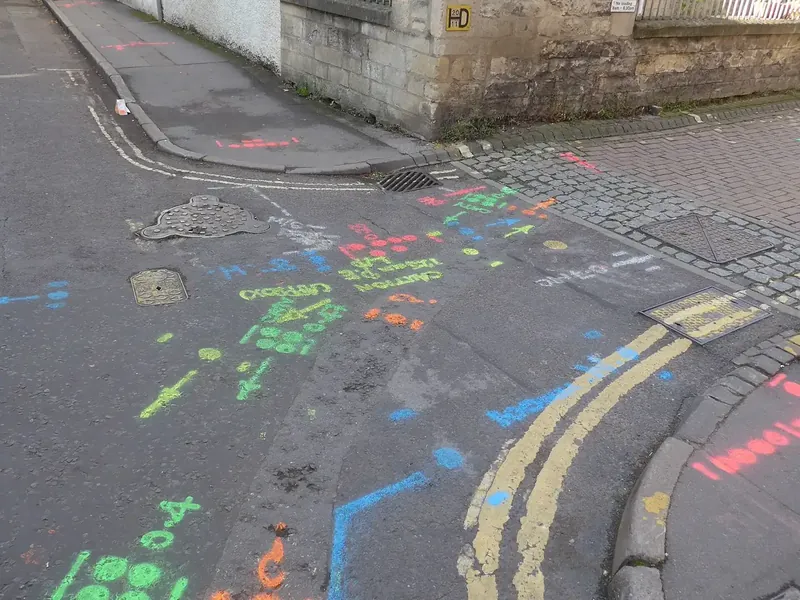
See our guide to avoiding utility strikes.
What is the street works card?
A qualification counts only once the certificate is entered on the approved register, the Street Works Qualifications Register (SWQR). The 2016 Regulations name the Scottish Qualifications Authority as the registration body, and the SWQR website now operates under the Qualifications Scotland name. The holder gets a photo card listing their units: the street works card or NRSWA card. A new certificate counts for two months from the date it is awarded, while registration goes through.
How often must the card be renewed?
Registration lasts five years. To renew, the holder passes a reassessment and registers a renewal certificate. Under the England regulations, a renewal issued more than 12 months but no more than 48 months before expiry gives six years, so reassessing early does not shorten the card. In Wales, the Welsh Government states that certificates on the SWQR are likewise valid for five years.
Who awards street works qualifications?
Certificates come from awarding organisations. The SWQR site links to CABWI Awarding Body, City & Guilds, Energy & Environment Awards, Highfield Qualifications, LANTRA, NOCN Group, Qualifications Scotland and Smart Awards.
What is the Red Book?
The Red Book is Safety at Street Works and Road Works: A Code of Practice, the code for signing, lighting and guarding works on roads and footways. The current version is the 2013 edition, which came into force on 1 October 2014. It is issued by the Secretary of State for Transport and Welsh Ministers under section 65 of NRSWA, and by Scottish Ministers under section 124, so it applies across Great Britain. It does not cover motorways or dual carriageways with a speed limit of 50 mph or more.
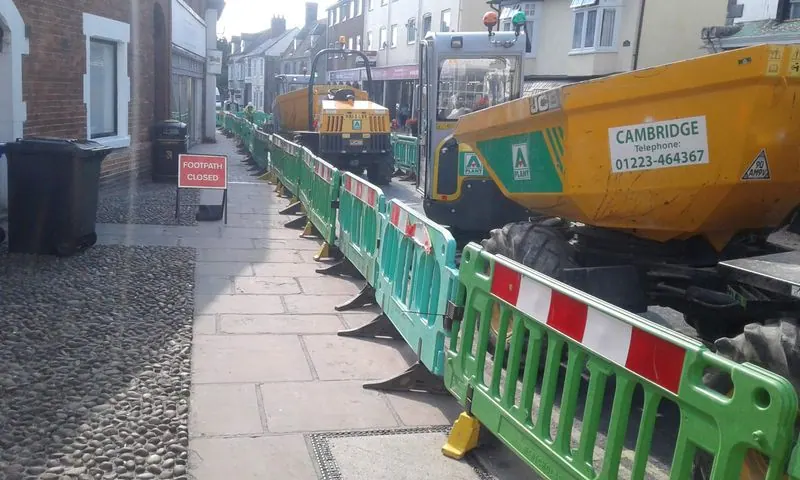
The code itself states that compliance with it is taken as compliance with the legal requirements it relates to. It covers safety zones and cone tapers, pedestrian routes and barriers, footway boards and ramps, unattended sites, vehicles and high visibility clothing.
A new edition is on the way. The Department for Transport published a draft updated code for consultation on 21 September 2026, closing on 14 December 2026. Until a revised code is published and brought into force, the 2013 edition applies.
How must the street be reinstated?
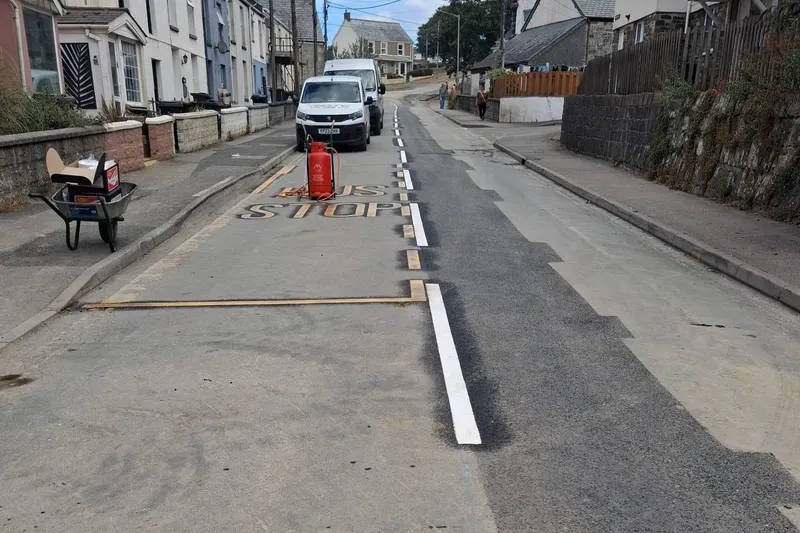
The undertaker must reinstate the street after the works and is responsible for the reinstatement's performance for a guarantee period. In England, the standard is the Specification for the Reinstatement of Openings in Highways (SROH), fourth edition, which became statutory guidance on 10 May 2021 and replaced the third edition on that date. A December 2024 addendum covers reinstating footways after cable channels are installed across or through them, and a 30 May 2025 update clarified when a guarantee period restarts after remedial works and when cold lay materials may be used.
The operatives laying backfill and surfacing need the reinstatement units for the materials they use. Our road reinstatement guide covers SROH in detail.
What happens when works break the rules or overrun?
Many street works offences can be discharged by paying a fixed penalty notice (FPN) instead of facing prosecution. The amounts were doubled by the Street and Road Works (Charges and Penalties) (Amendments) (England) Regulations 2025 from 5 January 2026.
| Offence (England) | Fixed penalty | Discounted for early payment |
|---|---|---|
| Working without a permit | £1,000 | £600 |
| Breaching a permit condition | £240 | £160 |
| Noticing offences under the Street Works (Fixed Penalty) (England) Regulations 2007 | £240 | £160 |
Breaching the qualifications duty in section 67 is a separate criminal offence, as described above.
What are overrun charges?
Under section 74 of NRSWA, an undertaker whose works stay in the street longer than the agreed period pays a daily charge to the highway authority. The rates are set in regulation 9 of the 2009 overrun charge regulations:
| Street | First three days, per day | Each later day |
|---|---|---|
| Traffic-sensitive or protected, road category 0 or 1 | £5,000 | £10,000 |
| Other street, road category 0 or 1 | £2,500 | £2,500 |
| Traffic-sensitive or protected, road category 2 | £3,000 | £8,000 |
| Other street, road category 2 | £2,000 | £2,000 |
| Traffic-sensitive or protected, road category 3 or 4 | £750 | £750 |
| Other street, road category 3 or 4 | £250 | £250 |
Since 5 January 2026 these charges apply to every day by which the works overrun, where previously only working days counted.
What should a client check before hiring a contractor for highway work?
Before you appoint a contractor for work in the highway, check:
- Who is the undertaker. Confirm whether the works go under a utility's statutory right or need a section 50 licence, and who will apply for it.
- Who applies for permits. Agree who raises applications in Street Manager, who pays permit fees, and who carries fixed penalties and overrun charges.
- Street works cards. Ask for the names and SWQR card details of the supervisors and operatives, and check the units match the work: excavation and the right reinstatement units for the surface, plus signing, lighting and guarding.
- Card expiry. Check the dates. A card that lapses mid-job takes that person out of the section 67 count.
- Traffic management. Ask who designs and installs it, and whether any closure will need a temporary traffic regulation order and three months' advance authorisation.
- Reinstatement. Ask how the contractor will meet SROH, who handles any failed inspection, and who carries the guarantee period.
- Track record. For power cable work, check the contractor's NERS scope on the LRQA register, and ask for comparable highway jobs.
Where Ground Utilities fits
Ground Utilities Ltd is a civils and utility-route contractor based at Highdrove Farm, Cottenham, Cambridgeshire, working across England and Wales since 2015. Our supervisors and operatives hold NRSWA street works cards. All operatives are CSCS or EUSR registered as a minimum and all supervisors are SMSTS qualified.
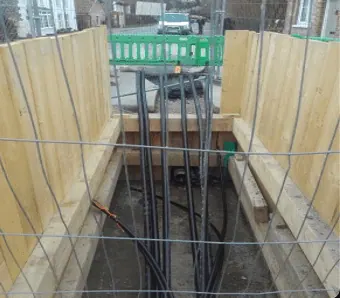
We build cable routes and install the cable: trenching, duct installation (double-stacked where the trench must stay narrow), joint bays, cable installation, and reinstatement of the highway, footpath, verge or field. Where a client needs it, we have applied for and managed the section 50 licence and highway permits ourselves.
- Indian Queens private wire, Cornwall: a 7.8 km 33kV route from Tregonning Solar Farm to National Grid's Indian Queens substation, with 4 km of trench in the highway. We managed the section 50 licence, permits, traffic management and council liaison.
- 5 x 33kV with fibre optic, North London: about 53,000 m of cable in a double-stacked duct route along main roads, worked 24 hours a day. Haringey and Enfield councils commended the work.
We also managed the section 50 licence and permits on a scheme in Grimsby. Ground Utilities holds full NERS approval for cable laying at LV, 11kV, 20kV, 33kV, 66kV and 132kV, and for civil works, with all six distribution network operators, including UK Power Networks (LRQA NERS register). Our NERS approval does not include cable jointing or design, and we do not make final live connections or connection applications: we work for ICPs, EPCs, utility contractors and principal contractors. We hold ISO 9001, 14001 and 45001, are validated by Achilles UVDB and hold Constructionline Gold. See our accreditations and HV and LV cable installation pages, or contact us.
Frequently asked questions
What does NRSWA stand for?
NRSWA is the New Roads and Street Works Act 1991. Part III sets the rules for street works in England and Wales: who may dig in a street, how works are noticed and co-ordinated, who must be qualified, and how the street is reinstated. Part IV covers road works in Scotland.
What is an NRSWA street works card?
It is the photo card issued when a person's street works qualifications are entered on the Street Works Qualifications Register (SWQR). It shows which operative or supervisor units the holder has passed, so an employer or highway inspector can check them.
How long does a street works card last?
Registration lasts five years under the England regulations. To stay qualified the holder must pass a reassessment and register a renewal certificate. A lapsed card means the holder no longer counts as the qualified operative or supervisor that section 67 requires.
Who needs an NRSWA qualification?
Where street works involve breaking up or opening the street, or tunnelling or boring under it, the works must be supervised by a person with a prescribed supervisor qualification, and at least one person with a prescribed trained operative qualification must be on site while the works are in progress.
Do I need a section 50 licence or a permit?
Often both. A section 50 street works licence gives a person who is not a statutory undertaker the right to place apparatus in the street. Each set of works then still needs a permit, or a notice where no permit scheme operates, from the highway authority.
How much is a street works fixed penalty notice?
In England, from 5 January 2026, working without a permit carries a £1,000 fixed penalty (£600 if paid early) and breaching a permit condition carries £240 (£160 if paid early). The noticing offences under the Fixed Penalty Regulations also carry £240, or £160 if paid early.