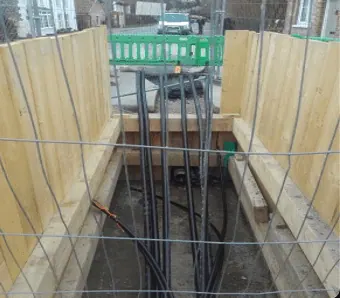
NERS is the accreditation scheme that lets companies other than the local network operator build new electricity connections in Great Britain. A company accredited under it is usually called an independent connection provider (ICP). This guide covers how NERS accreditation works, what ICPs and IDNOs do, where contestable work ends, and how to check a contractor's scopes.
Key points
- NERS, the National Electricity Registration Scheme, is run by LRQA on behalf of the UK distribution network operators (DNOs).
- Any provider doing contestable connection work, as Ofgem defines it, must hold the relevant NERS accreditation.
- Scopes are granted by activity, such as design, cable laying, jointing, overhead lines, substations and civil works, and by voltage up to 132kV.
- Partial accreditation lasts one year; full accreditation follows a witnessed site assessment and lasts three years.
- An ICP builds network for adoption but cannot operate it; an IDNO is licensed to own, operate and maintain local networks.
- Adoption and inspection of contestable work stay with the network operator, and final connection usually does too.
- The LRQA register shows each provider's scopes, voltages and DNOs, and whether each scope is full or partial.
In this guide
- What is NERS?
- Who needs NERS accreditation, and why?
- How does NERS accreditation work?
- What is an ICP?
- What is an IDNO, and how does it differ from a DNO?
- What are contestable and non-contestable works?
- How does a new connection through an ICP work?
- How do DNOs, IDNOs, ICPs and civils contractors compare?
- How do you check a contractor's NERS scopes?
- Where Ground Utilities fits
- Frequently asked questions
What is NERS?
The National Electricity Registration Scheme (NERS) assesses the technical competence of companies that want to build new electricity network that a network operator will later adopt. LRQA says it operates NERS "on behalf of the UK Distribution Network Operators", and runs a sister scheme in Northern Ireland for NIE Networks and SONI (LRQA NERS page). The scheme was formerly run under the Lloyd's Register name.
The rules sit in the NERS Requirements Document. The current GB edition is version 10, dated March 2025. It states the aim of NERS as facilitating "competition in the provision of new infrastructure connections in the electricity utility sector" (NERS Requirements Document v10). The scheme is governed by the NERS Advisory Panel (NERSAP). Assessment covers a provider's procedures before work starts and a technical audit of work in progress, and checks continue throughout the accreditation period.
Who needs NERS accreditation, and why?
LRQA's utility schemes factsheet says that any ICP "wishing to carry out this work within the contestable market, as defined by OFGEM, must be accredited under this scheme", and that all DNOs on mainland UK recognise it (LRQA utility schemes factsheet). The same factsheet says contractors who undertake "any part of the contestable connections process including project management, design, cable installation etc" need the relevant accreditation.
The reason is competition, which Ofgem sees as a way to improve customer service and efficiency. Work that must be done by the DNO is non-contestable. Work that ICPs and licensed independent distribution network operators (IDNOs) can do in competition with the DNO is contestable (Ofgem, August 2022). NERS is the check that lets a DNO adopt assets it did not build.
Accreditation does not guarantee adoption. Version 10 of the requirements document says adopting utilities keep the right to insist on defective work being corrected and to refuse to adopt infrastructure that is not fit for purpose, even when an accredited provider built it.
Does a civils subcontractor need NERS?
On contestable work, yes: either full NERS scopes of its own or 2nd tier accreditation. The 2nd tier scheme covers only excavation, cable laying (all voltages) and backfill to tile tape level, and 2nd tier providers can only work as subcontractors supervised by a NERS provider accredited for that activity or for project management of it.
How does NERS accreditation work?
A provider applies for the scopes it wants, LRQA assesses it, and the provider's name and approved scopes go on the LRQA website. Each scope is a separate accreditation, and within each category (except highway electrical equipment) scopes are awarded by voltage, for example 11kV, 20kV, 33kV, 66kV or 132kV.
What scopes can a provider hold?
| Scope category (NERS v10) | What it covers | Voltages |
|---|---|---|
| Design | LV, HV cable and overhead networks, substation layouts, self-determined point of connection | Up to 132kV |
| Project management | Managing subcontracted construction scopes (not design) | As the construction scope |
| Cable laying | Installing cable | Up to 132kV, by voltage |
| Cable jointing | Jointing and terminating cable | Up to 132kV, by voltage |
| Overhead lines | Wood pole and steel tower | Up to 132kV |
| Substation installation | Distribution, and primary or grid | Up to 20kV, and up to 132kV |
| Network connection | Jointing new mains to existing mains (including live LV), and switching | LV and HV |
| Highway electrical equipment | Street lighting, signs, bollards and similar | Not by voltage |
| Civil works | Excavation and backfilling up to tile tape level | Not by voltage |
Metering is not a NERS scope in version 10, although Electricity North West lists "making provision for the installation of metering equipment" as contestable work.
What is the difference between partial and full accreditation?
Partial accreditation follows an assessment of the provider's procedures, processes and documents. It is valid for one year and lets the provider tender for and win work. The provider must tell LRQA as soon as it wins accredited work, so a full assessment can be arranged; working without telling LRQA leads to termination.
Full accreditation depends on LRQA witnessing each element of the scope on site. If the full range is not witnessed, accreditation is restricted to the work seen. Design scopes are assessed on a design the adopting utility has approved. Full accreditation is valid for three years.
How is accreditation kept?
Through surveillance visits: at least one audit of each scope in the three years, the first within six months, and a minimum of six visits for construction or project management providers (two for design only). At the end of three years a reassessment covers every scope, and a scope not witnessed in the previous 36 months may drop back to partial.
What is an ICP?
An independent connection provider is a NERS accredited company that builds new electricity network to the network operator's specification, for adoption. Ofgem describes ICPs as companies that "complete and develop local electricity distribution networks but cannot operate or maintain them" (Ofgem, August 2022). UK Power Networks defines an ICP in the same way: a NERS accredited company, accredited to build networks to its specification (UK Power Networks, section 4.1.12).
Using an ICP for the contestable part of a connection gives the developer a competing price. The ICP usually takes on the contract with the DNO for the non-contestable work. UK Power Networks says the customer deals contractually with the ICP, and the ICP contracts with UK Power Networks for the non-contestable works. Under NERS v10, work outside an ICP's scopes must be done by another suitably accredited provider or the host utility.
What is an IDNO, and how does it differ from a DNO?
A DNO is the licensed operator of the electricity distribution network in its region. Ofgem sets price controls for the fourteen electricity DNOs in Great Britain; the current one, RIIO-ED2, runs from April 2023 to March 2028 (Ofgem, August 2022).
An IDNO is also licensed by Ofgem. Its networks are local, connected to a DNO network directly or through another IDNO. Ofgem says IDNOs "complete, develop, operate, and maintain local electricity distribution networks". UK Power Networks adds that an IDNO owns and operates its network and handles maintenance and fault repairs on it.
For a developer, the difference is who owns the new network once it is built. If an IDNO adopts it, the IDNO keeps ownership and provides the ongoing service, while the DNO still owns the upstream network.
How is an IDNO different from an ICP?
An ICP builds; an IDNO owns and operates. An ICP hands its assets to a DNO or an IDNO for adoption, and an IDNO can itself compete for contestable work.
What are contestable and non-contestable works?
Contestable works are the parts of a new connection that someone other than the network operator may build. Non-contestable works are the parts only the network operator may do, because they involve its existing network or its role as owner. The detail varies between operators. Electricity North West publishes the list below (ENWL, contestable vs non-contestable).
| Contestable (DNO or accredited contractor) | Non-contestable (network operator) |
|---|---|
| Design of the network extension and any contestable reinforcement | Processing the application and adopting the equipment |
| Procuring equipment and materials to the operator's specification | Connecting the extension to the distribution system and energising it |
| Trenching and site preparation, including routes to the connection point | Reinforcement and diversions where contestable conditions are not met |
| Building the extension, contestable reinforcement and diversions | Removing or repositioning existing equipment and cables |
| Recording the work done | Agreeing legal consents the operator needs |
| Temporary and permanent reinstatement | Operation, repair and maintenance |
| Making provision for metering equipment; legal consents | Inspection, monitoring and testing of contestable work |
The boundary has moved over time. Electricity North West says two activities that used to be non-contestable, determining the point of connection and approving contestable designs, can now be done by accredited contractors under the Competition in Connections Code of Practice. It also lists part-funded reinforcement and disconnections as contestable activities (ENWL, contestable activities). NERS v10 has matching design scopes for self-determination of point of connection at LV, HV and EHV.
Who makes the final connection?
That depends on the operator and the ICP's scopes. Electricity North West lists connection and energisation as non-contestable. UK Power Networks notes that the final joint to existing live mains can, in some cases, sit outside ICP accreditation, and its quotes include options so the ICP can choose whether it or UK Power Networks makes the final closing joint.
How does a new connection through an ICP work?
Details vary by operator, voltage and scheme, but the order of work is broadly the same.
- Quote. The developer gets prices for the contestable work from accredited ICPs, and the DNO prices the non-contestable work. UK Power Networks suggests passing its quote to the ICP so the ICP can accept the relevant option directly.
- Contracts. The developer contracts with the ICP, and the ICP contracts with the DNO for the non-contestable work. An adoption agreement between the network operator and the primary provider sets the terms for transfer of ownership on energisation.
- Point of connection and design. The DNO sets the point of connection, or a provider with the right design scope determines it where allowed. A NERS design-accredited provider does the design, which the operator approves or which is self-approved where the process allows.
- Build. Civils, cable laying, jointing and substation work are done by providers holding those scopes at the right voltage, or by 2nd tier civils contractors under supervision. As-laid drawings go to the adopting utility.
- Inspection and testing. The network operator inspects, monitors and tests the contestable work.
- Connection and energisation. The DNO, or the ICP where its scopes and the operator allow, connects the new network and it is energised.
- Adoption. The DNO or IDNO takes ownership and looks after the network from then on.
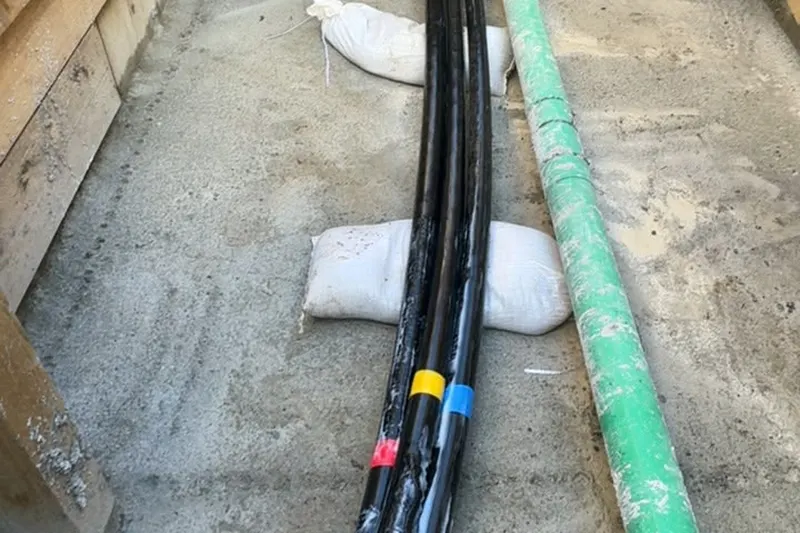
On a large HV scheme the build is often split between a principal provider, a jointing contractor and a civils and cable laying contractor, each holding the scopes for its own work.
How do DNOs, IDNOs, ICPs and civils contractors compare?
A summary based on the Ofgem, LRQA and network operator sources cited in this guide.
| Question | DNO | IDNO | ICP | NERS accredited civils contractor |
|---|---|---|---|---|
| Licensed by Ofgem | Yes | Yes | No; accredited under NERS | No; accredited under NERS (full scopes or 2nd tier) |
| Owns and operates network | Yes, regional network | Yes, local networks | No | No |
| Can do contestable work | Yes | Yes | Yes, within its scopes | Civil works and cable laying within its scopes; 2nd tier only under a NERS provider |
| Does non-contestable work | Yes, in its region | On its own network | No, except items opened to competition that its scopes cover | No |
| Adopts assets | Yes | Yes | No; hands over for adoption | No |
| Typical role on a scheme | Point of connection, approvals, inspection, final connection, ownership | Ownership and operation of the site network | Design, project management and build of the connection | Trenching, ducting, joint bays, cable laying, reinstatement |
How do you check a contractor's NERS scopes?
Use LRQA's Find a NERS registered provider search. Version 10 of the requirements document says that once a provider is accredited, its name and approved scope of works are added to the list on the accreditation body website, and that changes in accreditation status are shown there.
- Search by company name. Each entry shows regions, the DNOs the provider works with, and its scopes by category with voltages.
- Check the colour key. Full approval is shown in green and partial approval in blue. Yellow marks scopes expiring within a month, and fuchsia marks expired or suspended scopes.
- Check for "PM". A PM suffix means the provider can only project manage that scope through subcontractors and cannot carry it out itself.
- Match scope to job. Compare each activity on your scheme (design, civils, cable laying, jointing, substations) and its voltage against the scopes held, for the DNO area you are working in. A firm with 33kV cable laying does not automatically hold 33kV jointing.
- Ask for the certificate. The register shows the live position, and the certificate confirms what was awarded.
Our guide to cable jointing and joint bays explains why the split between cable laying and jointing scopes matters on site.
Where Ground Utilities fits
Ground Utilities Ltd is a civils and utility route contractor based at Highdrove Farm, Cottenham, Cambridgeshire. Founded in 2015, we work across England and Wales.
We hold full NERS approval for cable laying at LV, 11kV, 20kV, 33kV, 66kV and 132kV, and for civil works, with all six distribution network operators, including UK Power Networks. You can check this on the LRQA NERS register. In November 2026 the LRQA NERS register listed 545 accredited providers, and 45 of them, Ground Utilities among them, held full approval for cable laying at 132kV. Our NERS approval does not include cable jointing or design.
We work for ICPs, EPCs, utility contractors and principal contractors, building the route and installing the cable: trenching, duct installation (with double-stacked ducts where the trench must stay narrow), joint bays and reinstatement of each bay after jointing, cable installation, and reinstatement of the highway, footpath, verge or field. We do not joint or terminate cables, make final live connections to the network, make connection applications to network companies, do gas work or do design.
Our supervisors and operatives hold NRSWA street works cards. All operatives are CSCS or EUSR registered as a minimum, and all supervisors are SMSTS qualified. Where a client needs it, we have applied for and managed the Section 50 licence and highway permits ourselves, including on the Indian Queens private wire in Cornwall and a scheme in Grimsby.
Recent routes include two 33kV circuits and fibre over about 25 km in Cambridgeshire, with 45 joint bays each reinstated after jointing, and the Indian Queens private wire, a 7.8 km 33kV route to National Grid's Indian Queens substation, in progress.
See our accreditations, HV and LV cable installation and Section 50 licence pages, and our guides on cable ducting, NRSWA and street works and UKPN G81. To discuss a route, use our contact page.
Frequently asked questions
What does NERS stand for?
NERS stands for the National Electricity Registration Scheme. LRQA runs it on behalf of the UK distribution network operators to assess companies that want to build contestable electricity connection work for adoption.
Is NERS run by Lloyd's Register?
NERS is run by LRQA. The NERS requirements document records that references to Lloyd's Register were removed in 2021 after a change of name.
What is the difference between an ICP and an IDNO?
An ICP is a NERS accredited company that builds new network but cannot operate or maintain it. An IDNO is licensed by Ofgem to build, own, operate and maintain local networks connected to a DNO network, and can adopt networks that ICPs build.
What is the difference between partial and full NERS accreditation?
Partial accreditation follows a review of procedures and documents, lasts one year and lets a provider win work. Full accreditation follows LRQA witnessing that work on site and lasts three years, with surveillance visits throughout.
What are contestable works?
Contestable works are the parts of a new electricity connection that an accredited ICP or an IDNO may build instead of the DNO, such as design, trenching, building the network extension and reinstatement.
Can an ICP make the final connection to the network?
Sometimes. Electricity North West keeps connection and energisation as non-contestable work. UK Power Networks lets the ICP choose whether it or UK Power Networks makes the final closing joint, depending on the ICP's accreditation.