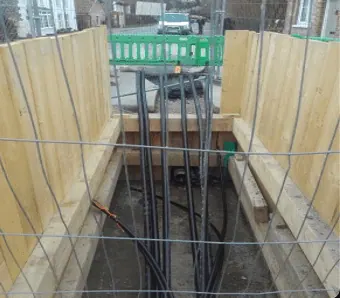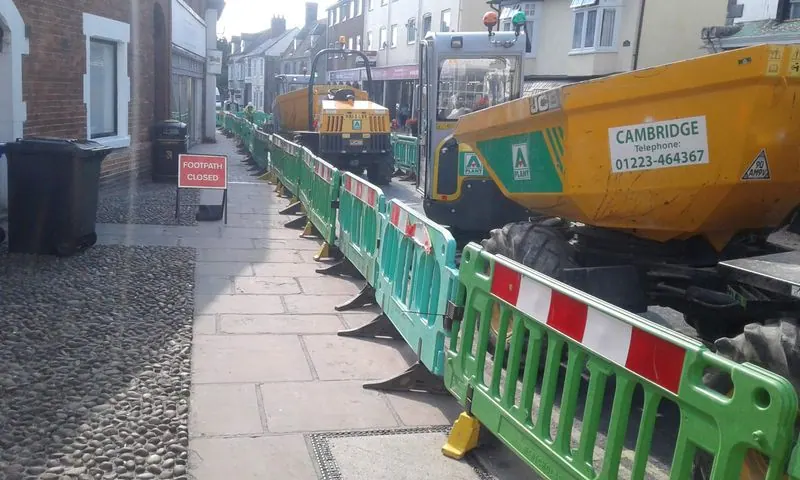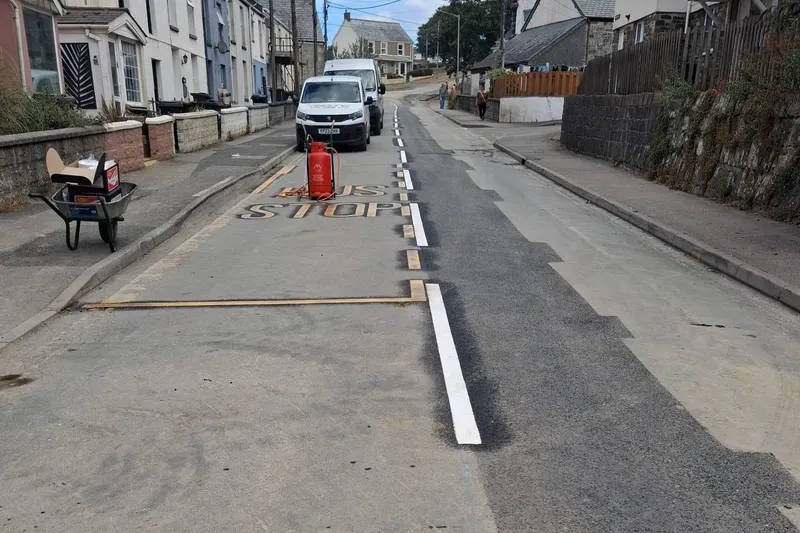
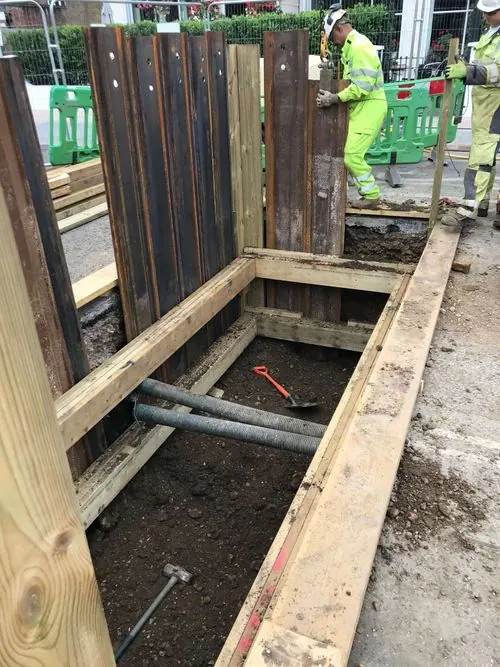
Reinstatement is the work of putting a road, footway or verge back after it has been dug up for a pipe, cable or duct. On street works in England and Wales it is a legal duty with a national specification behind it, set performance limits, a guarantee period and an inspection regime run by the highway authority.
Key points
- Sections 70 and 71 of the New Roads and Street Works Act 1991 (NRSWA) place the duty to reinstate, and to meet prescribed standards, on the undertaker who dug the hole.
- In England the standard is the Specification for the Reinstatement of Openings in Highways (SROH), fourth edition, in force as statutory guidance since 10 May 2021.
- An interim reinstatement must be made permanent within 6 months of completion.
- The guarantee period runs for two years from permanent reinstatement, or three years for deep openings with more than 1.5 m of cover over the apparatus.
- Roads are grouped into types 0 to 4 by the traffic they will carry over 20 years, measured in millions of standard axles (msa).
- An edge depression over 10 mm along more than 100 mm needs remedial work during the guarantee period.
In this guide
- What is reinstatement after street works?
- What is the legal basis for reinstatement?
- What is the difference between interim and permanent reinstatement?
- How are roads and trenches categorised?
- What performance standards must a reinstatement meet?
- Which materials can be used to reinstate a trench?
- How are footways, verges and fields reinstated?
- How are reinstatements inspected, and what do defects cost?
- A practical checklist for clients
- Where Ground Utilities fits
- Frequently asked questions
- Planning works in the highway?
What is reinstatement after street works?
When the highway is opened, the hole has to be filled and the surface rebuilt so the road performs as before. Road or trench reinstatement covers the surround to the apparatus, the backfill, the sub-base, the bound layers and the surface course, along with kerbs, ironwork, road markings and verges the works disturbed.
The rules sit alongside the wider street works regime of notices, permits and qualified operatives, covered in our guide to NRSWA and street works.
What is the legal basis for reinstatement?
Section 70 of NRSWA says it is the duty of the undertaker executing street works to reinstate the street, and that the reinstatement may be permanent or interim. The undertaker must notify the street authority within 10 working days of completing a reinstatement, stating whether it is permanent or interim (NRSWA s.70).
Section 71 requires prescribed materials, workmanship and performance standards, for an interim reinstatement until the permanent one is done and for a permanent one for a prescribed period afterwards. Failing to comply with either section is an offence (NRSWA s.71). Both sections extend to England and Wales.
"Undertaker" includes the holder of a street works licence, so a developer or private party with a Section 50 licence carries the same reinstatement duty as a utility.
Which edition of the SROH applies in England?
The practical standard is the Specification for the Reinstatement of Openings in Highways, a statutory code of practice published under section 71. The fourth edition, dated May 2020, replaces the third edition in England and came into force as statutory guidance on 10 May 2021 (DfT, SROH). A December 2024 addendum covers footways cut for electric vehicle cable channels.
What applies in Wales and Scotland?
Wales has its own code: the Welsh Government lists the Specification for the Reinstatement of Openings in Highways, 2nd edition 2006 (gov.wales). Scotland uses the Specification for the Reinstatement of Openings in Roads (SROR); Transport Scotland says its 4th edition (2019) has been superseded by version five, published by the Scottish Road Works Commissioner (Transport Scotland). The figures below are from the English SROH.
What is the difference between interim and permanent reinstatement?
A permanent reinstatement is the finished job, built to the full SROH specification. An interim reinstatement is a safe, temporary finish that will be cut out and replaced.
NRSWA section 70 requires the permanent reinstatement to follow as soon as reasonably practicable, and in any event within 6 months from completion of the interim reinstatement. The SROH repeats that an interim reinstatement must normally be made permanent within six months (S1.1), and the performance requirements apply to interim reinstatements too, with highway safety as the main consideration (S2.1). For very deep excavations in bad ground, the SROH says an agreed extension of the interim period should be considered so the ground can stabilise (S2.5).
What are immediate works?
Where an excavation must be trafficked straight away, the SROH allows it to be filled with excavated or other materials compacted in 100 mm layers, with at least 40 mm of bituminous surfacing. Anything that does not comply must be dug out and reinstated to interim or permanent standard within 10 working days, or as agreed with the authority (S1.7).
What are the reinstatement methods?
For flexible and composite roads, S6.1 sets how much is made permanent at the first visit.
| Method | Permanent at first visit | Second visit |
|---|---|---|
| A | Everything | None |
| B | Backfill, sub-base, base and binder course | Interim surfacing removed to the top of the binder course; permanent surface course laid |
| C | Backfill, sub-base and base | Interim surfacing removed to the top of the base; permanent binder and surface course laid |
| D | Backfill and sub-base | Interim materials removed to the top of the sub-base; permanent base, binder and surface course laid |
How are roads and trenches categorised?
SROH Table S1.1 sets five road types by expected traffic over the next 20 years, in millions of standard axles. Only commercial vehicles count; cars and light vans are excluded. Each authority categorises its own network, and the undertaker must use the authority's current information (S1.3).
| Road type | Traffic capacity |
|---|---|
| Type 0 | Over 30 to 125 msa |
| Type 1 | Over 10 to 30 msa |
| Type 2 | Over 2.5 to 10 msa |
| Type 3 | Over 0.5 to 2.5 msa |
| Type 4 | Up to 0.5 msa |
Roads carrying more than 125 msa are outside the code, and the reinstatement design must be agreed with the authority. Footways, footpaths and cycle tracks are graded separately as high duty, high amenity or other (S1.4).
How are excavations categorised?
- Narrow trench: over 60 mm and up to 300 mm wide, and over 1 m long.
- Small opening: up to 2 m2 of reinstatement in road types 0, 1 and 2, or up to 4 m2 in types 3 and 4 and in footways.
- Deep opening: any of these where the cover over the apparatus is more than 1.5 m, ignoring short lengths under 5 m.
A deep opening carries the longer guarantee, so the cover in your duct design affects your liability.
What performance standards must a reinstatement meet?
Section S2 of the SROH sets intervention limits. If a reinstatement goes beyond any of them during the guarantee period, the undertaker must restore it to its as-laid condition. When first laid, the surface must be flush with its surroundings, with a construction tolerance of plus or minus 6 mm at the edges (S2.2).
| Requirement | Intervention point | SROH clause |
|---|---|---|
| Edge depression | More than 10 mm over a continuous length of more than 100 mm | S2.2 |
| Surface depression or crowning | From 10 mm for reinstatements up to 400 mm wide, rising to 25 mm for those over 900 mm wide | S2.2 |
| Standing water | Wider than 500 mm or over 1 m2, two hours after rain stops | S2.2 |
| Ironwork and edgings | Mean level more than 10 mm from adjacent surfaces | S2.3 |
| Surface regularity | Rolling straightedge over 30 m sections; lower limits of 11 irregularities of 4 mm, 2 of 7 mm and 1 of 10 mm per section | S2.4 |
| Cumulative settlement | At least 30 mm up to 1,000 mm wide and 35 mm above that, higher in bad ground; triggers a joint engineering investigation | S2.5 |
Where the existing road is already deteriorated, S2.8 asks the undertaker to record its condition, ideally before excavating.
How long is the guarantee period?
The guarantee period is triggered by completion of the permanent reinstatement itself and runs for two years in general or three years for deep openings (S1.2). Remedial work for exceeding an S2 limit does not normally start a new guarantee period. A new one starts where the cumulative settlement limit is exceeded and the reinstatement is re-excavated for an engineering investigation (S2.1, S2.5). Where a reinstatement is found not to conform to a requirement outside S2, the guarantee period does not start until the remedial works are done (S1.1).
Which materials can be used to reinstate a trench?
The SROH classifies backfill from Class A, graded granular materials, to Class E, unacceptable materials that cannot be used anywhere in the permanent structure. Modified Type 1F, set out in Appendix A10.1, is the preferred unbound material. Recycled and primary materials are both allowed if they meet the performance and compositional requirements (S1.6, S5.1).
Foamed concrete
Foamed concrete for reinstatements (FCR) is a permitted backfill, alone or mixed with other permitted backfill, and counts as Class A for sub-base design. Under the carriageway it must have a cube compressive strength of at least 4 N/mm2 and no more than 10 N/mm2 at 7 days. FCR must come from an approved plant, its wet density must be checked before placing, and in excavations containing water its density must be at least 1050 kg/m3 (A2.5, S5.1).
Alternative reinstatement materials
Appendix A9 covers alternative reinstatement materials (ARMs) and alternative technologies, which may be used only with the authority's agreement through the A9 approval process. ARMs fall into three groups:
- Structural materials for reinstatements (SMRs): flowable or non-flowable bound materials, with minimum layer thicknesses and strengths by road type in Table A9.1.
- Treated materials for fills (TMFs): compacted treated mixes graded by CBR.
- Other ARMs that pass A9 trials.
Agreement must not be unreasonably withheld, and the performance requirements still apply in full during the guarantee period (S1.6). ARMs used within 450 mm of the road surface must be non-frost susceptible (A9.2).
How are footways, verges and fields reinstated?
Footways, footpaths and cycle tracks
Section S8 uses the same methods as roads. Cycle tracks that form part of the carriageway are reinstated to carriageway standards. Where a reinstatement edge comes within 150 mm of a kerb, edge, ironwork or another reinstatement, the trim-line must be extended to it (S8.6). A recognised commercial vehicle crossing over a footway is treated as a Type 4 road (S8.7).
The December 2024 addendum adds standards for footways cut by cable channels for electric vehicle charging cables (DfT EV addendum). See our page on EV charging groundworks.
Verges and unmade ground
Section S9 requires topsoil within 200 mm of the verge surface to be stored and re-used. Cultivated and grassed areas must show reasonable growth within 12 months, and mown grass must be free of stones over 20 mm. Verges, ditches and drainage courses go back to their original profile.
Private land and fields
The SROH is written for the highway. Its requirements apply in full to streets maintainable at public expense; on other streets only the surround and backfill sections apply (S1.1). Cable routes across farmland fall outside it, so reinstatement there is governed by the easement, wayleave or landowner agreement.
How are reinstatements inspected, and what do defects cost?
In England, the Code of Practice for Street Works Inspections, 3rd edition, has been statutory guidance since 1 April 2023 (DfT inspections code). It sets out three kinds of check.
| Sample category | When | What is checked |
|---|---|---|
| A | While works are in progress | Live site compliance with the safety code and SROH |
| B | Within six months after the interim or permanent reinstatement | Compliance with the SROH |
| C | Within the three months before the guarantee period ends | Compliance with the SROH |
Sample sizes are set by performance. Under the Street Works (Inspections Fees) (England) Regulations 2022, undertakers with a failure rate below 15% started at a 30% sample rate and those at 15% or higher at 50%. The fee is £50 per chargeable sample inspection.
A failed reinstatement is classed high risk (dangerous) or low risk; if a high-risk defect is not made safe within 2 hours, the authority may act and recover its costs. The authority may charge a single £120 for the stage one to three inspections of a non-compliant reinstatement, and £120 for each further inspection cycle, up to two. Authorities can also core reinstatements and test materials under section 72; the undertaker pays where the core confirms non-compliance.
A practical checklist for clients
- Confirm which code applies: SROH fourth edition in England, the Welsh code in Wales, SROR in Scotland, or a private agreement off the highway.
- Get the road type and footway category for every street on the route from the highway authority.
- Check whether any length has more than 1.5 m of cover over the apparatus, which brings the three-year guarantee.
- Agree interim or permanent reinstatement per section, and programme the permanent work inside 6 months.
- Record the existing surface before breaking out.
- Fix backfill materials in advance, and get written agreement for any ARM or SMR.
- Keep compaction, material and FCR test records.
- Notify completion within 10 working days and record who holds the guarantee.
- Agree field reinstatement with the landowner in writing.
Where Ground Utilities fits
Ground Utilities Ltd is a civils, groundworks and utility-route contractor based at Highdrove Farm, Cottenham, Cambridgeshire, founded in 2015 and working across England and Wales. We build routes for ICPs, EPCs, utility contractors and principal contractors: trenching, ducting, joint bays, cable installation and reinstatement of the highway, footpath, verge or field. We reinstate each joint bay after jointing. We do not joint cables or do design.
- HV cable installations, Cambridgeshire: two 33kV circuits and fibre over about 25 km, fully ducted, with 45 joint bays, each reinstated after jointing.
- 5 x 33kV with fibre optic, North London: about 53,000 m of cable in a double-stacked duct route along main roads. Haringey and Enfield councils commended the work.
- Indian Queens private wire, Cornwall: 7.8 km of 33kV route with 4 km of trench in the highway, where we applied for and managed the Section 50 licence, traffic management and council liaison.
- Irrigation main installation: a high-pressure main with thrust blocks, two road crossings, reinstatement and full system testing.
Our supervisors and operatives hold NRSWA street works cards. All operatives are CSCS or EUSR registered as a minimum, and all supervisors are SMSTS qualified. We hold full NERS approval for cable laying at LV, 11kV, 20kV, 33kV, 66kV and 132kV, and for civil works, with all six distribution network operators, including UK Power Networks (LRQA NERS register). We hold ISO 9001, ISO 14001 and ISO 45001, are registered with Achilles UVDB (Validated by Achilles) and hold Constructionline Gold. We have also managed the Section 50 licence and highway permits on a scheme in Grimsby.
See HV and LV cable installation, civil construction, accreditations, and guides on joint bays and NERS and ICPs.
Frequently asked questions
What does reinstatement mean in street works?
Putting the road, footway or verge back after an excavation. In England and Wales the undertaker who dug the hole must do it to a prescribed standard.
What is the difference between interim and permanent reinstatement?
Interim is a safe temporary finish that is replaced later; permanent is the final finish. NRSWA section 70 requires the permanent reinstatement within 6 months of the interim one.
How long is the guarantee on a road reinstatement?
In England, two years from completion of the permanent reinstatement, or three years for deep openings with more than 1.5 m of cover over the apparatus.
Which edition of the SROH applies in England?
The fourth edition (May 2020), in force as statutory guidance since 10 May 2021. Wales and Scotland have their own versions.
Can foamed concrete be used to backfill a trench in the road?
Yes. Under the carriageway it must reach 4 to 10 N/mm2 cube strength at 7 days, and at least 1050 kg/m3 density in excavations containing water.
What are category A, B and C inspections?
The three sample inspection stages in England: A while works are in progress, B within six months after reinstatement, and C within the three months before the guarantee period ends.
Does the SROH apply to private land and fields?
No. It covers streets, in full only where they are maintainable at public expense. Fields are reinstated to the landowner agreement.
Planning works in the highway?
If your route crosses public roads, footways or verges, involve the civils contractor before the reinstatement method and programme are fixed. Call +44 1223 423918, email info@ground-utilities.co.uk, or use our contact page.