A build over agreement is the water company's consent to build over, or within 3 metres of, one of its public sewers. If you cannot meet its conditions, the alternative is a sewer diversion under section 185 of the Water Industry Act 1991, which moves the sewer at your cost.
Public sewers run under gardens, fields and development sites across England and Wales. If you plan to build over one, or close to one, the water company that owns it gets a say. You will need its consent, a formal build over agreement, or a diversion that moves the sewer out of the way.
This guide covers all three. It sits beside our guide to section 38, 104 and 278 agreements, which explains how new sewers are adopted.
Key points
- Water UK's homeowner guide says to seek consent before building over, or within three metres of, a water company's sewer.
- Building Regulations requirement H4 applies to work over, or near enough to interfere with, a drain or sewer shown on the sewer map.
- Approved Document H says not to build over or within 3 m of a sewer more than 3 m deep or larger than 225 mm diameter without the owner's permission.
- Thames Water's 2023 technical specification does not allow new homes to be built over a public sewer, and limits a build over to 6 metres of sewer.
- Under section 185 of the Water Industry Act 1991, a person with an interest in the land can require the water company to move a sewer. The applicant pays, and the section does not apply to sewers in a street.
- Thames Water aims to reply to a diversion application within 14 days and give a technical decision within 28 days. It takes the new sewer back after a one-year maintenance period.
In this guide
- What is a build over agreement?
- When do you need consent to build near a sewer?
- What does Building Regulations H4 require?
- How do water companies decide?
- What can you never build over?
- How long does it take, and what does it cost?
- What if you have already built without consent?
- When is a sewer diversion the better answer?
- What is a section 185 sewer diversion?
- How does a section 185 diversion work?
- Who designs and who builds a sewer diversion?
- What does a diversion involve on site?
- Build over, section 185 or section 104?
- Where Ground Utilities fits
- Frequently asked questions
- Sources
What is a build over agreement?
A build over agreement is the water company's formal consent to build over or near one of its sewers. It sets the conditions for protecting the pipe and the terms for access if the sewer later needs repair.
Northumbrian Water describes the purpose clearly. The agreement sets out:
- each party's liability for future damage to the building or the sewer;
- the rights of access to repair the sewer if it collapses.
Not every project needs the full agreement. Water companies have agreed that projects meeting set conditions will be approved. Water UK's homeowner guide says a formal build over agreement is normally needed where a project does not meet them.
When do you need consent to build near a sewer?
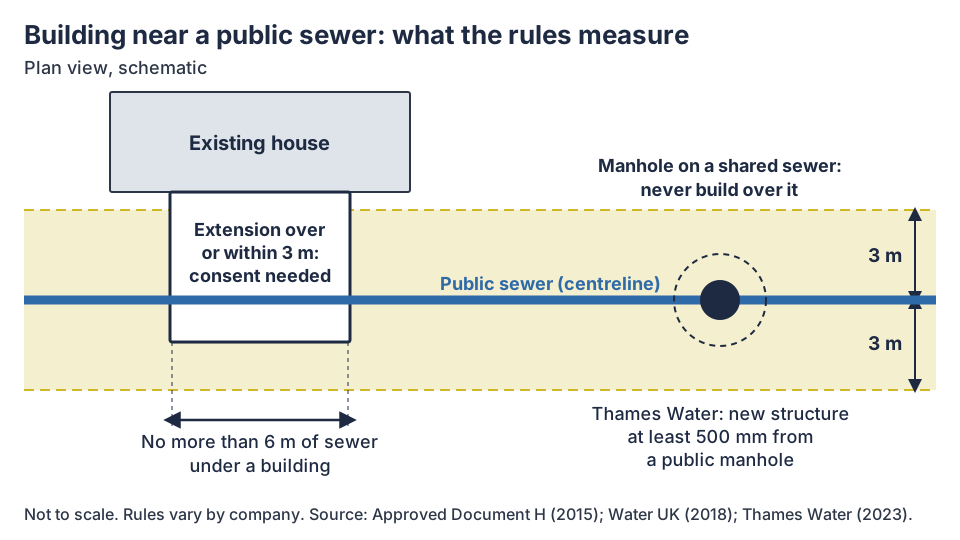
You need consent when you build over, or within three metres of, a public sewer or public lateral drain. Water UK's guide, written with the ten sewerage companies in England and Wales, uses this three-metre test.
It covers two kinds of pipe:
- Public sewers are pipes that carry wastewater from two or more properties.
- Public lateral drains are pipes that serve a single property, outside its boundary, such as under a neighbour's garden.
You still need the water company's consent:
- if you have planning permission or permitted development rights;
- if you have Building Regulations approval;
- if the work is a conservatory, car port or porch that is exempt from Building Regulations approval.
A sewer may be there even if you cannot see a manhole. Water UK says a property connected to the public sewer is likely to have a sewer or lateral drain within its boundary.
Your architect, your property's legal documents or the water company may help you find it. Our guide to avoiding utility strikes explains how to locate buried pipes before digging.
What does Building Regulations H4 require?
Requirement H4 says that building, extending or underpinning over a sewer must not harm the building or the continued maintenance of the drain, sewer or disposal main. It sits in Schedule 1 to the Building Regulations 2010. H4 applies only to:
- work over a drain, sewer or disposal main shown on the sewer map;
- work that may interfere with one.
The sewer map means the records the water company keeps under section 199 of the Water Industry Act 1991.
What does Approved Document H say?
Approved Document H, 2015 edition, gives the guidance for England on H4. Its section applies to building within 3 m of the centreline of a drain or sewer on the sewer records.
| Approved Document H guidance | What it says |
|---|---|
| Size and depth (para 1.6) | Do not build over or within 3 m of a drain or sewer more than 3 m deep or larger than 225 mm diameter, without the owner's permission |
| Length under a building (para 1.5) | No more than 6 m of drain or sewer under a building without the owner's permission |
| Access (para 1.3) | Do not build over a manhole or inspection chamber on a sewer serving more than one property |
| Diversion route (para 1.4) | A route should exist to rebuild the sewer without affecting the building, at least 3 m from it |
| Higher risk pipes (para 1.2) | Rising mains, brick or masonry sewers and pipes in poor condition need special measures |
| Erodible soils (para 1.1) | In fine sands, silty sands, saturated silts and peat, special foundation measures are needed |
| Piling (para 1.8) | Pile no closer to the sewer than twice the pile diameter; dig trial holes if within 1 m |
| Deep sewers (para 1.12) | Over 2 m deep under foundations, design the foundation as a lintel spanning at least 1.5 m each side |
Does building control talk to the water company?
Yes. Regulation 15 of the Building Regulations 2010 requires the authority to consult the sewerage undertaker on full plans applications where H4 applies.
It must do so before approval and again before a completion certificate. It cannot approve until 15 days after consulting, unless the undertaker replies sooner.
How do water companies decide?
Most water companies offer a simple self-certified or letter route for small, shallow sewers, and a formal agreement for the rest. Each company publishes its own criteria and forms.
| Water company | Simple route | Formal agreement needed when |
|---|---|---|
| Severn Trent | Self-certification for projects that meet its requirements | The sewer is larger than 150 mm, a manhole must be moved, altered or built over, or the project fails self-certification |
| Northumbrian Water | A consent letter where the build meets its consent criteria | The pipe is deeper than 2 m or larger than 150 mm internal diameter, for example |
| Thames Water | Applications are checked against its 2023 technical specification | Agreements are approved only if the application meets that specification |
Thames Water's specification includes these conditions:
- no new dwellings over the public sewer;
- no more than 6 metres of sewer built over, unless a suitable external manhole is available;
- foundations at least 1.2 metres from a parallel sewer;
- the new structure at least 500 mm from a public manhole;
- only continuous flight augered piles, at least 1.5 metres from the sewer;
- no manholes inside the new structure, including double-sealed bolt-down covers.
Water UK says companies can refuse a project that meets the conditions only for site-specific reasons. They must tell you within 14 days of receiving the application.
Criteria differ between companies, so check your own water company's build over page before the design is fixed.
What can you never build over?
You cannot build over a manhole on a shared sewer, and water companies generally forbid building over water mains. Some limits are firm:
- Manholes and inspection chambers on a sewer serving more than one property. Approved Document H says not to build over them unless an alternative access point is agreed with the owner.
- New homes over a public sewer, in Thames Water's area.
- Water mains: Water UK says building over or near water mains is generally strictly forbidden.
Where your layout hits one of these, the answer is usually to move the sewer or the building.
How long does it take, and what does it cost?
Severn Trent reviews a build over application within up to 10 working days of payment, but times and fees vary by company. Some published examples:
| Company | Stage | Published timescale |
|---|---|---|
| Severn Trent | Review of a build over application, after payment | Up to 10 working days |
| Northumbrian Water | CCTV survey, after the form is received | Normally within 15 working days |
| Thames Water | Sewer connection application | At least 21 days before work |
Expect to pay an application fee, plus any CCTV survey and legal costs. Severn Trent requires a CCTV survey with a formal application, and another after the works to confirm the sewer is still sound. Thames Water says all surveys are at the applicant's expense.
What if you have already built without consent?
Severn Trent says build over approval cannot be granted retrospectively, so contact the water company before you sell or extend again. The risk lasts beyond the build:
- Northumbrian Water warns that if building has started before its visit, surveys or repairs can delay or disrupt the work.
- Approved Document H notes that repairs to a public sewer are carried out by the water company.
- Northumbrian Water says a formal agreement protects your interests on any future sale. A buyer's solicitor may ask for evidence of consent.
When is a sewer diversion the better answer?
A diversion is usually the better answer when the sewer blocks the use of a development plot, or when the water company will not allow the building over it. Consider moving the sewer when:
- you are building new homes, and the water company does not allow them over the sewer;
- the sewer is large, deep or in poor condition;
- the sewer runs through the middle of a development plot, wasting land;
- the layout would block access to a manhole;
- a build over agreement's terms would be too restrictive for the building's use.
What is a section 185 sewer diversion?
A section 185 sewer diversion is a move of a public sewer that a landowner can require from the water company, at the landowner's cost. Section 185 of the Water Industry Act 1991 lets a person with an interest in the land, or adjacent land, serve the notice.
The notice requires the company to alter or remove a pipe or apparatus, because that is needed for a proposed improvement of the land. The water company must comply unless the requirement is unreasonable. Three limits apply:
- Section 185 does not cover pipes in, under or over a street (section 185(3)).
- The person serving notice pays the company's charges under its charging rules (section 185(5)).
- The company can ask for security before it starts (section 185(4)).
Severn Trent's guidance gives examples of what it may treat as unreasonable. These include no technically acceptable diversion route, or a diversion that would block other people's improvements. It may also refuse where it is willing to consent to a small domestic extension being built over the sewer.
How does a section 185 diversion work?
A section 185 diversion runs from application, through a technical decision and legal agreements, to construction, inspection and vesting. Thames Water's published process for a sewer that is not strategic is typical:
- Submit the diversion application form.
- The company checks whether the sewer is strategic.
- It responds within 14 days, asking for more information if needed.
- It gives a technical decision within 28 days.
- Sign the legal agreements before work starts.
- Tell the company when the diversion is due.
- A field engineer inspects the works and sets out any corrective work.
- On completion, provide as-built drawings and CCTV surveys.
- After any remedial work, the company issues a provisional vesting certificate.
- After a one-year maintenance period and a final inspection, it issues a final vesting certificate and takes responsibility for the new sewer.
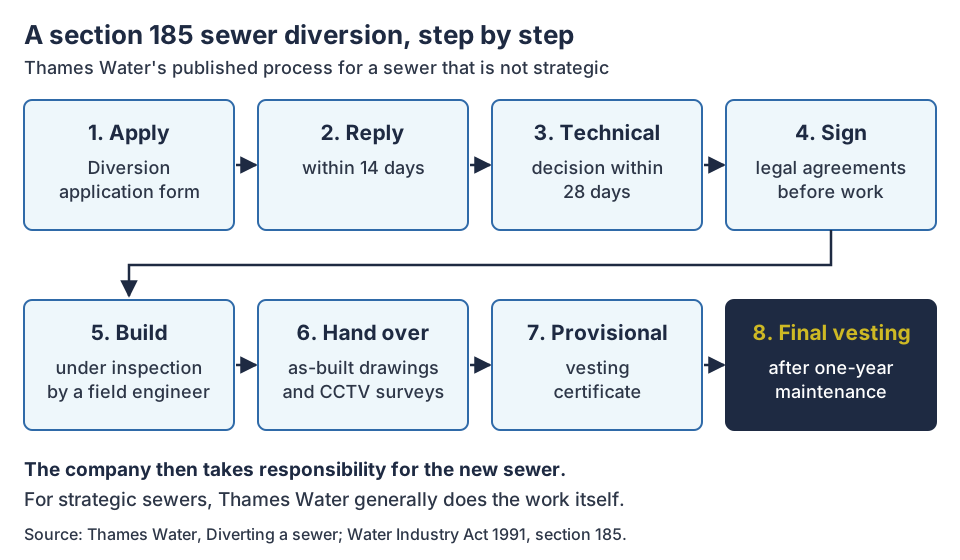
For strategic sewers, Thames Water generally does the work itself. It aims to give a budget estimate and indicative programme within 5 weeks, where there are no objections.
Severn Trent asks for a security deposit with the application. It may also need hydraulic modelling to set the size of the diverted pipe. Apply early: Severn Trent warns that a diversion it delivers itself could take considerable time.
Worked example: a plot crossed by a sewer
Picture a small housing site in Thames Water's area with a non-strategic public sewer running diagonally across it. New homes cannot go over the sewer, so the layout loses a strip of land.
- The developer's drainage engineer designs a new route around the site edge.
- The developer applies, and gets a reply within 14 days.
- A technical decision follows within 28 days, then the agreements are signed.
- A competent contractor builds the new length under inspection.
- After as-built CCTV, provisional vesting and a one-year maintenance period, Thames Water takes the new sewer back.
Who designs and who builds a sewer diversion?
A sewer diversion is designed and built either by the water company, or by the developer's own designer and contractor under the company's control. Severn Trent sets out both routes:
| Severn Trent designs and builds when | A self-construct agreement may be offered when |
|---|---|
| There is a high impact on or risk to the company or the environment | Impact and risk are minimal |
| The sewers are off site, on land the developer does not control | The sewers are entirely on land the applicant owns and occupies |
| The sewers are in the highway | Foul or combined sewers are no larger than 300 mm, or surface water sewers no larger than 600 mm |
| The work is beyond the applicant's designer or contractor | The designer and contractor pass Severn Trent's approval, including financial vetting |
Under a self-construct agreement, Severn Trent employs the applicant as its contractor to build the diverted sewer, under its supervision. The choice of route is at its discretion.
The design comes from the developer's drainage engineer or the water company. Ground Utilities does not design sewers or diversions.
What does a diversion involve on site?
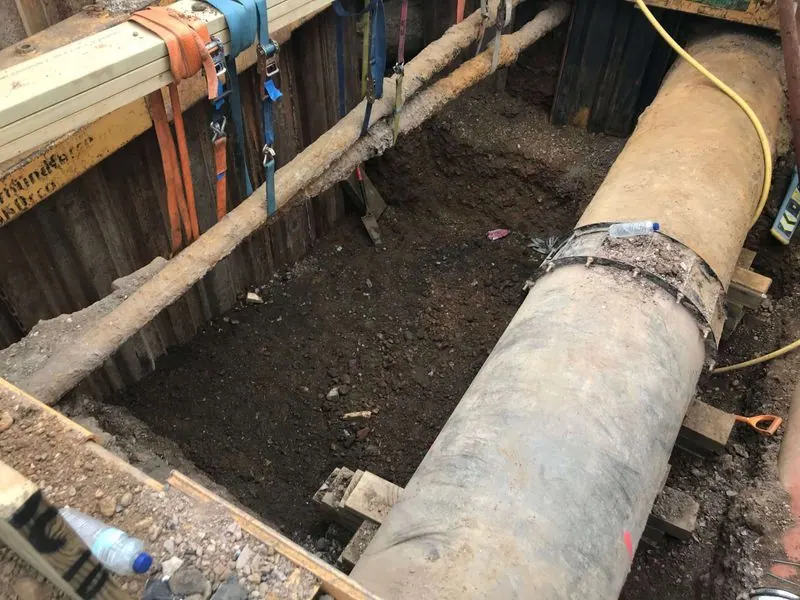
On site, a sewer diversion means exposing the existing sewer, digging and supporting a new route, laying and testing the new pipe, then switching flows across. A typical diversion has these stages:
- Locate and expose the existing sewer, and any other services nearby.
- Dig the new route, often deep, with trench support and temporary works.
- Lay the new pipe, build new manholes, and backfill to the specification.
- Test and CCTV survey the new sewer.
- Connect the new sewer to the network, and take the old length out of use.
- Hand over as-built drawings and survey records.
The live sewer must keep flowing while the new length is connected. The water company's agreement sets who makes that connection and how flows are kept moving.
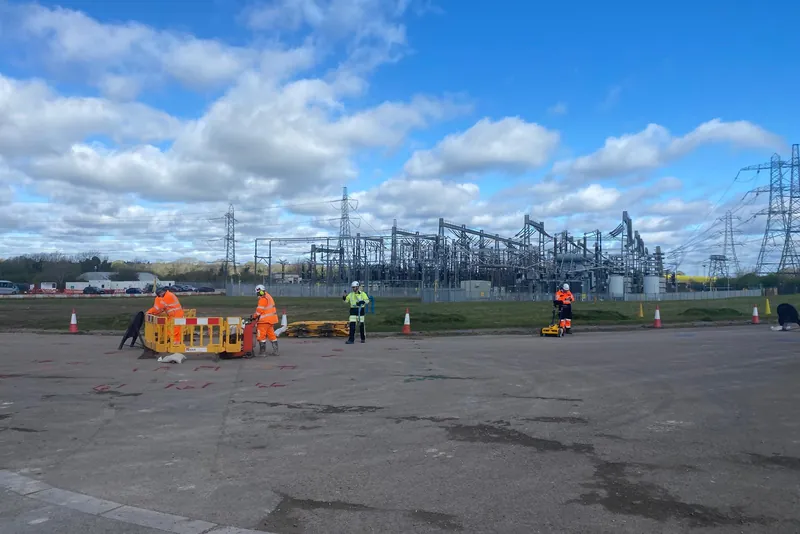
Excavation near other utilities is often the hardest part. Diversions in busy ground need careful service location, trial holes and support for the pipes and cables crossing the trench.
Build over, section 185 or section 104?
A build over agreement leaves the sewer where it is, section 185 moves an existing public sewer, and section 104 adopts a new one. The table compares them.
| Build over consent or agreement | Section 185 diversion | Section 104 agreement | |
|---|---|---|---|
| Purpose | Build over or near an existing sewer | Move an existing public sewer | Have new sewers adopted |
| Law | Building Regulations H4 and the company's own process | Water Industry Act 1991, section 185 | Water Industry Act 1991, section 104 |
| Who asks | Owner or builder | A person with an interest in the land | The developer |
| Sewer afterwards | Stays where it is | New route becomes public after vesting | New sewer becomes public after vesting |
| Typical use | Extensions, garages, small buildings | Development plots crossed by a sewer | New housing and commercial sites |
Where Ground Utilities fits
Ground Utilities digs the deep, supported excavations that sewer diversions need. We are a civils, groundworks and multi-utility contractor based in Cottenham, Cambridgeshire, working across England and Wales. Our waste water work covers mains sewers, sewer diversion routes, and the deep excavations needed to expose, support, lower and divert existing services.
- On a sewer diversion route for a new development in South West London, we dug 15 excavations, the deepest more than 3 metres. We exposed and supported the existing sewer and other utilities, with temporary works and full soil sampling of the spoil.
- On a site in Essex, our deep excavations let HV and LV cables, drainage and water be lowered and diverted. The asset owners carried out the diversions, working with Ground Utilities.
We do not design sewers or diversions, make connection applications or make final connections to the water network. See also our civil construction work, or contact us with your drainage drawings and the water company involved.
Frequently asked questions
What is a build over agreement?
A formal consent from the water company to build over or near its sewer. It sets conditions to protect the pipe and the terms for access if the sewer needs repair. Simpler projects may get a consent letter instead.
Do I need a build over agreement for an extension?
You need the water company's consent if the extension is over, or within three metres of, a public sewer or lateral drain. Whether that is a simple consent or a full agreement depends on the sewer's size, depth and condition, and on the company's criteria.
Can you build over a manhole?
Not on a sewer serving more than one property, unless the water company agrees an alternative access point. Thames Water does not allow manholes inside a new structure, including bolt-down covers.
How long does a build over agreement take?
It depends on the company. Severn Trent reviews an application within up to 10 working days of payment. Northumbrian Water normally carries out any CCTV survey within 15 working days of receiving the form.
What happens if I built over a sewer without permission?
Severn Trent says approval cannot be granted retrospectively. Contact the water company. Lack of consent can cause problems on a sale, and repairs to a public sewer are carried out by the water company.
Who pays for a sewer diversion?
The person who asks for it. Under section 185 of the Water Industry Act 1991, they pay the water company's charges, and the company can require security before it starts.
Can a developer divert a public sewer itself?
Sometimes. Thames Water may let you use competent contractors on non-strategic sewers once agreements are signed. Severn Trent may offer a self-construct agreement for small sewers on the applicant's own land.
Does section 185 apply to sewers in the road?
No. Section 185(3) says the water company does not have to alter or remove pipes in, under or over a street.
Sources
- Water Industry Act 1991, section 185 (legislation.gov.uk, 1991)
- The Building Regulations 2010, Schedule 1 (requirement H4) (legislation.gov.uk, 2010)
- The Building Regulations 2010, regulation 15: consultation with sewerage undertaker (legislation.gov.uk, 2010)
- Drainage and waste disposal: Approved Document H (Department for Communities and Local Government, 2015)
- Building over or close to a public sewer or lateral drain: a guide for homeowners (Water UK, 2018)
- Building over or near sewer pipes (Severn Trent)
- Sewer diversion guidance notes (GN6) (Severn Trent)
- Technical specifications: building over, or near sewers or drains (Thames Water, 2023)
- Diverting a sewer (Thames Water)
- Building over or close to a sewer: a guide 2026 to 27 (Northumbrian Water, 2026)