Street works traffic management in England is set by two codes. The Red Book (Safety at Street Works and Road Works) gives the on-site layouts for signing, lighting and guarding. Chapter 8 of the Traffic Signs Manual is the fuller design manual for temporary traffic management on all public roads.
The highway authority then adds its own controls: permission for traffic signals, temporary traffic orders for closures and, on the busiest roads, lane rental charges.
This guide is for clients, developers and site teams planning cable and pipe routes in the highway. Our guide to NRSWA and street works already covers the Act, permits, street works cards, fixed penalties and overrun charges, so this page does not repeat them. It goes into the layout figures, the traffic control choices and the costs.
Key points
- The Red Book's setting-out table gives a sideways safety zone of 0.5 m up to 40 mph and 1.2 m at 50 mph or more.
- The Red Book asks for a 1.5 m footway past the works where possible, and never less than 1.0 m.
- Give and take is only allowed at 30 mph or less, over 50 m or less, with no more than 20 vehicles in 3 minutes, says the Red Book.
- Portable traffic signals need the highway authority's written permission, except for emergency works, under the Red Book.
- A new single-volume Chapter 8 was added to GOV.UK on 4 November 2026, replacing the three-part version.
- DfT's lane rental guidance lets an approved authority charge up to £2,500 a day on the busiest streets at the busiest times.
In this guide
- Red Book or Chapter 8: which applies?
- How is a street works site laid out?
- How much space must pedestrians have?
- How much road must stay open to traffic?
- Which traffic control method can you use?
- When do you need permission or a traffic order?
- Who can design and set out traffic management?
- What is lane rental?
- How can you keep lane rental and overrun costs down?
- What happens if signing and guarding falls short?
- A pre-start checklist
- Where Ground Utilities fits
- Frequently asked questions
- Sources
Red Book or Chapter 8: which applies?
Both apply to street works, in different ways. The Red Book has legal backing for signing, lighting and guarding street works, and Chapter 8 is the full design manual that sits around it.
| Red Book | Chapter 8 (2026) | |
|---|---|---|
| Full title | Safety at Street Works and Road Works: A Code of Practice (2013) | Traffic Signs Manual Chapter 8: Traffic Safety Measures and Signs for Road Works and Temporary Situations |
| Legal backing | Sections 65 and 124 of NRSWA, and section 174 of the Highways Act 1980 | A code of practice for anyone designing or carrying out temporary traffic management |
| Roads covered | Single carriageways and lower-speed dual carriageways; not motorways | All roads to which the public have access, including motorways |
| Main audience | Operatives and supervisors on site | Designers, authorities and contractors planning traffic management |
| Format | A pocket guide with standard layouts | A full design and operations manual |
Chapter 8 says that where the Red Book has statutory effect and sets a specific requirement, the Red Book takes precedence over any flexibility in Chapter 8. It also warns that the Red Book is not a standalone document, because many roads and works are not covered by its standard layouts.
So a street works team works to the Red Book on site. Whoever designs a non-standard layout needs Chapter 8 as well.
What changed in 2026?
Two documents changed in late 2026:
- Chapter 8: a new single-volume edition was added to GOV.UK on 4 November 2026 and supersedes the three-part version. National Highways maintains it for the Department for Transport.
- Red Book: the Department for Transport is consulting on a new code, closing on 14 December 2026. Until a revised code is in force, the 2013 edition still applies.
Our NRSWA guide gives the background to both codes.
How is a street works site laid out?
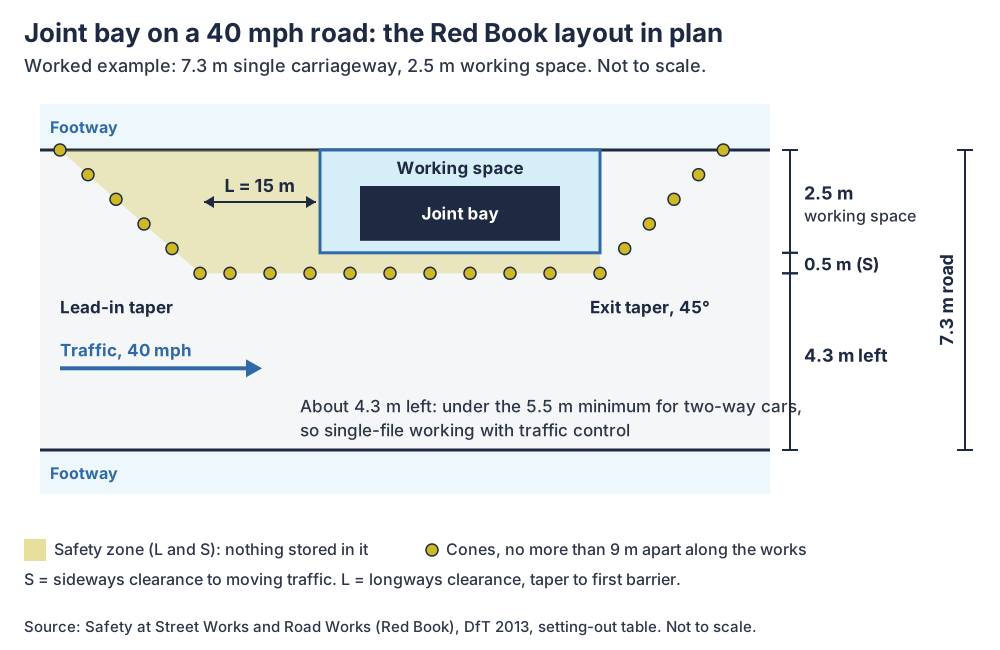
Every Red Book layout is built from the same parts, set out in this order along the road:
- Lead-in taper: a line of cones guiding traffic past the works.
- Longways clearance (L): the gap between the end of the taper and the first barrier. It is part of the safety zone.
- Sideways clearance (S): the gap between the working space and moving traffic.
- Safety zone: the buffer between workers and traffic. Nothing is stored in it, and people enter only to maintain cones and signs.
- Working space: room around the works for tools, spoil, plant and materials. Bucket swing and counterweights must stay clear of traffic.
- Works area: the excavation or chamber opening.
- Exit taper: normally at 45 degrees to the kerb.
What are the minimum clearances?
The setting-out table inside the back cover of the Red Book sets the dimensions by speed limit. These are its main figures for a single carriageway:
| Item | 30 mph or less | 40 mph | 50 mph | 60 mph |
|---|---|---|---|---|
| Sideways clearance (S) | 0.5 m | 0.5 m | 1.2 m | 1.2 m |
| Longways clearance (L) | 0.5 m | 15 m | 30 m | 60 m |
| Minimum cone height | 450 mm | 450 mm | 750 mm | 750 mm |
The speed limit used is the existing limit, or a temporary limit approved by the highway authority. The Red Book points out that cutting speeds to 40 mph or less lets a 0.5 m sideways clearance replace 1.2 m. Any reduced speed limit must be backed by a temporary traffic regulation order.
Two more Red Book rules apply on every layout:
- Cones along the works may be no more than 9 metres apart.
- An information board must be shown at every site, except mobile, short duration and minor works with no excavation.
A worked example: a joint bay on a 40 mph road
Say a joint bay needs a working space 2.5 m wide on a 40 mph single carriageway. Add the 0.5 m sideways clearance and the works take 3.0 m of road width. The longways clearance between the lead-in taper and the first barrier is 15 m.
If the road is 7.3 m wide, about 4.3 m is left. That is below the 5.5 m minimum for two-way car traffic in the next section, so the site needs single-file working with some form of traffic control.
How much space must pedestrians have?
The Red Book asks for a 1.5 m footway past the works where possible, and never less than 1.0 m. Barrier feet and other equipment must not intrude into these widths.
| Situation | Preferred | Absolute minimum |
|---|---|---|
| Footway width past the works | 1.5 m | 1.0 m |
| Walkway in the carriageway | 1.2 m (allows a visually impaired person being guided) | 1.0 m |
If the footway is already narrower than 1 metre, you need not provide a wider alternative. Section 65 of NRSWA requires undertakers to have particular regard to the needs of people with a disability.
Where a site is left unattended with an open excavation within 2 metres of a footway, the code says to consider temporary covers or an enhanced barrier. A site-specific risk assessment can show this is not needed.
How much road must stay open to traffic?
The Red Book sets 6.75 m as the minimum for two-way traffic including buses and HGVs, and 3.0 m as the absolute minimum for single-file traffic.
| Arrangement | Normal traffic, including buses and HGVs | Cars and light vehicles only |
|---|---|---|
| Two-way working | 6.75 m minimum | 5.5 m minimum |
| Shuttle (single-file) working | 3.25 to 3.5 m desirable; 3.0 m absolute minimum | 3.25 m desirable minimum; 2.5 m absolute minimum |
The shuttle range of 3.25 to 3.5 m is chosen to stop unsafe overtaking of cyclists. Where the minimum cannot be met, a competent person must consult the highway authority.
Which traffic control method can you use?
The Red Book sets a speed limit, length and traffic flow limit for each method of single-file control. A risk assessment comes first.
| Method | Maximum speed limit | Maximum length of works | Maximum two-way flow |
|---|---|---|---|
| Give and take | 30 mph | 50 m | 20 vehicles in 3 minutes, and no more than 20 HGVs an hour |
| Priority signs | 60 mph | 80 m | 42 vehicles in 3 minutes |
| Stop/Go boards (manual) | 60 mph | Up to 500 m | 70 vehicles in 3 minutes at 100 m, falling to 42 at 500 m |
| Portable traffic signals (two-way) | 60 mph | 300 m | No limit; highway authority permission needed |
Give and take also needs drivers to see 50 metres beyond the works, and parking near the works controlled. Priority signs need clear visibility before and beyond the works, set by speed limit.
Remotely controlled Stop/Go boards should be used where possible. The Red Book limits them to:
- daylight only
- boards no more than 200 m apart
- the operative within 100 m of both boards
- flows under 850 vehicles an hour
The Red Book says stationary traffic must never tail back across a railway level crossing. Portable traffic signals must never be used at works that straddle a level crossing, or to control traffic within 50 metres of a level crossing with wig-wag signals.
Where none of these methods works, the options are:
- convoy working
- a one-way system
- a road closure
When do you need permission or a traffic order?
You need written permission from the highway authority for portable traffic signals, and a temporary traffic regulation order (TTRO) for a closure, a banned turn or a temporary speed limit. Each has its own lead time.
Portable traffic signals
The Red Book requires the highway authority's written permission before portable traffic signals are used. For emergency works you can use them and seek permission as soon as possible afterwards. Multi-phase signal systems always need written permission.
Road closures and TTROs
Section 14 of the Road Traffic Regulation Act 1984 lets the traffic authority make a TTRO because of works on or near a road.
- The authority must publish notice of its intention at least 7 days before making the order.
- An order lasts up to 18 months, or 6 months on footpaths, bridleways and cycle tracks. The 18-month limit can be lifted where works will take longer.
- Where restrictions must start without delay, the authority can issue a notice instead. A notice for works lasts no more than 5 days.
Any works needing a TTRO also count as major works for the permit, with three months' advance notice. Our guide to permit and section 50 lead times sets out the full timetable.
Who can design and set out traffic management?
The Red Book says only trained and competent people should assess, design, set up, maintain and remove signing, lighting, guarding and traffic control. For street works, the signing, lighting and guarding unit is part of every NRSWA operative and supervisor qualification.
Chapter 8 adds two points:
- Anyone designing or in charge of portable traffic signals on a public road needs a full understanding of how they work.
- The National Highway Sector Schemes 12A to 12D are the national traffic management training schemes. Chapter 8 says NHSS 12D covers street works and goes beyond the training the 1991 Act requires. An authority may ask for it.
Larger schemes often bring in a specialist traffic management contractor. Ask who designs the layout, who installs it, and who checks it during each shift.
What is lane rental?
Lane rental is a daily charge a highway authority can make for works that occupy its busiest streets at the busiest times. DfT's guidance sets the maximum at £2,500 a day.
The aim is to change behaviour. Promoters can avoid the charge by:
- working at other times
- working jointly
- using less disruptive methods
The power is section 74A of NRSWA, with the detail in the Street Works (Charges for Occupation of the Highway) (England) Regulations 2012. DfT's guidance, updated on 17 December 2025, sets out how schemes work:
| Rule | What DfT's guidance says |
|---|---|
| Charge | Up to £2,500 a day. Each scheme must justify its own rates. |
| Streets | The busiest streets, normally 5% to 10% of an authority's network. |
| Times | Only the busiest times. |
| Exclusions | Works in footpaths, verges and bridleways are excluded. |
| Emergencies | A 48-hour charge-free period for genuine emergencies is recommended. |
| Permit fees | A separate permit fee cannot be raised where an activity is liable to a lane rental charge. |
| Overruns | Overrun charges under section 74 can still apply. |
DfT's section 50 guidance says lane rental charges apply to section 50 licensees in the same way as other undertakers. A private wire in a lane rental street pays the same as a utility.
Which authorities run lane rental?
DfT's December 2025 guidance listed five operating schemes: Transport for London, Kent, Surrey, West Sussex and East Sussex. It says authorities usually contact works promoters 12 weeks before a new scheme starts, so check the position for your route.
Two changes in 2026 affect how schemes are run:
- From 5 January 2026, authorities must spend half of their net surplus lane rental income on highway maintenance. The rest must go on reducing the disruption caused by street works.
- On 12 June 2026, DfT published statutory guidance for mayors of strategic authorities. Under the English Devolution and Community Empowerment Act 2026, they will approve schemes in their areas once the powers commence.
How can you keep lane rental and overrun costs down?
The cheapest day in a lane rental street is the one you never spend there. DfT's lane rental guidance points promoters to these methods, and they are good practice on any busy road.
- Work outside peak periods, including evenings and weekends, where noise limits allow.
- Plate over excavations so the road can reopen at busy times.
- Join up with other promoters' works on the same street.
- Use no-dig methods, such as directional drilling, under the busiest sections.
- Keep sites short and occupied. Do not leave closed lanes standing empty.
- Plan and co-ordinate early, so the permit and TTRO arrive in time.
- Get the reinstatement right first time, to avoid a return visit.
On a cable route, programme the highway sections so that duct laying, joint bays and reinstatement follow each other closely.
Common mistakes
- Designing the layout to the trench, not the plant. The working space must include the excavator's swing.
- Forgetting the TTRO. A one-day closure still needs an order, and it makes the works major.
- Assuming the footway can close. Pedestrians need a route of at least 1.0 m, and a plan for anyone who cannot use it.
- Leaving signals unpermitted. Portable signals without written permission break the Red Book.
What happens if signing and guarding falls short?
Section 65 of NRSWA makes poor signing, lighting and guarding a criminal offence, with a fine of up to level 5 on the standard scale. The undertaker must guard and light the works adequately, place the traffic signs reasonably needed, and follow any directions from the traffic authority on signs.
The street authority may also put things right itself and recover its reasonable costs. Removing or interfering with the signs, barriers or lights without lawful authority is a separate offence.
A pre-start checklist
- ☐ The undertaker is clear: a utility's statutory right or a section 50 licence.
- ☐ The traffic management layout is designed, and someone competent has checked it against the Red Book and Chapter 8.
- ☐ Clearances match the speed limit, and the working space includes plant swing.
- ☐ Pedestrian widths meet the Red Book, with a plan for anyone who cannot use a reduced route.
- ☐ The traffic control method fits the speed limit, length of works and traffic flow.
- ☐ Written permission for portable signals is in hand.
- ☐ Any TTRO has been applied for, with at least three months for the major permit.
- ☐ Bus stops, parking bays, crossings and level crossings near the site have been checked.
- ☐ You know whether the street is in a lane rental scheme, and at what times.
- ☐ Operatives and supervisors hold current street works cards, including signing, lighting and guarding.
Where Ground Utilities fits
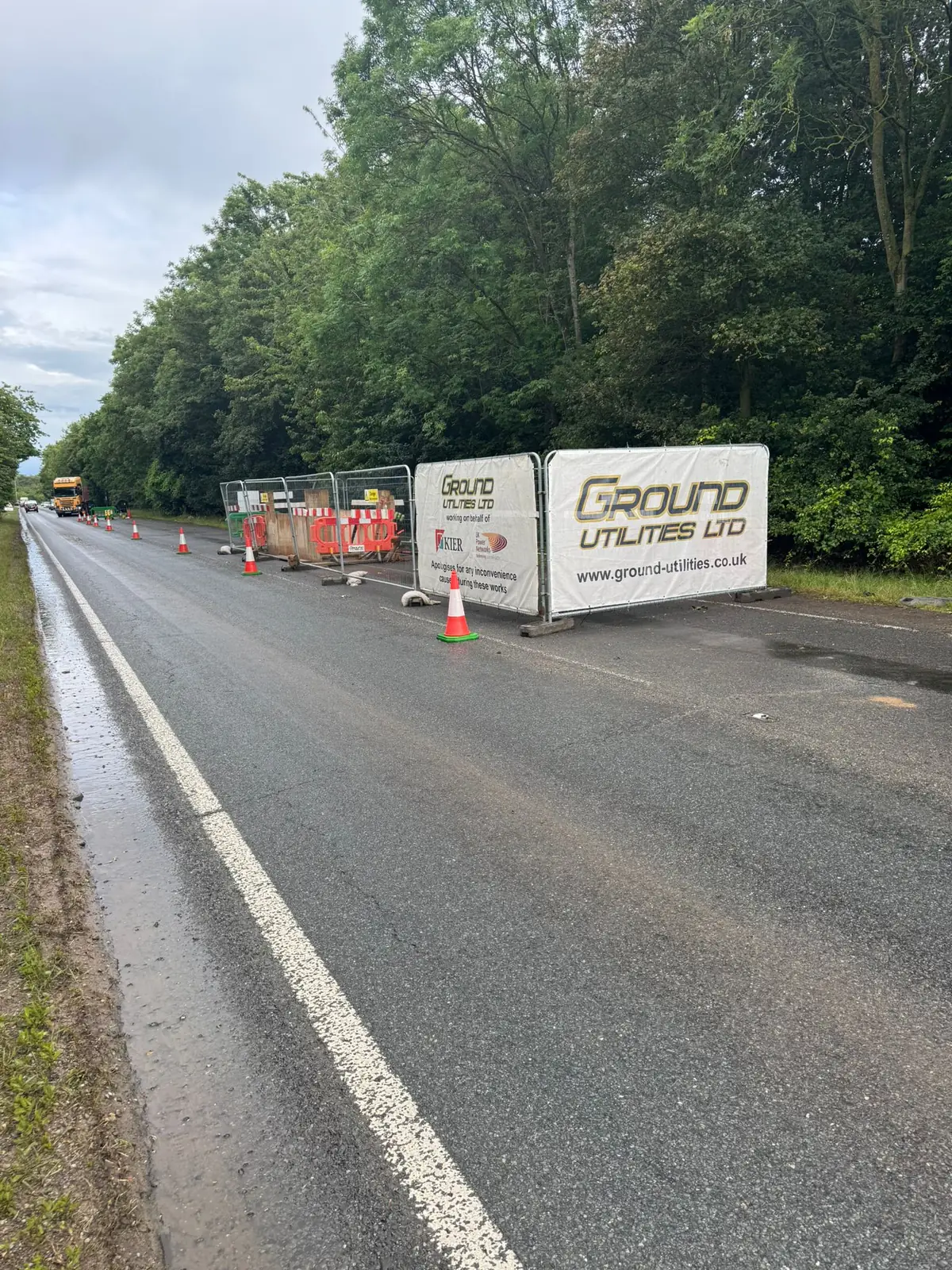
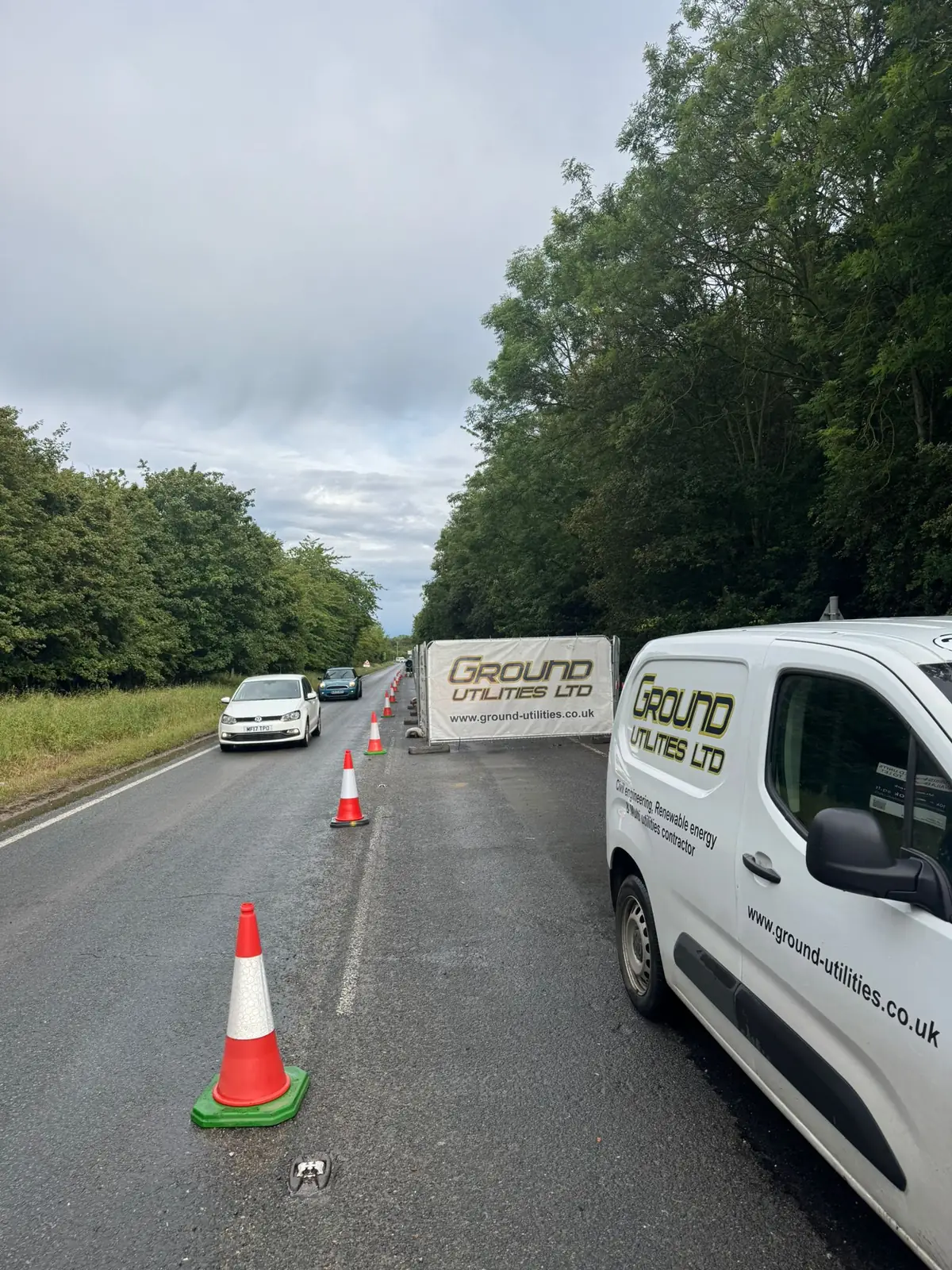
Ground Utilities is a civils and cable-laying contractor based in Cottenham, Cambridgeshire, working across England and Wales. Our supervisors and operatives hold NRSWA street works cards. Where a client needs it, we have applied for and managed the section 50 licence ourselves.
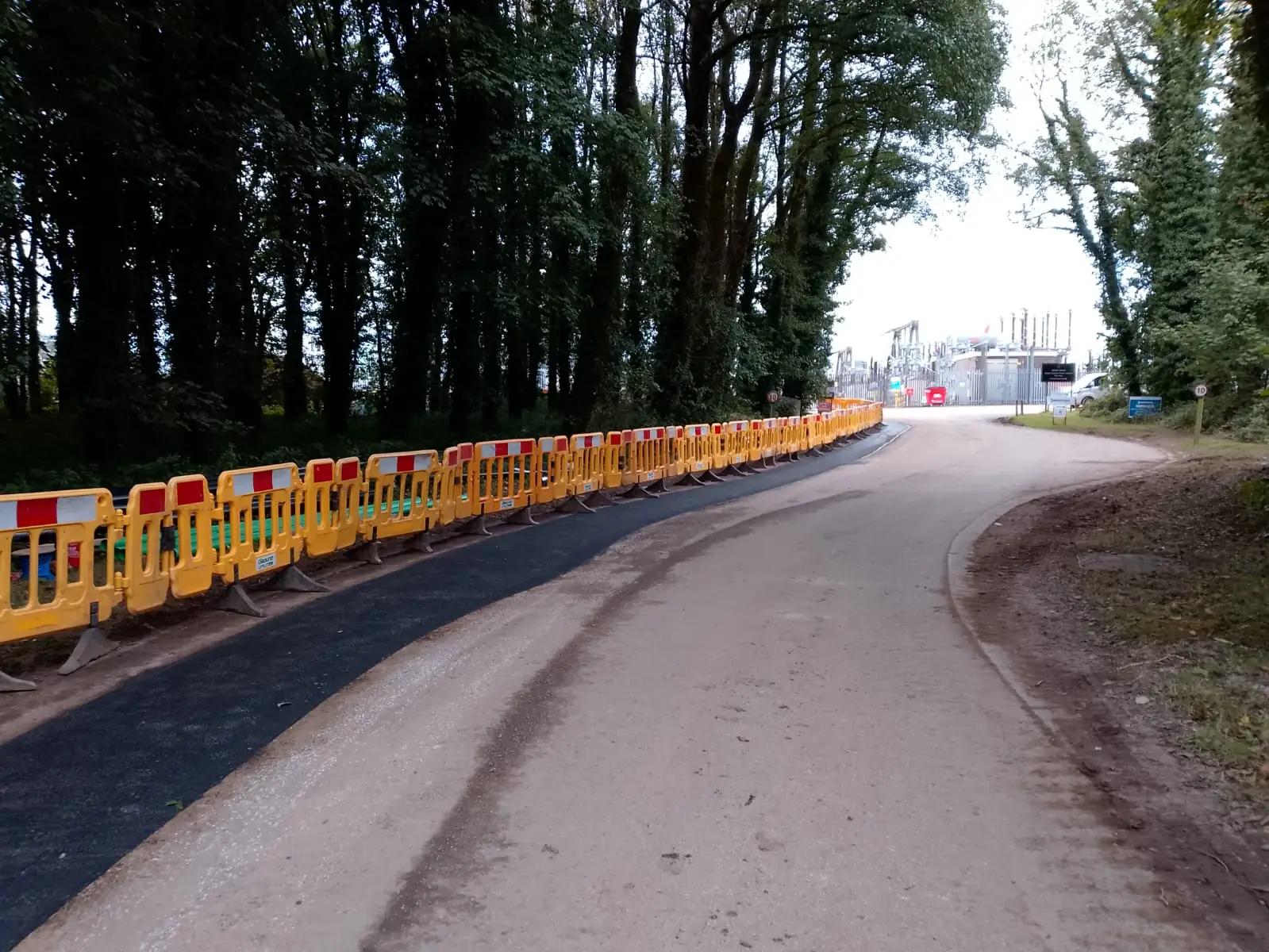
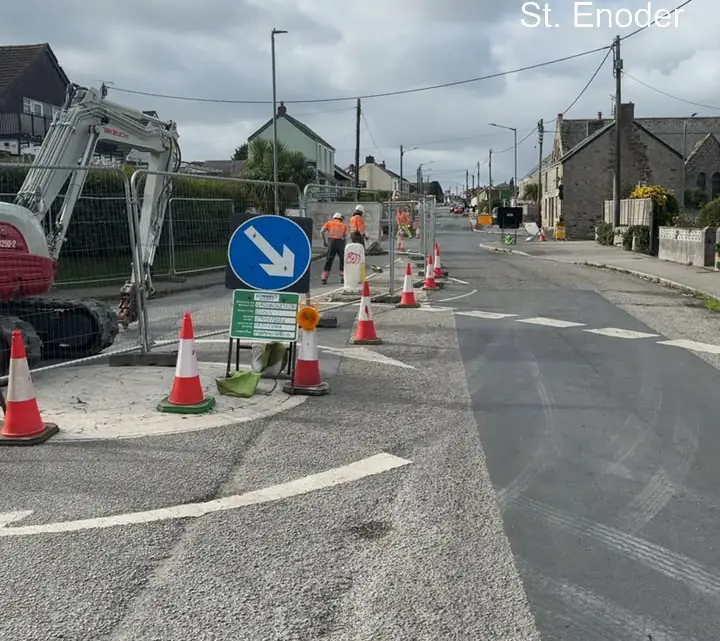
- On the Indian Queens private wire in Cornwall, the route has 4 km of trench in the highway. Our scope includes CDM set-up, traffic management and highway permits, council liaison and the section 50 licence. Community liaison has included letter drops, keeping access open and 10 bus stop suspensions.
- On a five-circuit 33kV route in North London, about 53,000 metres of cable went into a fully ducted route along main roads, with ducts double-stacked to reduce the trench width. We worked 24 hours a day to reduce disruption to the programme, and Haringey and Enfield councils both commended the work.
- We have used drone surveys of the highway to help plan traffic management before work starts.
We build the route and install the cable. We do no gas work, and we do not design networks, joint or terminate cables, make final live connections, or make connection applications. See section 50 licences and street works for how we handle the licence and permits.
Frequently asked questions
What is Chapter 8 traffic management?
It is traffic management designed and set out to Chapter 8 of the Traffic Signs Manual, the code of practice for temporary traffic management at road works. A single-volume 2026 edition was added to GOV.UK on 4 November 2026, replacing the old three-part version.
What is the difference between the Red Book and Chapter 8?
The Red Book is a short on-site code with legal backing for street works on single carriageways and lower-speed dual carriageways. Chapter 8 is a fuller design manual for all public roads. Chapter 8 says that where the Red Book sets a specific statutory requirement, the Red Book takes precedence.
What is the minimum safety zone at street works?
The Red Book's setting-out table gives a sideways clearance of 0.5 m at 40 mph or less and 1.2 m at 50 mph or more. The longways clearance rises from 0.5 m at 30 mph to 60 m at 60 mph.
Do you need permission to use temporary traffic lights?
Yes. The Red Book requires written permission from the highway authority before portable traffic signals are used. For emergency works, they can be used first and permission sought as soon as possible afterwards.
What is a lane rental charge?
It is a daily charge of up to £2,500, set by DfT guidance, for works occupying the busiest streets at the busiest times in an authority with an approved scheme. It is meant to push works to quieter times and places.
Which councils have lane rental schemes?
DfT's December 2025 guidance listed five operating schemes: Transport for London, Kent, Surrey, West Sussex and East Sussex. Check with the highway authority for your route, as more may be approved.
How long does a temporary traffic regulation order take?
The law requires at least 7 days' public notice before the order is made, but councils take far longer to process an application. Ask the authority for its own timescale. A closure also makes the works major under permit schemes, with three months' advance notice.
What is the minimum footway width at street works?
The Red Book asks for 1.5 metres where possible and never less than 1.0 metre. A walkway in the carriageway should be 1.2 metres, with an absolute minimum of 1.0 metre.
Sources
- Safety at street works and road works: a code of practice 2013 (Department for Transport, 2013)
- Safety at Street Works and Road Works: A Code of Practice (PDF) (Department for Transport, 2013)
- Updating the safety at street works and road works code of practice (Department for Transport, 2026)
- Traffic Signs Manual (Department for Transport, 2026)
- Traffic Signs Manual Chapter 8: Traffic Safety Measures and Signs for Road Works and Temporary Situations (PDF) (Department for Transport and National Highways, 2026)
- Traffic Signs Manual Chapter 8 (National Highways, 2026)
- New Roads and Street Works Act 1991, section 65 (legislation.gov.uk, 1991)
- Road Traffic Regulation Act 1984, section 14 (legislation.gov.uk, 1984)
- Road Traffic Regulation Act 1984, section 15 (legislation.gov.uk, 1984)
- The Road Traffic (Temporary Restrictions) Procedure Regulations 1992, regulation 3 (legislation.gov.uk, 1992)
- Permit schemes: statutory guidance for highway authorities (Department for Transport, 2026)
- Lane rental schemes: guidance for English highway authorities (Department for Transport, 2025)
- Assessing and implementing lane rental scheme applications: statutory guidance for mayors (Department for Transport, 2026)
- Issuing section 50 street works licences (Department for Transport, 2026)
- The Street Works (Charges for Occupation of the Highway) (England) Regulations 2012 (legislation.gov.uk, 2012)