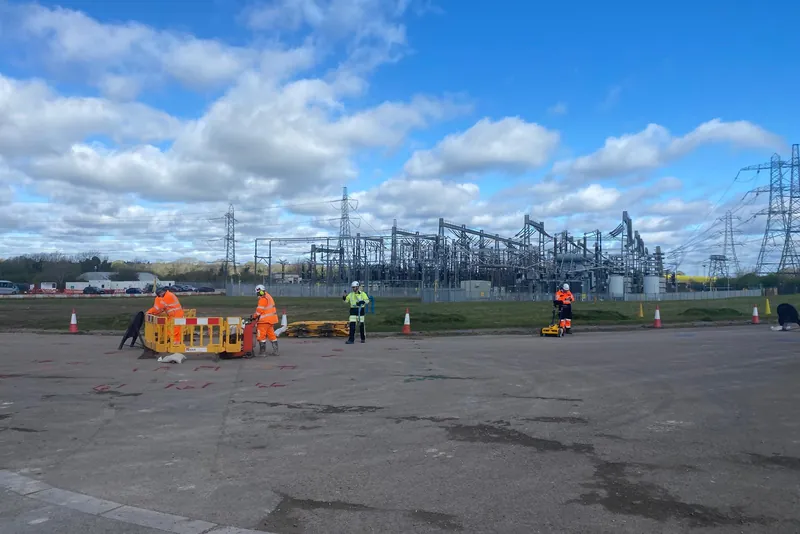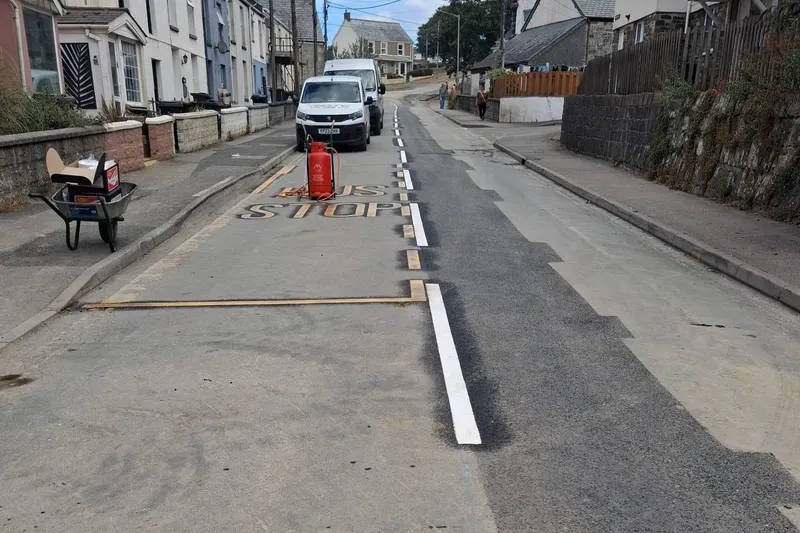
A CAT and Genny is the standard kit for finding buried cables and metal pipes before anyone digs on a UK site. The CAT is a handheld receiver. The Genny is a small transmitter that puts a signal onto a service so the CAT can trace it.
This guide explains how the pair works, how to sweep an area properly, what the tools cannot find and what training operators need. For the whole safe system of work, from utility records to trial holes, see our guide to avoiding utility strikes.
Key points
- CAT stands for cable avoidance tool. A Genny is a signal generator that works with it.
- A CAT has up to four modes: Power, Radio, Genny and a combined sweep mode. Power and Radio rely on signals that may not be there.
- HSE says to use signal generators whenever possible.
- The manufacturer's guide for one common model says never to use its depth reading to decide whether mechanical digging is safe.
- The usual qualification is EUSR Utility Excavations Category 1, Locate Utility Services (HSG47). EUSR says registration lasts three years.
In this guide
- What is a CAT and Genny?
- How does a CAT detect a buried cable?
- How do you put a Genny signal onto a service?
- How do you sweep an area with a CAT and Genny?
- How accurate is the depth reading?
- What can a CAT and Genny miss?
- What are the most common CAT and Genny mistakes?
- CAT and Genny, GPR or a PAS 128 survey: which do you need?
- What training do CAT and Genny operators need?
- Where Ground Utilities fits
- Frequently asked questions
- Planning a cable route?
- Sources
What is a CAT and Genny?
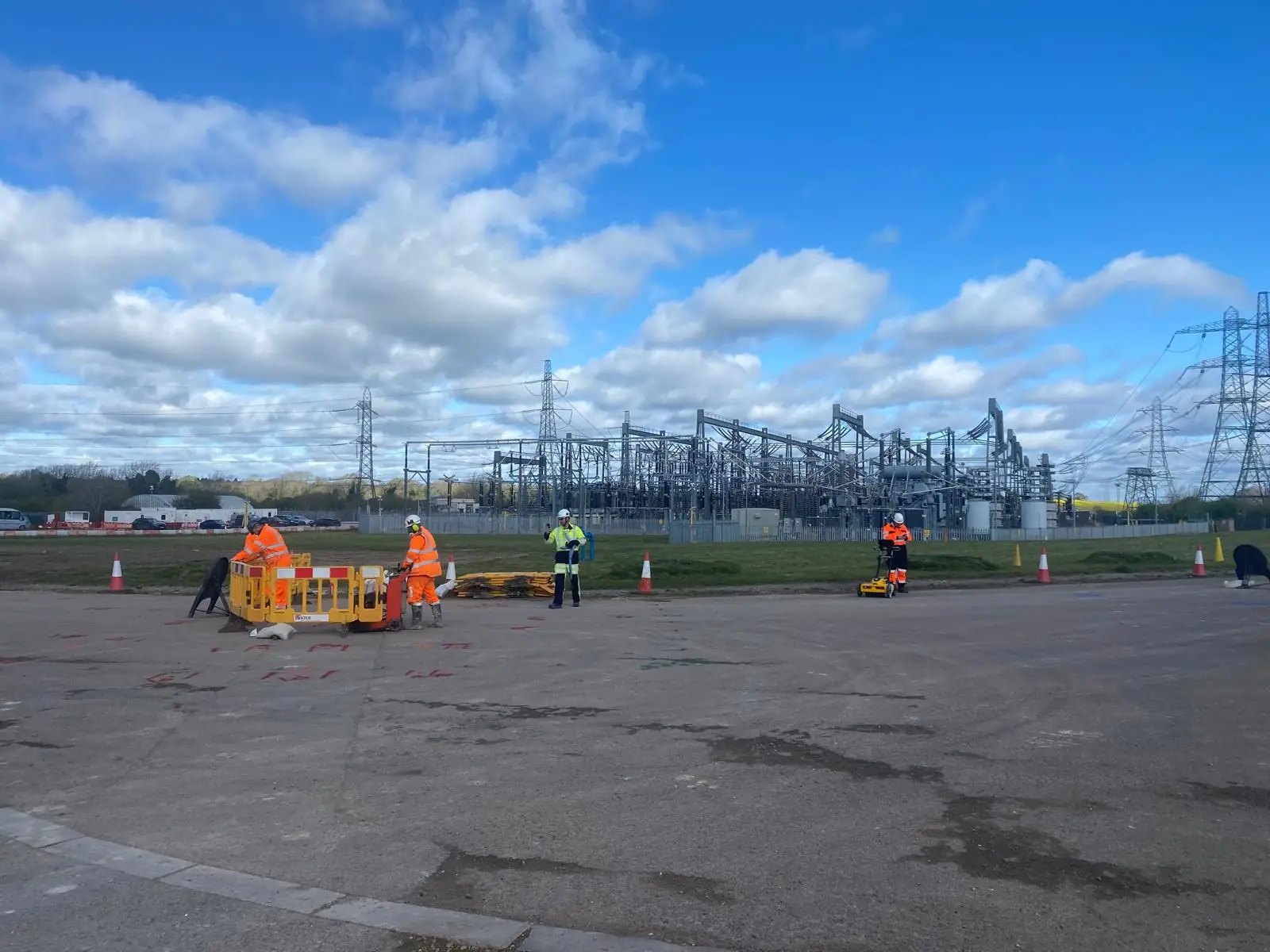
A CAT is a handheld receiver that detects the electromagnetic field around a buried metal cable or pipe. A Genny is a portable transmitter that puts its own signal onto that cable or pipe, or into the ground above it. Used together, the CAT can follow the Genny's signal along the line of the service.
"C.A.T" and "Genny" are Radiodetection trade marks. On site, people use the words for any locator and signal generator of this type.
HSE's guidance HSG47 describes the main detector types. A modern CAT combines three of them in one instrument:
- a power (hum) detector;
- a radio detector;
- a receiver for a transmitter's signal. The Genny is that transmitter.
How does a CAT detect a buried cable?
It listens for three kinds of signal, each in its own mode. A fourth mode listens for all three at once.
| Mode | Where the signal comes from | What to watch for |
|---|---|---|
| Power | Current flowing in the power network. Radiodetection notes the signal can appear on any pipe or cable | Some power cables give no detectable signal. Cables that are switched off, such as street lighting in daylight, may not show |
| Radio | Distant radio transmitters, whose signals travel along long metal services | Radio signals are not always present. HSG47 says results vary with locality, length and orientation of the service |
| Genny | The signal your own Genny applies to the service | You need a rough idea where the service runs to apply the signal well |
| Avoidance (combined) | Power, Radio and Genny signals together | Good for a first sweep. Pinpointing may need a single mode |
The CAT's bar graph and tone rise as you approach the service and fall once you pass it. The peak marks the line.
HSG47 says confidence depends on the operator, the device and its calibration, and the service itself. Nearby services, the ground and the use of a signal generator also matter.
How do you put a Genny signal onto a service?
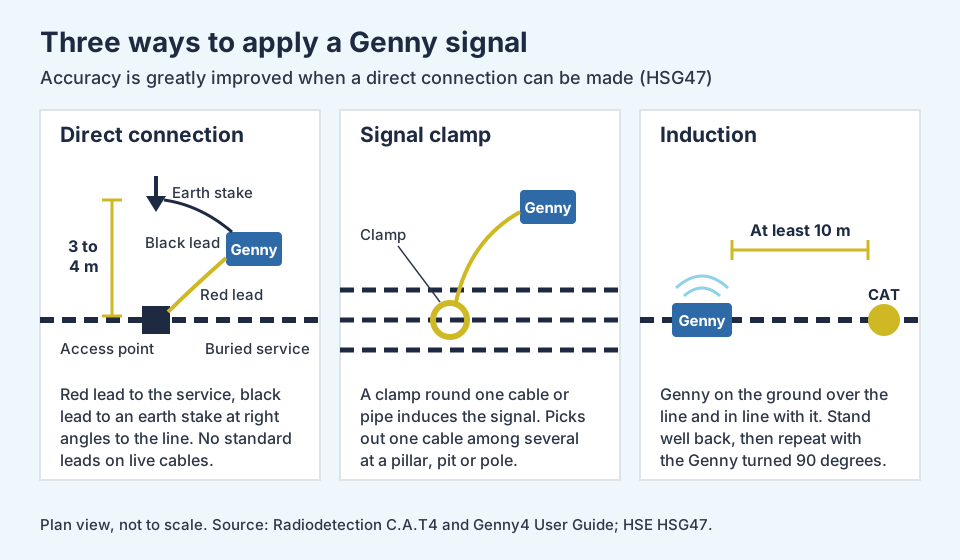
There are three ways: connect the Genny directly to the service, clamp it round the cable, or broadcast the signal from the ground above by induction. HSG47 says accuracy is greatly improved when a direct connection can be made.
| Method | How it works | Best for | Watch for |
|---|---|---|---|
| Direct connection | The Genny's red lead clips to an exposed metal part of the service, such as a valve, meter, street light or junction box. The black lead goes to an earth stake | Tracing one known pipe or cable a long way | Radiodetection's guide says to place the earth stake 3 to 4 m away, at right angles to the line. Do not use standard leads on live cables |
| Signal clamp | A clamp goes round the cable or pipe and induces the signal into it | Picking out one cable among several at a pillar, pit or pole | You need access to the cable |
| Induction | The Genny sits on the ground over the expected line and broadcasts the signal into any metal service below | Searching an area when no access point exists | Stand well back. The manufacturer says at least 10 m, or the CAT picks up the Genny's signal through the air |
Radiodetection's guide says connection to a power cable sheath, or to live power cables, should only be done by qualified personnel. It supplies separate live connectors for that work.
Tracing plastic pipes and ducts
A CAT cannot see a plastic pipe or empty duct on its own. HSG47 lists the ways round this:
- a metal tracer wire laid with the pipe, which a Genny can then energise;
- a small transmitter (a sonde) or tracing rod pushed along the pipe or duct;
- RFID markers fixed to the pipe.
HSG47 adds that tracer wire may be broken or badly laid, so the full length of a service can be missed. Radiodetection's guide says its flexible tracing rod can be located at depths of up to 3 m.
How do you sweep an area with a CAT and Genny?
Get the utility records first, so you know what you are looking for. HSG47 says to pinpoint services using a detecting device together with up-to-date plans. Then work through the steps below.
- Check the kit. Run the self-test or functional test before use. Radiodetection also advises regular checks, in all modes, over a cable that gives a response you know.
- Check calibration. HSG47 says to check and calibrate detection devices regularly. Do not use a locator past its calibration date.
- Keep phones away. Radiodetection recommends at least 60 cm between a mobile phone and the locator.
- Set the sensitivity to maximum. If the bar graph stays at maximum, turn it down until it sits below half.
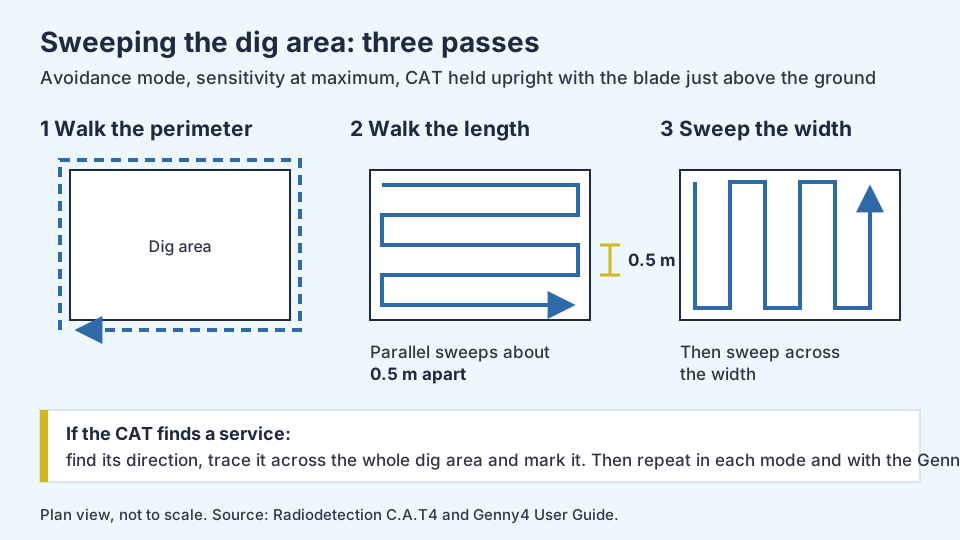
- Sweep in Avoidance mode. Walk the perimeter of the dig area first. Then walk its length in parallel passes about 0.5 m apart, then across its width.
- Hold the CAT upright. Keep the blade vertical and just above the ground. Swinging it affects accuracy.
- Pinpoint each find. Turn the sensitivity down and pass back and forth over the peak. Rotate the CAT to find the direction: the signal is strongest across the line and weakest along it.
- Trace it through the whole area. HSG47 says services may not run in straight lines. Cables can have kinks or loops, and pipes can have bends not shown on drawings.
- Repeat in Power, Radio and Genny modes. Each one can show services the others miss.
- Sweep again with the Genny. Use induction across the area, then repeat with the Genny turned 90 degrees. Use direct connection or a clamp where you can reach the service.
- Mark what you find. HSG47 says to use waterproof crayon, chalk or paint on paved surfaces. On grass, use wooden pegs, preferably to one side of the service. Do not use steel pins or spikes.
- Re-check as you dig. HSG47 says location becomes more accurate as cover is removed, so use the locator often during the work.
Then prove each service by hand-dug or vacuum-excavated trial holes. See our guide to trial holes and trial pits.
How accurate is the depth reading?
Treat it as a guide only. Some CATs estimate depth, but only in Genny mode. Radiodetection's specification for one model gives line depth accuracy of plus or minus 5% from 0.1 m to 3 m.
That figure assumes good conditions. The same guide says:
- do not estimate depth near a bend or tee;
- stand at least 10 m from a Genny used in induction, or about 5 m with a direct connection or clamp;
- never use the depth estimate to decide whether mechanical digging is appropriate.
The Survey Association's client guide explains why. Locators work out depth from the shape of the electromagnetic field, and nearby cables or pipes can distort it. HSG47 says to use a locator as a depth guide down the side of the excavation as you dig.
What can a CAT and Genny miss?
A CAT and Genny can miss any service that carries no detectable signal, such as a plastic pipe or a cable carrying no current. Our utility strikes guide lists the main gaps. HSG47 and the Survey Association add several that catch out experienced teams:
- Pot-ended cables. Cables sealed off in the ground can be hard to detect even when live. HSG47 says to treat them as live, never as abandoned.
- Stacked or bunched services. A locator may show two services close together as one. If one sits above the other, the lower one may not be detected.
- A big signal masking a small one. Radiodetection notes that a strong signal on one cable can hide a weaker one beside it.
- Unsheathed fibre. The Survey Association says small fibre cables laid straight in the ground are unlikely to be detectable. Fibre in a duct needs GPR or a tracing rod.
- Interference. Dense networks, reinforced concrete and high-voltage substations can distort readings.
- Services on the plan that you cannot find. HSG47 says to ask the service owner for help. Never assume a recorded service has gone.
What are the most common CAT and Genny mistakes?
The most common mistake is sweeping without a Genny and taking no signal to mean no service. Each mistake below breaks a step that HSG47 or the manufacturer sets out, and a briefing before the sweep fixes most of them.
- Sweeping in Avoidance or Power mode only, with no Genny.
- Standing too close to a Genny in induction, so the CAT reads the Genny itself.
- Swinging the CAT like a metal detector instead of holding it upright.
- Sweeping one line down the middle of the trench instead of the whole area.
- Trusting the depth reading enough to bring in a machine.
- Using a locator that is past its calibration date or has failed its self-test.
- Assuming that no signal means no service.
- Not repeating the locate as the dig goes down.
CAT and Genny, GPR or a PAS 128 survey: which do you need?
Use a CAT and Genny before every dig. Add a PAS 128 survey where the designer decides the site needs one, which HSG47 says should be settled at the planning stage. On many jobs you use more than one method.
A CAT and Genny sweep is a site check by the digging team. A PAS 128 survey is a specified survey, carried out by a specialist, with a recorded quality level for each service.
| Method | Who usually does it | What it gives you | What it cannot do |
|---|---|---|---|
| CAT and Genny sweep | The digging team, just before work | Marked lines of metal services and services carrying a signal | Find most plastic services, or prove depth |
| GPR | A specialist surveyor | Possible services, including some plastic ones | Identify a service on its own. HSG47 says false readings are likely in disturbed ground |
| PAS 128 Type B survey | A specialist surveyor | Services detected by at least two methods (usually a locator and GPR), drawn up with quality levels | Guarantee every service. The Survey Association says no technology can |
| Trial holes | The digging team or the surveyor | Proof of position, depth and identity | Cover the whole route. Each hole proves one spot |
For when a full survey is worth paying for, see our guide to PAS 128 surveys.
What training do CAT and Genny operators need?
HSG47 says anyone who uses a locator should have received thorough training in its use and limitations. There is no legal licence to use one. Most contractors and asset owners expect an EUSR registration.
| EUSR category | What EUSR says it covers | Validity |
|---|---|---|
| Utility Excavations Category 1, Locate Utility Services (HSG47) | The minimum training and assessment for people who detect utility services | Three years |
| Utility Excavations Category 2, Implement Safe (Digging) Excavating Practices | The minimum training and assessment for people who excavate and maintain holes and trenches | Three years |
Category 1 is the course people mean when they search for "CAT and Genny training". EUSR says it draws on National Occupational Standards and on HSG47 itself. Providers deliver it through EUSR-approved programmes, so check the provider is approved for that category before booking.
Where Ground Utilities fits
Ground Utilities is a utility and civil engineering contractor based in Cottenham, Cambridgeshire. We build HV and LV cable routes from 240V to 132kV, and our list of what a cable route involves starts with site investigations before excavation.
Our accreditations page records that:
- we have an in-house EUSR-approved trainer, so our operatives are trained and assessed by our own team;
- all our operatives are CSCS/EUSR registered as a minimum, and all our supervisors are SMSTS qualified;
- we are a member and supporter of the Utility Strike Avoidance Group (USAG).
On the Indian Queens 33kV private wire in Cornwall, our scope includes trial holes and HSG47 hand digging at 22 areas of concern. In the village of Fraddon, 16 gas services in around 300 m of narrow road were all hand dug. In 2024 our operatives and management also joined a pipeline awareness course for National Safe Digging Week.
What we do not do: we do no gas work. We do not joint or terminate cables, make final live connections to the network, make connection applications to the network companies, or carry out design. The network operator, the client's connection provider or the client's designer does those.
Frequently asked questions
What does CAT and Genny stand for?
CAT stands for cable avoidance tool, a handheld receiver that detects buried metal services. Genny is short for generator: a signal generator, or transmitter, that puts a known signal onto a service so the CAT can trace it. C.A.T and Genny are Radiodetection trade marks, but the terms are used for any kit of this type.
Can a CAT and Genny find plastic pipes?
Not on their own. HSG47 says locators miss plastic pipes unless they have a metal tracer wire or RFID markers. A sonde or tracing rod pushed through the pipe also works. Ground probing radar may detect some plastic pipes, and trial holes prove them.
How deep can a CAT and Genny detect?
It depends on the signal, the service and the ground. Radiodetection's specification for one model gives depth accuracy of plus or minus 5% between 0.1 m and 3 m, in Genny mode. The same guide says never to use the depth reading to decide whether to dig by machine.
Do you need a licence to use a CAT and Genny?
There is no legal licence. HSG47 says users should be thoroughly trained in the locator's use and limitations. In practice most clients and asset owners expect EUSR Utility Excavations Category 1, Locate Utility Services (HSG47).
How often should a CAT and Genny be calibrated?
HSG47 says to check and calibrate detecting devices regularly and follow the manufacturer's instructions. Radiodetection recommends a service and calibration check at least once a year, plus regular checks over a known cable.
What should you do if the CAT finds nothing?
Do not assume the area is clear. Repeat the sweep in every mode with a Genny, check the records again and ask the asset owner about any service you cannot find. Then dig trial holes by hand or by vacuum excavation before any machine digs.
Planning a cable route?
Tell us the route, the voltage and the programme, and we will come back to you. Send an enquiry or call 01223 423918.
Sources
- Avoiding danger from underground services (HSG47), third edition (Health and Safety Executive, 2014)
- C.A.T4 and Genny4 User Guide, 90/UG092ENG/07 (Radiodetection)
- Client Guide to BS: EN PAS 128:2022, Issue 3 (The Survey Association, May 2025)
- Utility Excavations Category 1: Locate Utility Services (HSG47) (EUSR)
- Utility Excavations Category 2: Implement Safe (Digging) Excavating Practices (EUSR)
- Utility Strike Avoidance Group (USAG)