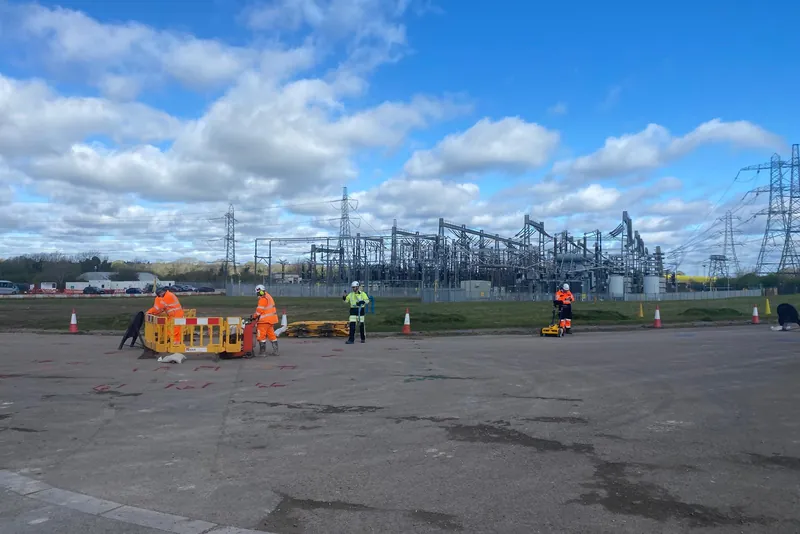
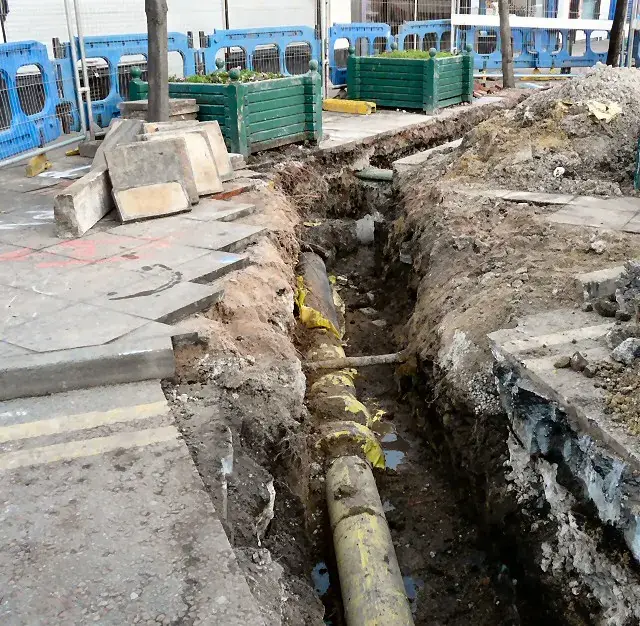
A trial hole is a small excavation dug to expose a buried service and prove its position, depth and identity. HSE's guidance HSG47 says to use trial holes to positively identify a service and its depth. It also says a cable is positively located only when it has been safely exposed.
This guide explains how trial holes, trial pits and slit trenches differ, when and how to dig them, and what to record. It also covers permits and reinstatement when the hole is in a road. For how services are found before the first hole, see our guides to avoiding utility strikes and CAT and Genny locating.
Key points
- On utility work a trial hole and a trial pit are the same thing. In ground investigation, a trial pit is dug to look at the soil.
- A slit trench is a narrow trench dug across the expected line of services. The Survey Association's PAS 128 guide says trench excavations can verify several utilities at once.
- HSG47 says to dig trial holes with suitable hand tools or vacuum excavation once services have been detected.
- Hand-held power tools should break hard surfaces 500 mm or more from the line of a service, where practicable.
- In a public road, trial holes are reinstated to the Specification for the Reinstatement of Openings in Highways (SROH), fourth edition.
- A permanent reinstatement carries a guarantee period of two years, or three years for a deep opening.
In this guide
- What is the difference between a trial hole, a trial pit and a slit trench?
- When do you need trial holes?
- How many trial holes do you need, and where?
- How do you dig a trial hole safely?
- How do you identify what you have found?
- What should you record from each trial hole?
- When does a trial pit need support?
- Do you need a permit to dig a trial hole in the road?
- How are trial holes reinstated in the highway?
- Where Ground Utilities fits
- Frequently asked questions
- Planning a cable route?
- Sources
What is the difference between a trial hole, a trial pit and a slit trench?
On utility work, a trial hole and a trial pit are the same small dig to prove a service, and a slit trench is a longer, narrow trench dug across the expected line of services. The words overlap, and people use them differently on different jobs, so agree the terms in the method statement so everyone digs the same thing.
| Term | What it is | Why it is dug |
|---|---|---|
| Trial hole | A small excavation over a detected service, dug by hand or vacuum excavation | To prove the position, depth and identity of a service before work nearby |
| Trial pit (utility work) | Usually the same as a trial hole. The Survey Association's PAS 128 guide uses both terms for Type A verification | As above |
| Trial pit (ground investigation) | A pit dug to see and sample the soil, logged by a geotechnical engineer | To assess whether the ground suits the planned construction |
| Slit trench | A narrow trench dug across the expected line of services. The Survey Association's guide says verification can take the form of single spot holes or more extensive trench excavations for several utilities | To expose every service that crosses the line of the trench in one dig |
| Large diameter core | A core over 150 mm across, cut from the road surface, with the ground below removed by vacuum | To reach one piece of apparatus whose position is already precisely known |
Ground investigation is a separate discipline. BS 5930:2015+A1:2020, the code of practice for ground investigations, covers how sites are investigated to assess their suitability for construction. The same precautions for buried services apply before any geotechnical pit is dug.
When do you need trial holes?
You need trial holes wherever the work will come close to a detected or recorded service, before any machine digs near it. HSG47 sets out the sequence:
- A detecting device shows where services run.
- Excavation can then go ahead.
- Trial holes are dug as necessary to confirm the position of any services detected.
On a cable or pipe route, that usually means trial holes:
- wherever the route crosses a detected service;
- where the route runs parallel to and close to a service;
- where a service shown on the records cannot be found with a locator;
- where the locate is confused, such as at junctions or in congested footways;
- before a machine digs near any detected service;
- on the line of a planned drill or bore, to confirm the crossing is clear (see our guide to horizontal directional drilling).
How many trial holes do you need, and where?
There is no fixed number, and HSG47 does not set a spacing. The Survey Association's PAS 128 client guide says the interval and position of trial holes depend on the project. It says the client should specify them, based on where services conflict with the work.
A practical way to plan them:
- Lay the utility records, any PAS 128 survey and your CAT and Genny marks on one drawing.
- Mark every point where the new route crosses or comes close to a known service.
- Mark areas where records and locate disagree, or where nothing was found but something is expected.
- Add slit trenches across the route where unrecorded services are likely, such as near property entries, street furniture or old trench scars.
- Number each hole and agree the list with the client before work starts.
The Survey Association also notes that a trial hole can be expensive if it is not well targeted. Reinstatement can be a large part of the cost, especially in a carriageway.
How do you dig a trial hole safely?
Dig by hand or by vacuum excavation. HSG47 says hand tools, used carefully, can normally provide a satisfactory way of exposing services. The method below follows HSG47.
- Brief the gang. HSG47 says workers should have a written plan showing where services are and what they are.
- Mark the line. Locate and mark each service before breaking ground.
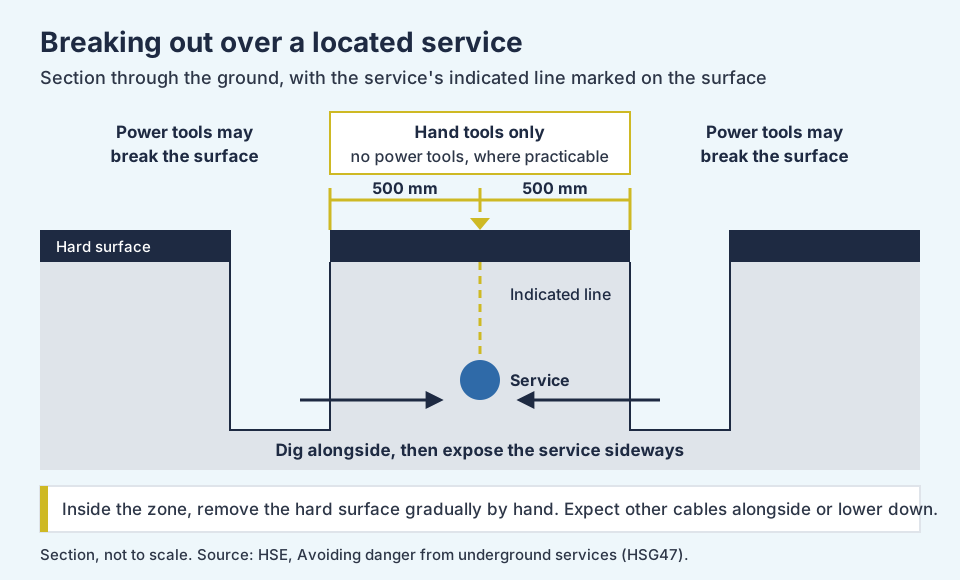
- Break the surface away from the line. Where practicable, use hand-held power tools only 500 mm or more from the indicated line of a service.
- Keep power tools off the service. HSG47 says to avoid them over a service unless physical protection is in place. The exception is a service already exposed and at least 300 mm below the hard surface.
- Dig under the surface by hand. Remove the hard surface gradually. If you cannot find the cable, assume it is embedded in the surface layer.
- Dig alongside, then expose sideways. HSG47 recommends final exposure by horizontal digging, because the force on hand tools is easier to control.
- Use the right tools. Use insulated tools near cables. Ease spades and shovels in with gentle foot pressure; never throw or spike them in. Do not use picks in soft clay or soft soils near services.
- Re-check as you go. Use the locator as a depth guide down the side of the hole.
- Support what you expose. Exposed services may need support, and must never be used as steps or handholds.
- Expect more than one. HSG47 says other cables may lie alongside or lower down. Single-phase cables of 11kV or more can be spread up to 600 mm across, especially near joints.
How deep should a trial hole go?
Deep enough to expose the service, and no deeper than needed. HSG47 gives typical depths, but warns never to assume them:
| Service | Typical depth given in HSG47 |
|---|---|
| Electricity cables | Most between 450 mm and 1 m. Some high-voltage cables deeper |
| Gas mains in a road | Cover of about 750 mm |
| Gas mains in a footway | Cover of about 600 mm |
| Gas service connections | Cover of about 450 mm, possibly about 375 mm on private property |
| High-pressure gas transmission pipelines | At least 900 mm cover |
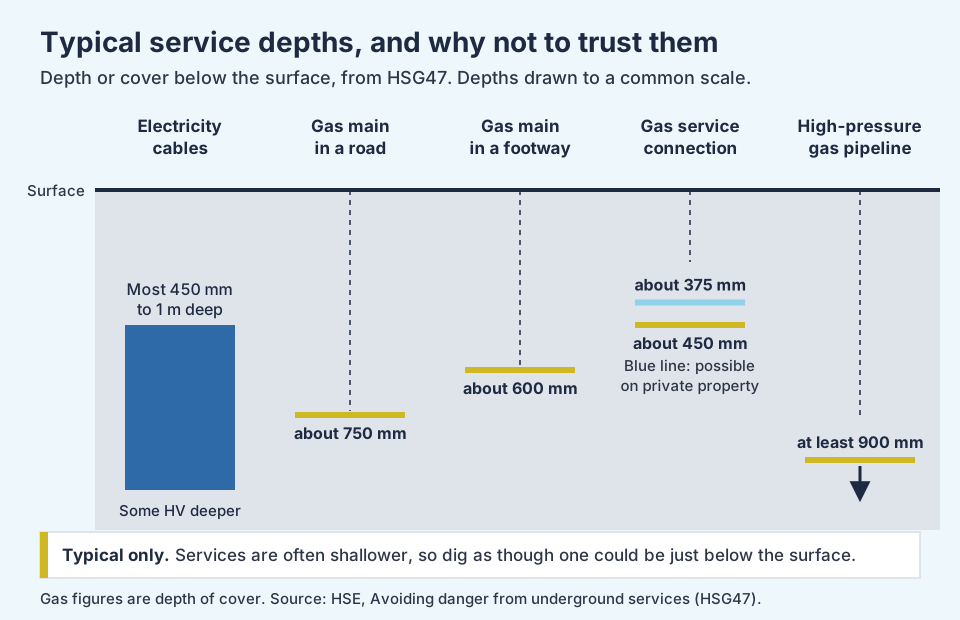
Services are often shallower than these figures, so dig every trial hole as though the service could be just below the surface.
How do you identify what you have found?
Treat what you find as live and dangerous until its identity is confirmed, because exposing a service is only half the job. HSG47 says failure to identify an exposed service correctly is another common cause of accidents. Until the identity is confirmed, it advises:
- treat any black plastic service as a live electricity cable;
- treat iron or steel pipes as gas pipes;
- treat continuously welded steel pipes as carrying a hazardous or high-pressure fluid;
- remember that electricity cables have been found in yellow or blue pipes on some sites;
- if in doubt, treat the service as an electricity cable or gas pipe until proved otherwise.
Colour is a clue, never proof. See our guide to underground utility colour codes. HSG47 also says to assume all services are live until disconnected and proven safe at the point of work.
What should you record from each trial hole?
HSG47 says survey results should go onto working drawings shared with the site team. A PAS 128 Type A survey goes further and produces cross-section drawings of each trial hole. Whatever the format, record the same facts every time.
- ☐ Trial hole number, date and the name of the person who dug it
- ☐ Position, by coordinates or by measured offsets from fixed features
- ☐ Size of the hole and the surface it was dug through
- ☐ For each service: type, owner if known, material, colour, diameter or size
- ☐ Depth to the top of each service, measured from the finished surface
- ☐ Any protection found, such as tiles, tape or concrete
- ☐ Condition of the service and any damage found
- ☐ Whether it matches the records and the locate
- ☐ Photos with a scale and a north arrow or reference point
- ☐ Services expected but not found, and what was done about it
- ☐ Who was told about any difference from the records
If a service is not where the records show, tell the owner. That keeps the records right for the next team.
When does a trial pit need support?
A trial pit needs support or battered sides whenever it could collapse on someone, and the law sets no depth below which that risk can be ignored. HSE says a cubic metre of soil can weigh more than 1.5 tonnes. People are killed or seriously injured every year by collapses in excavations.
Regulation 22 of the Construction (Design and Management) Regulations 2015 (CDM 2015) requires all practicable steps to stop an excavation collapsing or burying anyone. That includes support or battering the sides. Where an excavation is supported or battered, a competent person must inspect it:
- at the start of each shift in which work is done;
- after any event likely to have affected its strength or stability;
- after any material falls or is dislodged unexpectedly.
HSE also says to plan support before digging starts, protect edges with substantial barriers and keep plant and spoil away from the edges. Do not climb into a deep trial pit to look at a service unless the pit is supported or battered. Our guide to trench support and deep excavations covers support systems and inspections in detail.
Do you need a permit to dig a trial hole in the road?
Usually, yes. Which permission applies depends on who is digging and why.
- Utility companies dig under their own statutory rights to work in the street. In most of England they still need a permit from the highway authority's permit scheme.
- Anyone else placing apparatus in the highway, such as a private cable, needs a section 50 licence under the New Roads and Street Works Act 1991.
- A temporary excavation by anyone else needs the highway authority's consent. Section 171 of the Highways Act 1980 allows a person, with that consent, to make a temporary excavation in a street maintainable at public expense.
For trial holes dug ahead of a private route, ask the highway authority which of these it expects before you programme the work.
Most English highway authorities run permit schemes under Part 3 of the Traffic Management Act 2004. Each scheme sets its own rules, so check the one for your road. Torbay Council's 2025 scheme is a typical example:
| Activity | Duration in Torbay's scheme | Permit application lead time in Torbay's scheme |
|---|---|---|
| Minor | 3 days or less | 3 days |
| Standard | 4 to 10 days | 10 days |
| Major | Over 10 days, in an annual programme, or needing a temporary traffic regulation order | Provisional advance authorisation 3 months ahead, then permit 10 days ahead |
| Immediate | Emergency or urgent works | Can start without a permit |
Most trial holes are minor works. A short job that needs a temporary traffic regulation order is classed as major in Torbay's scheme.
For cards, notices and the Red Book, see our guide to NRSWA and street works.
How are trial holes reinstated in the highway?
To the Specification for the Reinstatement of Openings in Highways (SROH), fourth edition. It became statutory guidance on 10 May 2021. Three of its rules matter most for trial holes.
| SROH rule | What it says |
|---|---|
| Small openings | An excavation with a reinstatement area of up to 2 m² in road types 0, 1 and 2, or up to 4 m² in road types 3 and 4 and in footways, footpaths and cycle tracks |
| Deep openings | Any opening where the cover over the apparatus is more than 1.5 m |
| Interim reinstatement | Must normally be made permanent within six months |
| Guarantee period | Two years from completion of the permanent reinstatement, or three years for a deep opening |
| Large diameter cores | Cores over 150 mm can be reused only where strict SROH conditions are met. The method is only for apparatus whose position is precisely known |
Plan the reinstatement before you dig, as The Survey Association advises for trial holes. For interim and permanent reinstatement, road types and inspections, see our guide to road reinstatement.
Where Ground Utilities fits
Ground Utilities is a utility and civil engineering contractor based in Cottenham, Cambridgeshire. Site investigations before excavation are the first item on our list of what an HV and LV cable route involves, from 240V to 132kV.
Recent examples from our project pages:
- Indian Queens 33kV private wire, Cornwall. Our scope includes trial holes and HSG47 hand digging at 22 areas of concern. In Fraddon, 16 gas services in around 300 m of narrow road were all hand dug. Deep crossings run around 2.9 m deep, beneath a high-pressure gas main and a trunk main.
- Deep excavations for sewer and water, South West London. Fifteen excavations, from 1.5 m to 13 m wide and more than 3 m deep. They exposed and supported an existing sewer and other utilities, with temporary works and utility supports.
Our supervisors and operatives hold NRSWA street works cards. Where a client needs it, we have applied for and managed the Section 50 licence ourselves. Examples are Indian Queens and a scheme in Grimsby.
What we do not do: we do no gas work. We do not joint or terminate cables, make final live connections to the network, make connection applications to the network companies, or carry out design.
Frequently asked questions
Is a trial hole the same as a trial pit?
On utility work, yes. Both mean a small excavation to expose a buried service and confirm its position, depth and identity. In ground investigation, a trial pit is dug to look at and sample the soil, which is a different job.
What is a slit trench used for?
A slit trench is dug across the expected line of services, usually by hand. It catches services that cross the route, including ones missing from the records or missed by the locator. It is useful before a long trench or a machine dig.
How deep should a trial hole be?
Deep enough to expose the service. HSG47 says most electricity cables lie between 450 mm and 1 m deep, and gas service connections usually have about 450 mm of cover. It warns never to assume depths, because services are often shallower.
Can you use a mini digger to dig trial holes?
Not to find a service. HSG47 says to dig trial holes with suitable hand tools or vacuum excavation. Mechanical excavation is a common cause of damage and must be carefully planned, with a second person watching the bucket.
Do you need a permit for a trial hole in the road?
Usually. In most of England a trial hole in a public road needs a permit under the local highway authority's scheme, typically as minor works. Check the scheme for that road, because lead times vary.
What if a trial hole finds a service that is not on the plans?
Stop, treat it as live and identify it before going on. Tell the client and the likely owner, record it and add it to the working drawings. HSG47 says to assume all services are live until proven safe at the point of work.
Planning a cable route?
Tell us the route, the voltage and the programme, and we will come back to you. Send an enquiry or call 01223 423918.
Sources
- Avoiding danger from underground services (HSG47), third edition (Health and Safety Executive, 2014)
- Client Guide to BS: EN PAS 128:2022, Issue 3 (The Survey Association, May 2025)
- BS 5930:2015+A1:2020 Code of practice for ground investigations (BSI, 2020)
- Excavations (Health and Safety Executive)
- The Construction (Design and Management) Regulations 2015, regulation 22 (legislation.gov.uk)
- Specification for the reinstatement of openings in highways, fourth edition (Department for Transport, 2020; statutory from 10 May 2021)
- Streetworks Permit Scheme Policy 2025 (Torbay Council, 2025)
- New Roads and Street Works Act 1991, section 50: Street works licences (legislation.gov.uk, 1991)
- Highways Act 1980, section 171: Control of deposit of building materials and making of excavations in streets (legislation.gov.uk, 1980)