On a UK utility civils site you will usually be asked for an EUSR card with a SHEA registration, a CSCS card (or an EUSR card carrying the CSCS logo), an NRSWA street works card for highway work, and SMSTS or SSSTS for supervisors and managers. Only one of them, the street works card, is a direct legal requirement, and only for certain work in the street.
The rest are industry schemes. Principal contractors and utilities use them to control who comes on site and to show they have appointed competent people.
This guide is for operatives, supervisors, site managers and the clients who appoint them. It reflects the scheme rules as published in November 2026.
Key points
- EUSR is the Energy & Utility Skills Register. EUSR says its SHEA Core registration is a one-day course with six modules, valid for three years.
- CSCS cards show that site workers have the right training and qualifications. CSCS itself says holding one "is not a legislative requirement".
- EUSR is the CSCS Alliance Partner for utilities, so an EUSR card can carry the CSCS logo. EUSR launched a separate EUSR CSCS Utilities Labourer card on 3 August 2026.
- NRSWA street works cards are required by section 67 of the New Roads and Street Works Act 1991 when a street is broken open. Registration lasts five years.
- SMSTS (five days) is for site managers and SSSTS (two days) is for supervisors. CITB says both certificates are valid for five years.
In this guide
- Which cards does a utility civils site ask for?
- Is a CSCS card a legal requirement?
- What is an EUSR card and the SHEA Core?
- How do EUSR cards and CSCS cards fit together?
- What is an NRSWA street works card?
- What are SMSTS and SSSTS, and which do you need?
- What about plant operator tickets?
- Which cards does each role need?
- How should an employer check cards?
- Where Ground Utilities fits
- Looking for a role?
- Frequently asked questions
- Sources
Which cards does a utility civils site ask for?
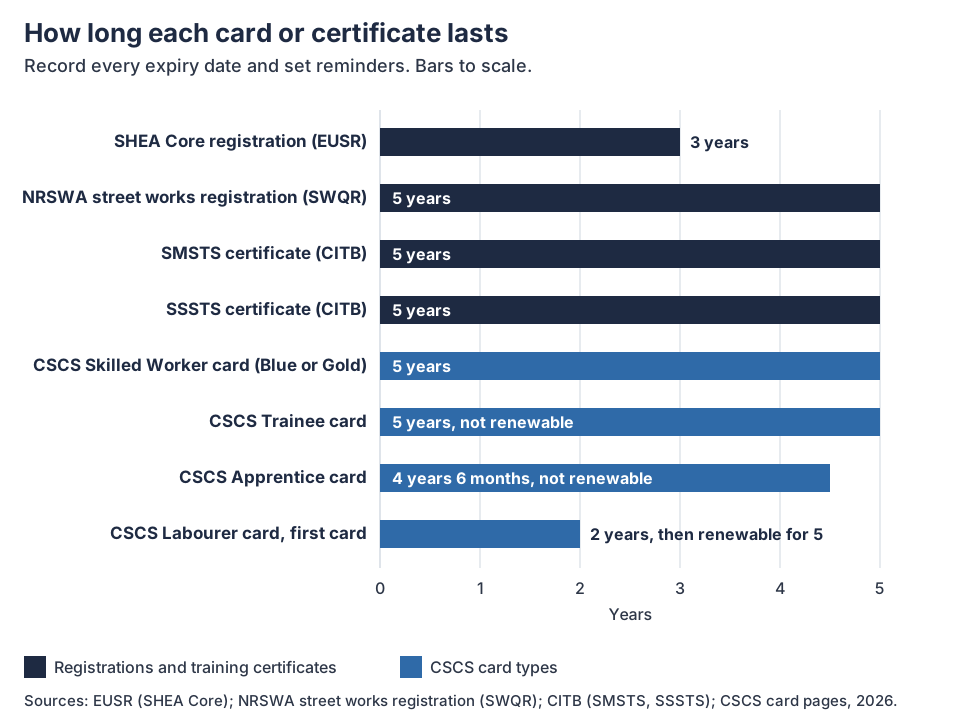
Most utility civils sites ask for a SHEA registration, a CSCS or EUSR CSCS card, and street works cards for highway work, plus SMSTS or SSSTS for anyone running the site. The table shows who runs each scheme and how long it lasts.
| Card or ticket | Run by | What it shows | Who needs it | How long it lasts | Required by law? |
|---|---|---|---|---|---|
| EUSR card with SHEA Core | Energy & Utility Skills | Health, safety and environmental awareness for utility work | Anyone working on operational utility sites | SHEA Core: 3 years | No, an industry scheme |
| CSCS card (or EUSR CSCS card) | CSCS, with EUSR as the utilities partner | Training and qualifications for the job | Most people on construction sites, where the principal contractor requires it | Depends on the card | No |
| NRSWA street works card | Qualifications Scotland, through the Street Works Qualifications Register (SWQR) | Street works units passed | The supervisor and at least one operative on works that break open a street | 5 years | Yes, under NRSWA section 67 |
| SMSTS | CITB (Site Safety Plus) | Site management of health, safety and environment | Site managers | 5 years | No, a training certificate |
| SSSTS | CITB (Site Safety Plus) | Site supervision of health and safety | Supervisors | 5 years | No, a training certificate |
| CPCS or NPORS card | Plant card schemes | Competence to operate a type of plant | Plant operators | Set by each scheme | No, usually a site rule |
Is a CSCS card a legal requirement?
No. CSCS states that holding a CSCS card is not a legislative requirement. Whether you need one is up to the principal contractor or client, and CSCS notes that most principal contractors and major house builders ask for one.
What the law does require is competence. Regulation 15(7) of the Construction (Design and Management) Regulations 2015 (CDM 2015) says a contractor must not employ or appoint someone on a construction site unless they have, or are getting, the skills, knowledge, training and experience for their tasks.
Cards are how the industry evidences that duty. A missing or expired card is often the first thing an auditor or client will spot.
What is an EUSR card and the SHEA Core?
An EUSR card is the photo card issued when your training is recorded on the Energy & Utility Skills Register. In brief:
- Who runs it: Energy & Utility Skills Limited.
- Industries covered: gas, power, waste management and water.
- What you get: completing an eligible scheme gives you a unique EUSR ID number.
- How it is checked: employers can check the record online.
What does the SHEA Core cover?
SHEA stands for Safety, Health and Environmental Awareness. EUSR describes the SHEA Core as a one-day course for anyone working on operational utility sites, from operatives to managers. It has six modules:
- Workplace responsibilities
- Environmental impacts of our work
- Identifying and controlling risks
- Common workplace hazards and controls
- Occupational health hazards
- Emergency response
Each module has a multiple-choice test set by EUSR. You can take the first course in a classroom with a paper test, or in a live virtual classroom with a remote assessment.
How long does a SHEA Core registration last?
EUSR states that SHEA Core registration is valid for three years. To renew, you can:
- retake the full-day course, or
- take a half-day classroom, remote or e-learning route. These need a current SHEA registration, so do not let it lapse.
EUSR also runs SHEA schemes for particular sectors, including Power, Water, Gas, Drains and Sewers, Telecommunications, Cross-Country Pipelines, and Waste and Resource Management. The National Water Hygiene scheme, which gives the card often called the "Blue Card" for restricted water sites, also sits on the EUSR register.
Does a SHEA registration show technical skill?
No. SHEA is an awareness scheme, and technical competence is shown by qualifications for the role.
| What you need to show | How it is shown |
|---|---|
| Safety, health and environmental awareness | SHEA registration |
| Excavation in the highway | Street works units |
| A skilled trade | An NVQ for the trade |
| Locating buried services with a cable locator | Another EUSR scheme, covered in our guide to the CAT and Genny |
How do EUSR cards and CSCS cards fit together?
EUSR is the CSCS Alliance Partner for the utilities sector, so an EUSR card can carry the CSCS logo. EUSR says SHEA is mandatory for all EUSR CSCS cards, with one exception: the Apprentice card, which accepts the CITB health and safety test instead.
What changed for labourers in 2026?
EUSR changed how labourers get a CSCS-logo card:
- 3 August 2026: EUSR launched the EUSR CSCS Utilities Labourer card.
- 1 October 2026: SHEA is no longer issued automatically on an EUSR CSCS Green Labourer card. Labourers apply for the Utilities Labourer card separately. This date was moved from 1 July 2026.
- Existing cards: EUSR says SHEA cards issued before 30 September 2026 keep the CSCS logo until they expire.
People who are not labourers need the EUSR CSCS card that matches their job. EUSR's pages cover Trainee, Apprentice, Experienced Worker and Gold Skilled Worker cards. For skilled worker cards, EUSR sets a Level 2 qualification or above as the benchmark, or an equivalent competence set by the sector's own representative body.
EUSR also says employer endorsement ended in December 2024. An employer can no longer vouch for experience in place of a qualification.
What other CSCS cards are there?
CSCS publishes the full list of card types. These are the ones you are most likely to meet on a civils site:
| CSCS card | Who it is for | Key rule |
|---|---|---|
| Apprentice | People on a recognised apprenticeship | Free. Valid 4 years 6 months. Not renewable. |
| Trainee | People registered on a qualification such as an NVQ | 5-year card is not renewable. Needs the operative-level HS&E test. |
| Labourer | Unskilled roles only | First card 2 years, then renewable for 5 years. Needs the HS&E test and a Level 1 health and safety award or accepted alternative. |
| Blue Skilled Worker | Skilled workers with a construction NVQ or SVQ | Valid 5 years. |
| Gold Skilled Worker | A construction NVQ or SVQ at Level 3, or an approved apprenticeship | Valid 5 years. |
| Experienced Worker | Workers with on-the-job experience who are not yet fully qualified | Typically needs at least a year of recent experience. |
| Professionally Qualified Person | Members of approved professional bodies | Valid 5 years. |
For most CSCS cards you must pass the CITB Health, Safety and Environment (HS&E) test at the right level for your role. CSCS says the pass must usually be within the last two years when you apply.
What is an NRSWA street works card?
The NRSWA street works card is the one card on this list that the law requires. Section 67 of the New Roads and Street Works Act 1991 says works that break open a street must be supervised by someone with a prescribed supervisor qualification, with at least one qualified operative on site.
In England the qualifications are set by the Street Works (Qualifications of Operatives and Supervisors) (England) Regulations 2016. Supervisors hold the monitoring versions of the same units as operatives. Every operative needs:
- at least one type of work unit: excavation, or a reinstatement unit for the material used
- signing, lighting and guarding
- location and avoidance of underground apparatus
A qualification only counts once it is registered:
- The certificate is entered on the Street Works Qualifications Register (SWQR).
- The holder gets a photo card listing their units.
- Registration lasts five years.
Our NRSWA and street works guide lists every unit, the renewal rules and the awarding bodies, so we do not repeat them here. For the client's side of highway work, see our section 50 licence page.
What are SMSTS and SSSTS, and which do you need?
SMSTS is CITB's five-day course for site managers and SSSTS is its two-day course for supervisors. Both belong to CITB's Site Safety Plus suite, both certificates last five years, and both are separate from any CSCS card.
| SSSTS | SMSTS | |
|---|---|---|
| Full name | Site Supervision Safety Training Scheme | Site Management Safety Training Scheme |
| Length | 2 days | 5 days |
| For | People who have, or are about to have, supervisory duties | People who plan, organise, monitor and control groups of staff, such as site managers |
| Content | Health and safety law, risk assessment, method statements, permits to work, leadership on site | Legal duties, CDM 2015, risk assessment, site set-up, managing hazards, occupational health, environment |
| Valid for | 5 years | 5 years |
| Refresher | SSSTS-R, one day | SMSTS-R |
| Entry requirements | None formal | None formal |
SMSTS or SSSTS: how to choose
- If you run a gang or a section and report to a site manager, take SSSTS.
- If you are responsible for the whole site, or will be, take SMSTS.
- If you have no previous health and safety management experience, CITB recommends starting with the two-day SSSTS.
What happens if the certificate expires?
CITB says that to stay certified you must retake the course, or complete the refresher before the expiry date. If you miss the date, plan for the full course again. Put the expiry in the diary at least six months ahead.
What about plant operator tickets?
Plant operators will usually need a plant card as well. The National Careers Service says plant operators will usually need a Construction Plant Competence Scheme (CPCS) card or a National Plant Operators Registration Scheme (NPORS) card to work on a site. Check that the card covers each type of machine the operator will use.
- If the site is an operational utility site, the plant operator will usually also need a SHEA registration.
- If the work is in the highway and the operator counts towards the section 67 requirement, they need the right street works units.
Which cards does each role need?
The exact list depends on the client, the utility and the principal contractor. This is a typical starting point on an electricity cable route or substation civils job:
| Role | Typical cards |
|---|---|
| Labourer | SHEA Core with the EUSR CSCS Utilities Labourer card, or a CSCS Labourer card |
| Groundworker or civils operative | SHEA, a skilled or trainee card for the role, NRSWA operative units for highway work |
| Plant operator | SHEA, a CPCS or NPORS card for each machine, NRSWA units where needed |
| Supervisor or ganger | SHEA, a supervisory card, SSSTS or SMSTS, NRSWA supervisor units for highway work |
| Site or contract manager | SHEA, a manager card, SMSTS |
Some clients add their own requirements, such as a utility's own safety rules training or a substation access authorisation. Always check the contract and the site rules before mobilising.
A worked example: a 33kV route that crosses a road
Picture a gang of four on a farmland cable route that crosses a B road. In the field, the client asks for SHEA and a CSCS-logo card for everyone, and SMSTS for the site manager.
At the road crossing, section 67 applies:
- The ganger needs supervisor units for excavation and the reinstatement materials in that road, plus signing, lighting and guarding, and location and avoidance.
- At least one operative on site needs the matching operative units at all times.
- If that one qualified operative goes off sick, the road works stop until another qualified operative arrives.
How should an employer check cards?
A card in a wallet proves little until it is checked against the scheme's own records. Before someone starts:
- ☐ Check the EUSR record using EUSR's online register search.
- ☐ Check the street works card against SWQR, and confirm the units cover the work: excavation, the right reinstatement units, signing and guarding, and location and avoidance.
- ☐ Check the CSCS card type matches the job the person will actually do. A Labourer card must not be used for a skilled role.
- ☐ Check the SMSTS or SSSTS certificate date for every supervisor and manager.
- ☐ Check plant cards cover each machine the operator will use.
- ☐ Record every expiry date and set reminders. A street works card that lapses mid-job takes that person out of the section 67 count.
- ☐ Confirm the client's or utility's own extra requirements.
Common mistakes
- Counting one qualified operative twice. If two highway crossings run at once, each needs its own qualified operative on site.
- Missing the refresher window. SMSTS, SSSTS and SHEA refreshers must be done before expiry, or you go back to the full course.
- Matching the card to the person, not the task. A labourer moved onto a skilled task needs the card for that task.
Where Ground Utilities fits
Ground Utilities Ltd is a utility and civil engineering contractor based at Highdrove Farm, Cottenham, Cambridgeshire, working across England and Wales since 2015. As a minimum, all our operatives are CSCS/EUSR registered and all our supervisors are SMSTS qualified. Our supervisors and operatives hold NRSWA street works cards.
We have an in-house trainer approved by Energy & Utility Skills (EUSR), so our operatives are trained and assessed by our own team. Each employee is assessed individually and given a training programme to meet their needs.
Our safety record and certification:
- 1,095+ days worked with no lost time incidents.
- Ground Utilities Ltd has never had enforcement action of any kind from the HSE.
- Certified to ISO 45001 for occupational health and safety, alongside ISO 9001 and ISO 14001.
See our accreditations for the full list, and about us for more on how we work.
We build cable routes and civils: trenching, ducting, joint bays, cable pulling and reinstatement. We hold full NERS approval for cable laying from LV to 132kV and for civil works. We do no gas work, and we do not joint or terminate cables, make final live connections, make connection applications or carry out design.
Looking for a role?
If you hold these cards, or want to work towards them, see careers at Ground Utilities.
Frequently asked questions
What does EUSR stand for?
EUSR stands for the Energy & Utility Skills Register. It is the online record of training and skills for the gas, power, waste management and water industries, run by Energy & Utility Skills Limited. Each registered person has a unique EUSR ID and a photo card.
How long does an EUSR card last?
It depends on the scheme on the card. EUSR states that SHEA Core registration is valid for three years. Renew before expiry, because the shorter half-day and e-learning renewal routes need a current SHEA.
Is an EUSR card the same as a CSCS card?
No, although EUSR is the CSCS Alliance Partner for utilities, so EUSR cards can carry the CSCS logo. Since 1 October 2026, labourers apply for the EUSR CSCS Utilities Labourer card separately. EUSR says SHEA is mandatory for every EUSR CSCS card except the Apprentice card.
Is SMSTS a legal requirement?
No. SMSTS is a CITB training certificate. CDM 2015 requires contractors to appoint people with the right skills, knowledge, training and experience, and many principal contractors use SMSTS as their standard for site managers.
How long is an SMSTS certificate valid?
CITB says SMSTS certification is valid for five years. To stay certified you must complete the SMSTS refresher, or retake the full five-day course, before the expiry date. SSSTS works the same way, with a one-day refresher.
What is the difference between SMSTS and SSSTS?
SSSTS is CITB's two-day course for supervisors. SMSTS is its five-day course for site managers and covers more law, including CDM 2015, site set-up and environmental management. Both are valid for five years.
Do you need an NRSWA card to dig in a footpath or road?
Yes, where the work breaks open a street. Section 67 of NRSWA requires a qualified supervisor and at least one qualified operative on site, with qualifications registered on the SWQR. Failing either duty is a criminal offence.
What happens if a street works card expires?
The holder stops counting as a qualified operative or supervisor until they renew by reassessment. Under the England regulations, a renewal within five years after expiry gives a further five years from the date of the renewal certificate.
Sources
- SHEA Core (Energy & Utility Skills, 2026)
- Home: EUSR (Energy & Utility Skills, 2026)
- EUSR CSCS Cards (Energy & Utility Skills, 2026)
- Important update regarding EUSR CSCS card changes: revised date 1 October 2026 (Energy & Utility Skills, 2026)
- EUSR issues new cards (CSCS, 2018)
- CSCS and CSCS cards (CSCS, 2026)
- Types of CSCS cards (CSCS, 2026)
- Gold Skilled Worker card (CSCS, 2026)
- Labourer card (CSCS, 2026)
- Trainee card (CSCS, 2026)
- Apprentice card (CSCS, 2026)
- Site Management Safety Training Scheme (SMSTS) (CITB, 2026)
- Site Supervision Safety Training Scheme (SSSTS) (CITB, 2026)
- Site Safety Plus (SSP) courses (CITB, 2026)
- Health, safety and environment (HS&E) test (CITB, 2026)
- New Roads and Street Works Act 1991, section 67 (legislation.gov.uk, 1991)
- The Street Works (Qualifications of Operatives and Supervisors) (England) Regulations 2016 (legislation.gov.uk, 2016)
- Street Works Qualifications Register (Qualifications Scotland, 2026)
- The Construction (Design and Management) Regulations 2015, regulation 15 (legislation.gov.uk, 2015)
- Construction plant operator (National Careers Service, 2026)