As of 19 November 2026, LRQA's NERS register listed 543 accredited providers. 393 of them held full approval for at least one scope. The other 150 held partial approval only, project management approval only, or expired scopes.
The numbers fall away sharply with voltage. As of 19 November 2026, 284 providers held full NERS cable laying approval at LV, 113 at 33kV and 45 at 132kV. For cable jointing, 26 held full approval at 132kV.
This page explains how we counted the register, gives the counts by scope and voltage, and sets out what they mean when you choose a contractor. It names no provider except Ground Utilities. The register is run by LRQA, and you may also see it called the Lloyd's Register NERS list.
Key points
- 543 providers were on the NERS register as of 19 November 2026.
- 393 (72%) held full approval for at least one scope as of 19 November 2026. 150 (28%) held no full scope.
- Civil works was the most common full scope: 315 providers held it in full as of 19 November 2026.
- 132kV cable laying: 45 providers (8%) held full approval as of 19 November 2026. 40 of them held full cable laying approval at all six voltages, LV to 132kV.
- 132kV jointing: 26 providers (5%) held full approval as of 19 November 2026.
- Overhead lines were the rarest scopes: 12 full approvals for wood pole lines and 3 for steel towers, as of 19 November 2026.
- 526 of 543 providers listed all six DNOs as of 19 November 2026, so the DNO field does little to separate them. The scope badges do.
In this guide
- How did we count the NERS register?
- How many providers are on the NERS register?
- Which NERS scopes do providers hold?
- How many NERS providers can lay cable at each voltage?
- How rare is 132kV NERS approval?
- How many NERS providers specialise?
- What do the DNO and region fields show?
- What do the numbers mean when you hire a contractor?
- Where Ground Utilities fits
- Frequently asked questions
- Sources
How did we count the NERS register?
We downloaded LRQA's public "Find a NERS registered provider" page on 19 November 2026 and read every entry with a script. Each entry lists the provider's site types, regions and DNOs, with a badge for each scope and voltage. Each count is of providers, so a provider with five badges in one scope counts once in that scope.
LRQA's approval key defines the badges. We used it as follows.
| Status on the register | LRQA's meaning | How we counted it |
|---|---|---|
| Full approval (green) | The provider has "successfully demonstrated that they have adequately met the schemes requirements" for the construction of adoptable assets | Full |
| Partial approval (blue) | The first stage: systems, processes and procedures are in place, but the work has yet to be demonstrated. Partial holders "can tender and obtain work for the scopes they hold" | Partial |
| PM suffix | The provider cannot carry out that scope directly, but has shown it can project manage the work subcontracted to a NERS provider registered for it | Project management only |
| Approval expired (fuchsia) | Expired or suspended | Excluded |
The key also lists yellow (due to expire within a month), aqua (gap analysis) and BIM ready. None of the entries we read on 19 November 2026 carried a yellow or aqua badge.
Other rules we applied:
- A provider counts as "full" for a scope if it holds full approval at any voltage in that scope.
- "Partial only" means partial approval and no full approval in that scope.
- "PM only" means every live badge the provider holds in that scope carries the PM suffix.
- Design scopes cover the electrical design of distribution networks. We counted the single transmission design entry with them.
- The two network connection jointing scopes (including unmetered) are counted together.
What are the limits of this count?
- It is a single snapshot, taken on 19 November 2026. LRQA updates entries as assessments and audits happen, so the counts on any other day may differ.
- We counted what the register shows. We did not check any provider's certificates.
- 2nd tier civils providers are not flagged as a separate class on the register. As of 19 November 2026 only 13 entries mentioned 2nd tier in their notes, so we have not reported a 2nd tier count.
How many providers are on the NERS register?
As of 19 November 2026, the NERS register listed 543 providers. Most held full approval for at least one scope.
| Group (as of 19 November 2026) | Providers | Share of 543 |
|---|---|---|
| Full approval for at least one scope | 393 | 72% |
| No full scope (partial, project management or expired only) | 150 | 28% |
| Project management only, across every scope | 14 | 3% |
| At least one scope shown as expired | 13 | 2% |
Partial approval is a real accreditation. It lets a provider bid for and win work in that scope. Full approval is the status where the provider has demonstrated the work itself to LRQA.
Which NERS scopes do providers hold?
Civil works and cable laying are the scopes most providers hold in full. Design and the network connection scopes are held by far fewer. The table counts providers per scope as of 19 November 2026, and each provider can appear in several rows.
| Scope | Full | Partial only | PM only | Full share of all 543 |
|---|---|---|---|---|
| Civil works | 315 | 127 | 35 | 58% |
| Cable laying | 293 | 142 | 33 | 54% |
| Cable jointing | 253 | 97 | 49 | 47% |
| Substation installation | 189 | 127 | 42 | 35% |
| Network connections: jointing | 172 | 101 | 46 | 32% |
| Design (distribution networks) | 155 | 60 | 0 | 29% |
| Highway electrical equipment | 138 | 69 | 25 | 25% |
| Network connections: operational | 74 | 96 | 33 | 14% |
| Overhead lines, wood pole | 12 | 33 | 35 | 2% |
| Overhead lines, steel tower | 3 | 18 | 15 | 1% |
Source: LRQA NERS register as of 19 November 2026; Ground Utilities count.
LRQA's key defines civil works as excavation and backfilling up to tile or tape level. Cable laying is a separate scope, so a provider with civil works alone is approved to dig and backfill, and not to lay the cable. The pattern matches how a connection scheme is usually split: a few providers design and connect, and many more build.
How many NERS providers can lay cable at each voltage?
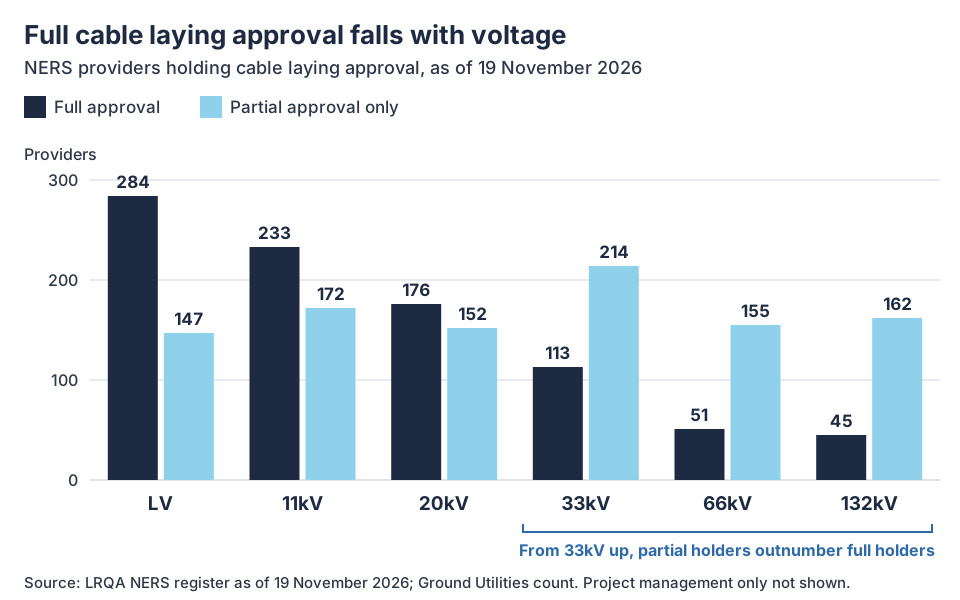
Fewer providers hold full cable laying approval at each step up in voltage. As of 19 November 2026, 284 held it at LV and 45 at 132kV.
| Voltage | Full approval | Partial only | PM only |
|---|---|---|---|
| LV | 284 | 147 | 34 |
| 11kV | 233 | 172 | 30 |
| 20kV | 176 | 152 | 23 |
| 33kV | 113 | 214 | 30 |
| 66kV | 51 | 155 | 23 |
| 132kV | 45 | 162 | 24 |
Source: LRQA NERS register as of 19 November 2026; Ground Utilities count.
Two patterns stand out.
- Full approvals fall with voltage. 284 at LV drops to 113 at 33kV, then to 51 at 66kV and 45 at 132kV.
- Partial approvals do not fall the same way. From 33kV up, partial holders outnumber full holders. At 132kV there were 162 partial holders and 45 full ones.
So from 33kV up, a provider listing the voltage was more likely to hold partial approval than full as of 19 November 2026.
What about cable jointing?
Full jointing approval is scarcer than full cable laying approval at every voltage from 11kV up. As of 19 November 2026 the counts were:
| Voltage | Full jointing approval | Partial only |
|---|---|---|
| 11kV | 199 | 121 |
| 20kV | 140 | 118 |
| 33kV | 74 | 168 |
| 66kV | 30 | 113 |
| 132kV | 26 | 113 |
Source: LRQA NERS register as of 19 November 2026; Ground Utilities count. LV jointing is recorded as separate live and dead badges, so it is left out of this table.
How rare is 132kV NERS approval?
It is rare. As of 19 November 2026, 45 of 543 providers (8%) held full NERS cable laying approval at 132kV, and 26 (5%) held full jointing approval at 132kV.
| Measure (as of 19 November 2026) | Providers |
|---|---|
| Full cable laying approval at 132kV | 45 (8%) |
| Full cable laying approval at every voltage from LV to 132kV | 40 |
| Full 132kV cable laying and full civil works | 42 |
| Full 132kV cable laying, full civil works and all six DNOs listed | 40 |
| Full jointing approval at 132kV | 26 (5%) |
On a 132kV route, the civils, the cable pull and the jointing are often split between firms. Check each firm's own badge at 132kV.
How many NERS providers specialise?
Most providers fall into two groups: specialists holding one or two scopes, and broad providers holding five to eight. We counted the scopes each provider held directly, at full or partial approval, out of the ten scopes above.
| Scopes held (as of 19 November 2026) | Providers |
|---|---|
| 0 (project management or expired only) | 25 |
| 1 | 69 |
| 2 | 88 |
| 3 | 18 |
| 4 | 35 |
| 5 | 67 |
| 6 | 71 |
| 7 | 107 |
| 8 | 46 |
| 9 | 13 |
| 10 | 4 |
The median provider held 5 scopes as of 19 November 2026. Among the specialists on that date:
- 90 providers held civil works, cable laying or both, and no other scope.
- 10 held civil works only.
- 55 held design only.
What do the DNO and region fields show?
They show very little that separates providers. Nearly every entry lists every DNO, region and site type.
- As of 19 November 2026, 526 of the 543 providers listed all six DNOs.
- Every region was listed by at least 506 providers.
- Every site type (commercial, housing, industry, small) was listed by at least 538.
The scope and voltage badges are where providers differ, so read those first.
What do the numbers mean when you hire a contractor?
Use the register as a check, scope by scope and voltage by voltage. A provider being "on the NERS register" tells you little until you know which badge it holds for the work you are buying.
- ☐ Search the provider on LRQA's register and open its entry
- ☐ Find the scope you are buying: civil works, cable laying, jointing, substation, design or network connection
- ☐ Check the badge at your voltage. 33kV approval does not cover 132kV
- ☐ Check whether it is full, partial or PM. PM means the provider will subcontract that scope
- ☐ For partial holders, ask how and when LRQA will witness the work
- ☐ Check every firm in the chain, including subcontractors
- ☐ Note the date you checked, because badges change
Common mistakes when reading the register
- Reading the provider name, not the badge. A firm with full jointing approval may hold only partial cable laying approval.
- Assuming civil works covers cable laying. LRQA defines civil works as excavation and backfilling up to tile or tape level.
- Treating PM as delivery. A PM badge means the work goes to another registered provider.
- Relying on an old screenshot. Entries change as audits happen.
Our guide NERS, ICPs and IDNOs explained covers what each scope means and how accreditation is kept. For who builds what on a new connection, see ICPs and NERS: what they mean for your new connection.
Where Ground Utilities fits
Ground Utilities is one of the 45 providers that held full NERS approval for cable laying at 132kV as of 19 November 2026. Our register entry shows full approval for civil works, and for cable laying at LV, 11kV, 20kV, 33kV, 66kV and 132kV, with all six DNOs. That puts us among the 40 providers holding full cable laying approval at every voltage from LV to 132kV on that date.
We are also one of the specialists counted above: our NERS approval does not include cable jointing or design. We do no gas work, and we do not joint or terminate cables, make final live connections or make connection applications. Others, such as the ICP or the network operator, hold and carry out those scopes.
Our cable routes include:
- two 33kV circuits over about 25 km in Cambridgeshire, with 45 joint bays
- five 33kV circuits with fibre along main roads in London
- the 7.8 km Indian Queens 33kV private wire in Cornwall, which we are now building
See HV and LV cable installation, our accreditations, our ICP civils and cable laying page, or cable jointing and joint bays for how the joint bay work fits with the jointers.
Frequently asked questions
How many companies are NERS accredited?
As of 19 November 2026, 543 providers were on LRQA's NERS register. 393 of them held full approval for at least one scope.
How many NERS providers can lay 132kV cable?
As of 19 November 2026, 45 providers held full NERS cable laying approval at 132kV. Another 162 held partial approval at 132kV.
How many NERS providers can joint at 132kV?
As of 19 November 2026, 26 providers held full NERS jointing approval at 132kV, and 113 held partial approval only.
What is the difference between full and partial NERS approval?
LRQA's key says full approval means the provider has demonstrated that it meets the scheme's requirements for that scope. Partial approval means its systems and procedures are in place but the work has yet to be demonstrated. Partial holders can still tender for and win work.
What does PM mean on the NERS register?
PM means the provider can project manage that scope but cannot carry it out directly. LRQA's key says the work must be subcontracted to a NERS provider registered for that scope.
What does civil works cover under NERS?
LRQA's key defines civil works as excavation and backfilling up to tile or tape level. Laying the cable is a separate scope, approved voltage by voltage.
How do I search the NERS register?
Use LRQA's "Find a NERS registered provider" search, then open the provider's entry to see each scope and voltage badge and its colour.
Is 2nd tier accreditation shown on the register?
It is not shown as a separate class. As of 19 November 2026, 13 entries mentioned 2nd tier in their notes. Ask the provider for its certificate if it says it works as a 2nd tier civils provider.
Is Ground Utilities on the NERS register?
Yes. Ground Utilities Ltd holds full approval for civil works, and for cable laying from LV to 132kV, with all six DNOs. It does not hold jointing or design scopes.
Sources
- Find a NERS registered provider (LRQA, 2026; register downloaded and counted 19 November 2026; includes the NERS scopes of approval key)
- Ground Utilities Ltd on the LRQA NERS register (LRQA, 2026; checked 19 November 2026)