If an electricity cable is coming across your land, you will be asked for a wayleave or an easement. A wayleave is a personal agreement, usually paid yearly. An easement is a permanent right registered against your title.
Two separate things then happen. First, someone negotiates the legal right to put the cable there, then a contractor builds the route. This guide covers both, from the landowner's side of the gate.
Key points
- A wayleave is a licence with the owner or occupier and is not registered at the Land Registry. An easement is a permanent right that is registered and binds later owners (SSEN land rights guide).
- If you refuse, an electricity licence holder can apply to the Secretary of State for a "necessary wayleave" under paragraph 6 of Schedule 4 to the Electricity Act 1989. You must be offered a hearing first.
- Government guidance says a necessary wayleave is usually granted for 15 years, and that voluntary wayleaves normally need six or twelve months' notice to end.
- Under paragraph 7 of Schedule 4 you can claim compensation for the rights and for damage and disturbance. Disputes over the amount go to the Upper Tribunal (Lands Chamber).
- One published landowner pack gives a minimum cable depth of 1.05 m in normal arable land and 1.2 m where land is deep ploughed.
- Defra's soil code says to stop stripping soil after sustained heavy rain, such as more than 10 mm in 24 hours.
- The contractor who digs the trench is usually not the party who negotiated your wayleave. Know who to call for each.
In this guide
- Who will contact you about a cable on your land?
- What is the difference between a wayleave and an easement?
- Do I have to agree to a wayleave?
- How is wayleave and easement compensation worked out?
- What restrictions come with a buried cable?
- Can I end a wayleave later?
- What happens before work starts?
- What does cable construction on farmland look like?
- What happens to my land drains?
- How should the soil be reinstated?
- What aftercare should I expect?
- A landowner's checklist
- Where Ground Utilities fits
- Frequently asked questions
- Sources
Who will contact you about a cable on your land?
You will usually hear first from a land agent or wayleave officer acting for the network company, a connection provider or a developer. Several parties can be involved, and it helps to know which is which.
| Party | What they do |
|---|---|
| Distribution network operator (DNO) | Owns and runs the local network. Takes the land rights for cables it will own. |
| Independent connection provider (ICP) | Builds connections that the DNO or an IDNO then adopts. Often secures the land rights itself. |
| Independent distribution network operator (IDNO) | Owns and runs networks it builds or adopts, and obtains its own land rights. |
| Developer or generator | The customer paying for the connection, such as a solar farm or housing site. |
| Land agent or wayleave officer | Negotiates terms with you for one of the parties above. |
| Civils contractor | Digs the trench, lays ducts and cable, and reinstates the land. |
SSEN's guidance for ICPs shows how this splits. The ICP must identify every affected landowner, occupier and tenant, and get consent in principle from each. It prepares the land rights documents and must meet the fees of landowners, occupiers, tenants and their land agents.
You should have your own land agent or solicitor. Ask early who is paying their fees.
What is the difference between a wayleave and an easement?
A wayleave is a personal agreement that can be ended, while an easement is a permanent right over the land itself. Both let a network company keep a cable on your land and come back to maintain it.
| Wayleave | Easement | |
|---|---|---|
| Legal form | A personal agreement (a licence) with the owner or occupier | A deed granting a right over the land itself |
| Registered at the Land Registry? | No | Yes |
| Binds a buyer of the land? | Not automatically | Yes |
| Can it be ended? | Yes, by notice under its terms | Normally permanent |
| Usual payment | Annual, or sometimes one-off | Usually a lump sum |
| Who prepares it | The company's wayleave officer | Solicitors for both sides |
SSEN's land rights guide says its wayleave agreements are made with landowners and are not registered against the land title. Its deeds of easement are registered in the Land Register and cannot be terminated. The government's guidance on necessary wayleaves makes the same distinction: an easement confers a right over the land itself, and is usually permanent.
Many companies prefer an easement for a long-life cable. Some cables are secured by a termed wayleave instead. UK Power Networks, for example, asks for a termed wayleave along the cable routes shown on its quotation plan.
Do I have to agree to a wayleave?
You can refuse a voluntary wayleave, but an electricity licence holder can then ask the Secretary of State to impose one. The power is in paragraph 6 of Schedule 4 to the Electricity Act 1989, and the process has fixed steps:
- The licence holder serves notice asking you to grant the wayleave within at least 21 days.
- If you refuse, or offer terms it will not accept, it can apply to the Secretary of State.
- You, and the owner if different, must be offered a hearing before an appointed person.
- If granted, the wayleave binds later owners and occupiers. It is not registered against your title.
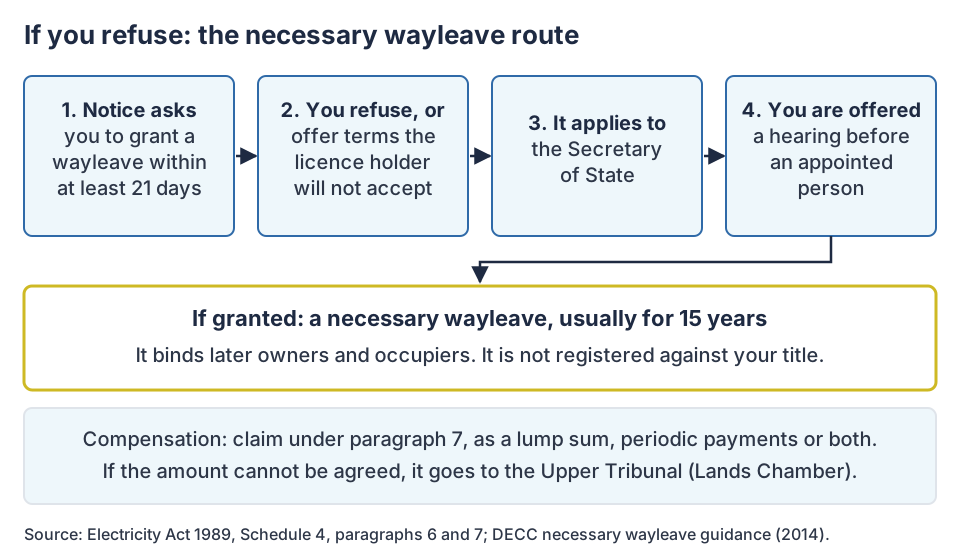
Government guidance says the Secretary of State usually grants a necessary wayleave for 15 years. Licence holders can also use compulsory purchase under Schedule 3 of the Act. SSEN describes the necessary wayleave route as long, complex and costly, and a last resort.
Two limits apply:
- If the land is covered by a dwelling, or will be built on once planning permission is used, the Secretary of State will not consider a line on or over it.
- If the cable is a private wire for a company without an electricity licence, these powers do not apply. Ask your agent how the rights will be secured.
How is wayleave and easement compensation worked out?
Wayleave and easement payments are negotiated, and there is no fixed national rate. For a necessary wayleave, paragraph 7 of Schedule 4 lets the occupier, and the owner if different, claim compensation as a lump sum, periodic payments, or both.
You can also claim for damage to land or property, and for disturbance. If you cannot agree a figure, either side can refer it to the Upper Tribunal (Lands Chamber). The Secretary of State cannot set the amount.
| Type of right | How payment is usually made | Who settles a dispute |
|---|---|---|
| Voluntary wayleave | Negotiated; SSEN says it depends on the amount and type of equipment and its effect on operations such as farming, and is normally reviewed each year | Agreed between the parties |
| Easement | A one-off payment is more usual | Agreed between the parties |
| Necessary wayleave | Lump sum, periodic payments, or both, under paragraph 7 of Schedule 4, plus damage and disturbance | The Upper Tribunal (Lands Chamber), not the Secretary of State |
Ask your agent to cover:
- the payment for the right itself;
- crop loss and loss of use during construction, including any temporary working area;
- damage to drains, fences, gates, tracks and water supplies;
- any effect on agri-environment scheme payments;
- your agent's and solicitor's fees.
The Norfolk Boreas offshore wind farm landowner pack is one published example. It says compensation would cover the rights sought, temporary occupation, crop losses and other direct disturbance, including losses from agricultural subsidy payments.
What restrictions come with a buried cable?
Expect limits on building and deep-rooted planting over the cable, while normal farming can usually carry on. Two published examples:
- UK Power Networks' termed wayleave restricts planting trees and putting up structures that could damage or obstruct access to the cables. Structures already there, or shown on the plan, are exempt.
- The Norfolk Boreas pack says normal farming can continue once the land is reinstated. It also lists restrictions on new buildings and deep-rooted planting over the cables.
Depth matters for cultivation. The same pack calls these figures standard electricity industry practice:
| Land use | Minimum cable depth (Norfolk Boreas pack) |
|---|---|
| Normal arable land | 1.05 m |
| Land that is deep ploughed | 1.2 m |
Each network operator sets its own cover depths, so check the figure in your agreement. Our cable ducting guide compares several operators' requirements.
Tell the company now about any plans for the land: drainage schemes, subsoiling, new buildings or planting. These are easier to design around before the route is fixed.
Can I end a wayleave later?
You can usually end a voluntary wayleave by giving the notice it requires, but the cable does not simply go. Government guidance says termination clauses normally require six or twelve months' notice. Removal is then a two-step process:
- Serve a notice to terminate under the wayleave's own terms.
- When that expires, serve a notice to remove the line under paragraph 8 of Schedule 4.
The licence holder then has three months to apply for a necessary wayleave or make a compulsory purchase order. If it does neither, it must remove the line. If it applies and is refused, it has one month from the decision, or longer if the Secretary of State allows.
Government guidance warns that a notice must clearly ask for removal. A request to discuss, divert or reroute is not enough. An easement, once granted, cannot normally be ended this way.
What happens before work starts?
Surveys come first, and a licence holder must give the occupier 14 days' notice before entering to survey. The power is in paragraph 10 of Schedule 4, and the surveyor must make good any damage. Before the contractor arrives, you should know:
- the agreed route and working strip, marked on a plan;
- where the access points and haul route will be;
- which gates, fences and hedges will be crossed, and how stock will be kept in;
- where topsoil and subsoil will be stored;
- the known land drains, water pipes and private services;
- the working hours and the name of the site contact.
Two things to do yourself:
- ☐ Give the contractor any drainage plans you hold. Old tile drain maps, even rough ones, are worth handing over.
- ☐ Take dated photographs of the strip, gateways and boundaries before anyone arrives. They make any later claim for damage far simpler.
The contractor will also look for buried services, in fields as well as roads. Our guide to avoiding utility strikes explains how.
What does cable construction on farmland look like?
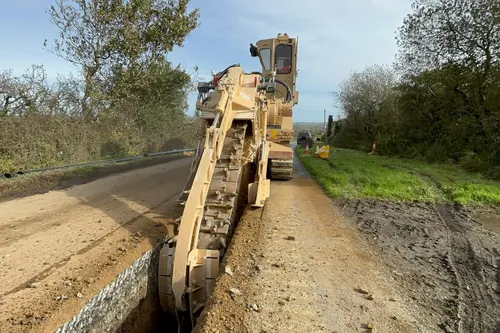
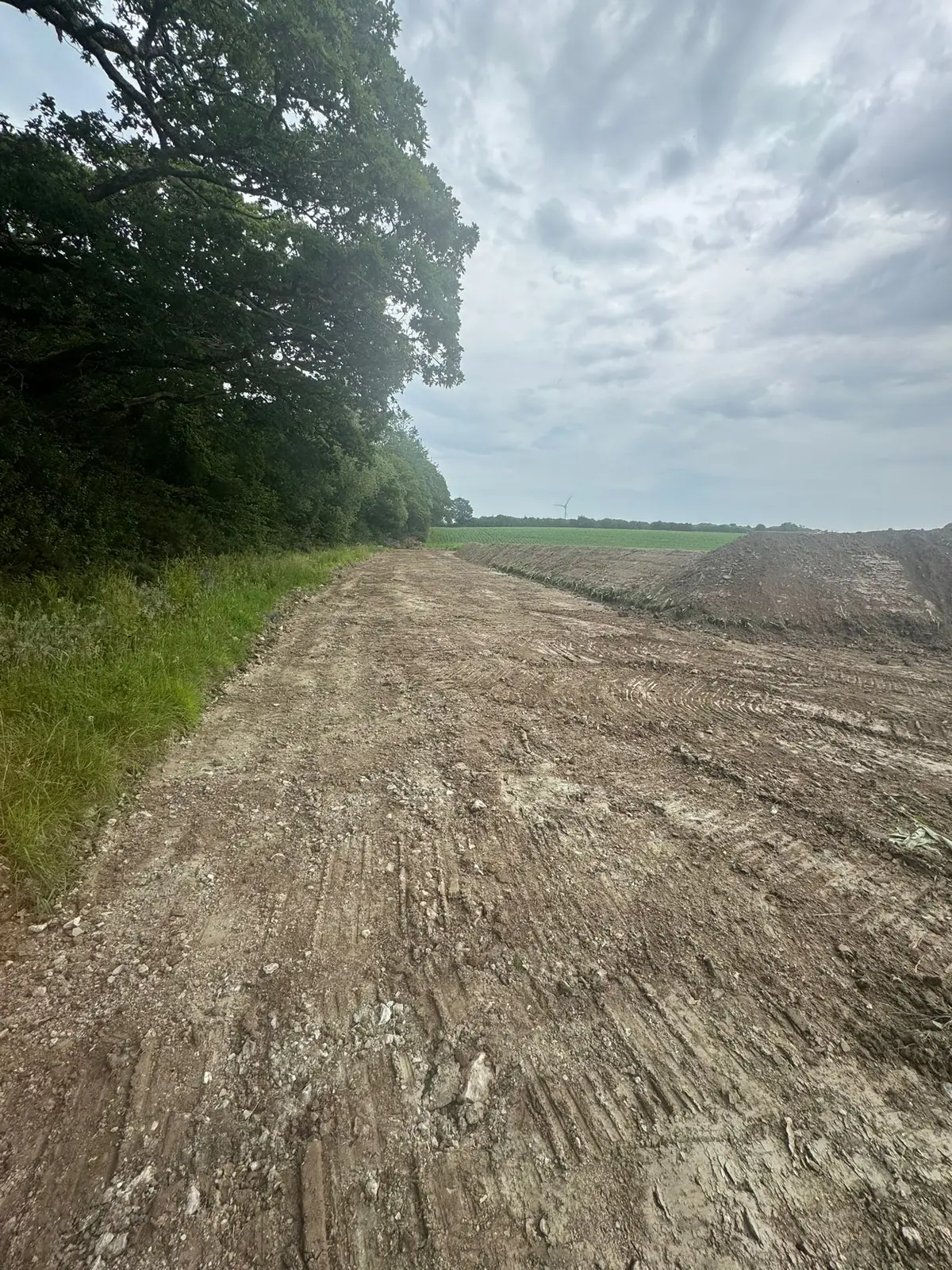
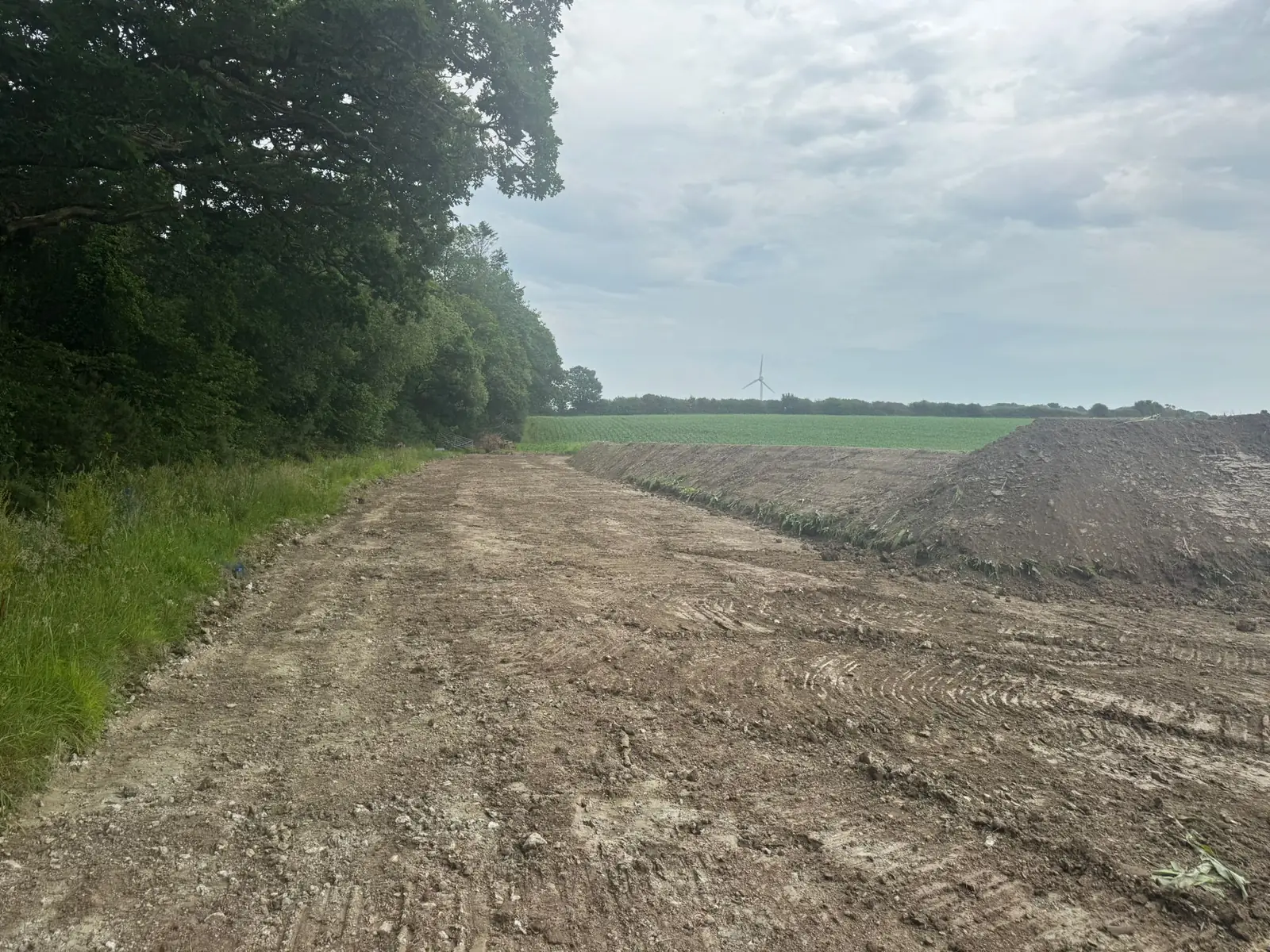
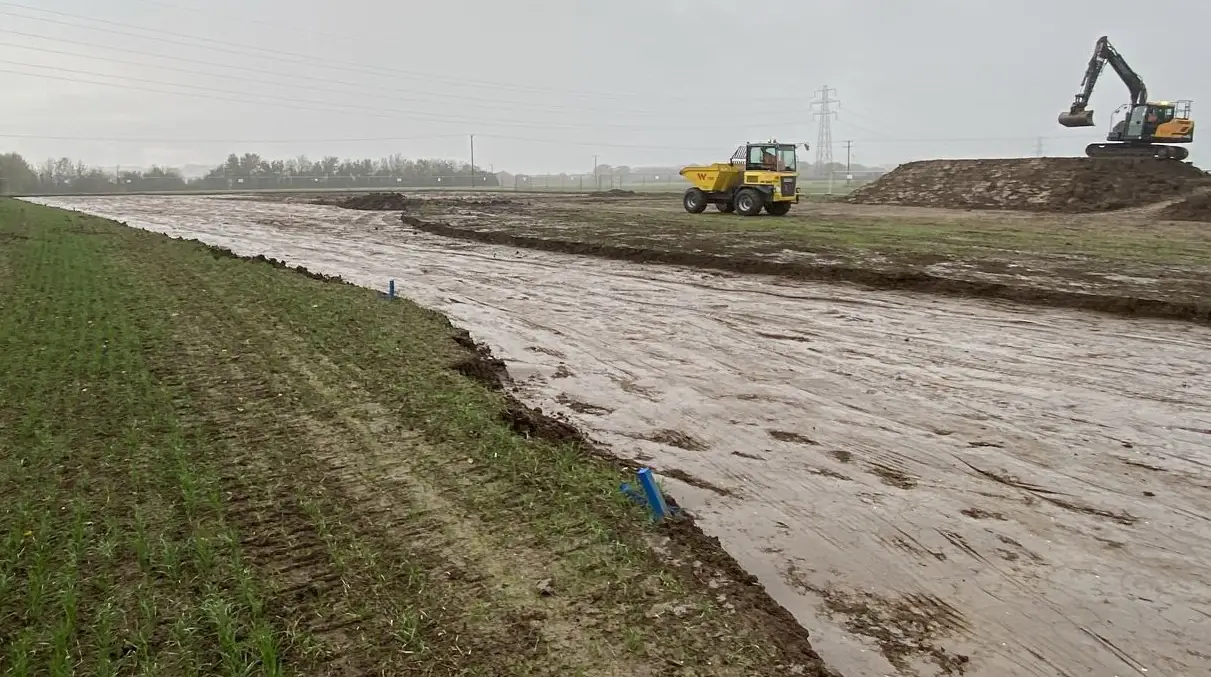
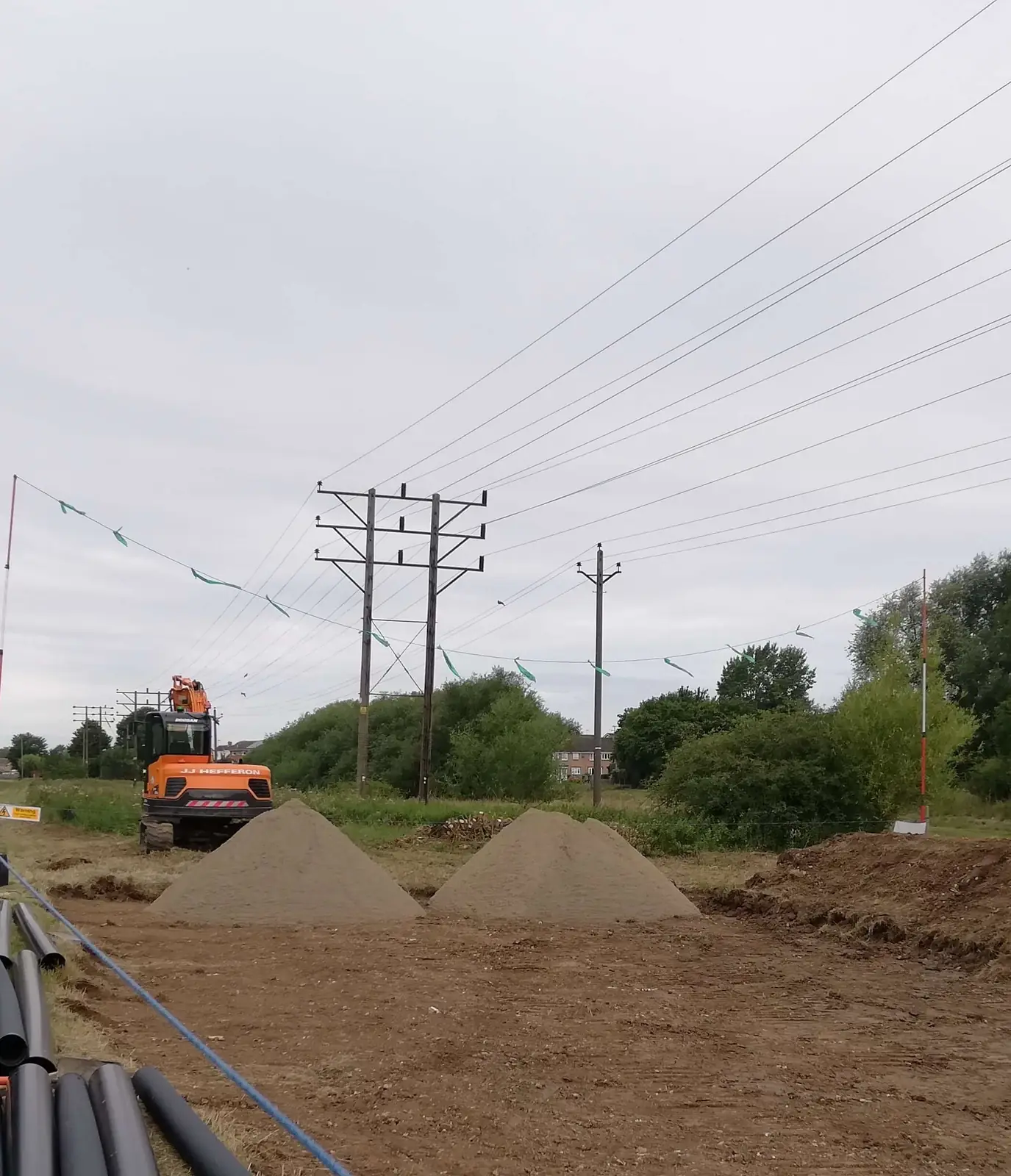
A field cable route is a fenced working strip where topsoil is stripped, a trench is dug, ducts or cable are laid, and the land is put back. Most 11kV and 33kV field routes follow the same broad sequence, moving along the strip in stages.
- Fence the working strip and set up access from the road.
- Strip topsoil from the working area and store it separately.
- Lay trackway or a haul road where ground is soft.
- Dig the trench, usually with an excavator or a trencher.
- Lay cable ducts, or the cable direct, on a bedding layer.
- Backfill with the specified material, with marker tape above.
- Build joint bays at intervals, where cable lengths are joined.
- Pull the cable through the ducts.
- Jointers join and test the cable. This is specialist work done by others.
- Reinstate the joint bays, then the subsoil and topsoil.
- Remove fencing and trackway, and reinstate boundaries.
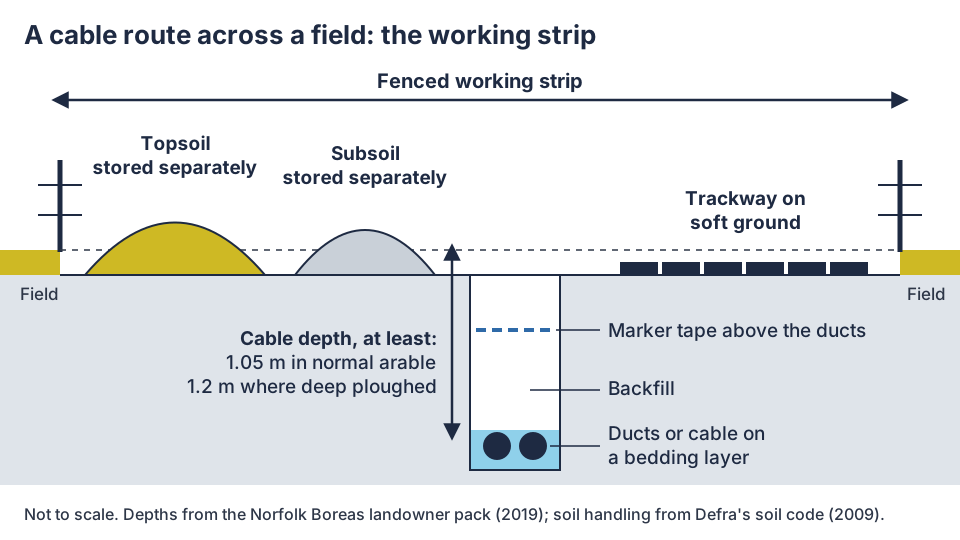
Where a hedge, ditch, watercourse or road must stay intact, the route may go under it by horizontal directional drilling. That avoids an open cut but needs a compound at each end.
Expect machinery, cable drums and some noise for the length of the job. On a long route, any one field may see work for a few weeks, then a return visit for joint bays and cable pulling.
What happens to my land drains?
A cable trench cuts every land drain it crosses, so drains need to be recorded and reconnected. Land drainage is the issue most likely to cause trouble after the contractor has gone. Good practice is to plan for this before the trench opens:
- Survey and record existing drains, using your plans and what is found on site.
- Install cut-off or header drains where needed, so water from cut drains is carried away.
- Record every drain cut, with its position, depth and size.
- Reconnect or replace cut drains across the trench, so they will not settle.
- Give the landowner the records when the job is finished.
- Agree in writing who repairs drains that fail after the job, and for how long.
The Norfolk Boreas landowner pack sets out one published approach. Agricultural drainage specialists prepare pre- and post-construction drainage designs, intercept existing drains and drain the working width. The aim is to restore the land to its condition before the works.
How should the soil be reinstated?
Topsoil and subsoil should be stripped, stored and replaced separately, in dry conditions, with compaction relieved at the end. Defra's Construction Code of Practice for the Sustainable Use of Soils on Construction Sites sets out sound methods. It dates from 2009, and Defra keeps it for reference.
Points from the code worth holding a contractor to:
- Strip, store and replace topsoil and subsoil separately. Mixing them harms the topsoil.
- Handle soil in the driest condition possible, using tracked plant where you can.
- Soil wetter than its plastic limit should ideally be left to dry further.
- If sustained heavy rain falls during stripping, such as more than 10 mm in 24 hours, stop. Restart only after at least a full dry day.
- Wet soil stored in windrows should be heaped no higher than 2 m, with no machines running on it.
- Relieve compaction after replacement, for example by ripping.
One case study in the code, a scheme restoring farmland after temporary use, kept topsoil stockpiles below 3 m and subsoil below 5 m. It also required a five-year aftercare scheme.
Field reinstatement has no national standard, as our road reinstatement guide explains:
- In the highway, reinstatement follows a national specification, the SROH.
- In a field, it is governed by your easement, wayleave or landowner agreement. So write the standard you expect into that agreement.
What aftercare should I expect?
Most problems on a reinstated cable route show up a season or two after the works. Look for:
- settlement along the trench line or over joint bays;
- wet patches or ponding, which can mean a drain was missed or failed;
- poor crop growth along the strip, often a sign of compaction or mixed soil;
- stones brought to the surface;
- gaps in replanted hedges, or failed fencing.
Photograph problems as they appear and report them in writing. Your agreement should say who fixes defects and for how long.
A common mistake
Many landowners sign heads of terms that cover the payment but say nothing about drains, soil handling or aftercare. Those are the items that cost money later. Make sure the agreement names who repairs them, to what standard, and for how many years.
A landowner's checklist
Use this list before you sign and before work starts.
- ☐ I know who is asking for the rights: DNO, ICP, IDNO or developer.
- ☐ I have my own land agent or solicitor, and I know who pays their fees.
- ☐ I know whether I am being asked for a wayleave or an easement, and for how long.
- ☐ The route, working strip, access and storage areas are on an agreed plan.
- ☐ Restrictions over the cable are clear, and fit my future plans for the land.
- ☐ Compensation covers crop loss, temporary occupation and damage.
- ☐ Drainage records are shared, and drain repair is agreed in writing.
- ☐ The soil handling method, including wet-weather stops, is agreed.
- ☐ Stock, gates, fences, hedges and water supplies are covered.
- ☐ I have dated photographs of the land before entry.
- ☐ I have a named contact on site and an agreed aftercare period.
Where Ground Utilities fits
Ground Utilities is a civils and cable laying contractor that builds cable routes across farmland, from its base at Highdrove Farm, Cottenham, Cambridgeshire. We work across England and Wales. We build the route: trenching, ducts, joint bays, cable installation and reinstatement of the highway, footpath, verge or field.
Wayleaves and easements are negotiated by land agents acting for the developer, the connection provider or the network operator. We do not design networks, joint or terminate cables, make connection applications or make final live connections.
Some of our field work:
- On a 33kV and 11kV overhead line refurbishment in Norfolk, we installed two 33kV and two 11kV underground ducted circuits. The trench, up to 1.6 metres wide, ran mainly through agricultural land, with 13 joint bays.
- On Novus Power's Indian Queens private wire in Cornwall, 3.3 km of the open-cut trench runs through farmland. Winter work there needed trackway, ground protection and dewatering on waterlogged farmland. The scope includes full reinstatement of the highway, hedges and farmland.
We do the work in-house with our own equipment, and every job has a dedicated contract manager as one point of contact. We hold full NERS approval for cable laying from LV to 132kV and for civil works, with all six distribution network operators. See HV and LV cable installation or contact us.
Frequently asked questions
What is the difference between a wayleave and an easement?
A wayleave is a personal agreement with the owner or occupier, usually paid yearly, and not registered against the title. An easement is a deed granting a permanent right over the land, registered at the Land Registry and binding later owners.
Can I refuse a wayleave for an electricity cable?
You can refuse a voluntary wayleave. An electricity licence holder can then apply to the Secretary of State for a necessary wayleave under Schedule 4 of the Electricity Act 1989. You must be given a chance to be heard first.
How much is a wayleave payment?
There is no single rate. Payment depends on the equipment and its effect on your use of the land, and is negotiated. For a necessary wayleave, unresolved compensation is decided by the Upper Tribunal (Lands Chamber).
Who pays my land agent's fees?
Often the party seeking the rights. SSEN requires ICPs to meet the fees of landowners, occupiers, tenants and their land agents. Confirm this in writing before your agent starts.
Does a wayleave transfer when I sell the land?
A voluntary wayleave does not automatically bind a buyer, because it is not registered. An easement does. A necessary wayleave granted by the Secretary of State binds later owners and occupiers.
How deep will the cable be in a field?
It depends on the network operator and the land. The Norfolk Boreas landowner pack gives 1.05 m in normal arable land and 1.2 m where deep ploughing happens. Check the depth stated in your agreement.
Who repairs land drains damaged by a cable trench?
Whoever your agreement makes responsible. Agree before work starts how drains will be recorded, reconnected and repaired, and for how long after the works.
Can I end a wayleave?
Usually, by giving the notice the wayleave requires, often six or twelve months. You then serve a notice to remove. The licence holder has three months to apply for a necessary wayleave or a compulsory purchase order.
Sources
- Electricity Act 1989, Schedule 4 (legislation.gov.uk, 1989)
- Electricity Act 1989: Guidance for applicants and landowners and/or occupiers: application for the grant of a necessary (compulsory) electricity wayleave or felling and lopping of trees order in England and Wales (Department of Energy and Climate Change, 2014)
- Construction code of practice for the sustainable use of soils on construction sites (Defra, 2009)
- Land Rights, Wayleaves and Legal guide: New Connections England (Scottish and Southern Electricity Networks, 2018)
- Wayleaves guide: New Connections, requirement for land rights (Scottish and Southern Electricity Networks, 2015)
- Guidance for Independent Connection Providers undertaking Wayleaves and Consenting activities (Scottish and Southern Electricity Networks, 2020)
- 3.22 Land rights (non-contestable works only): termed wayleave for underground cables (UK Power Networks)
- Norfolk Boreas Offshore Wind Farm Consultation Report, Appendix 13.24: Landowner Information Pack (Norfolk Boreas Limited, via the Planning Inspectorate, 2019)