If you have a Gate 2 offer, you now hold a confirmed connection date and a place in the reformed queue. To keep that place you must sign on time, post any securities and then meet a series of queue management milestones. None of that builds the cable route, whose land rights, street works consents and civils all still have to be arranged and were not covered by your Gate 2 evidence.
Position at 18 November 2026. NESO had to issue Gate 2 Phase 1 offers by 31 October 2026, and Ofgem expects distribution (DNO) Phase 1 offers to be complete by 30 November 2026. Phase 2 offers follow by 31 January 2027, and Phase 2 distribution offers by 31 March 2027. Dates in this guide are as published by Ofgem and NESO on or before that date.
Key points
- A Gate 2 offer sets out your connection date, works, cost, technical information and next steps. NESO asks directly connected customers to sign within 90 days and to post securities within 30 days of signing.
- Projects connecting through a DNO get their offer from the DNO, which also manages their queue milestones. Check your own offer letter for the acceptance period.
- Gate 2 land evidence covers the project site only. NESO's methodology says the red line boundary "excludes the cable routes or access roads or land needed for the network substation".
- After signing, milestones run from starting planning (M1) and securing land (M3) to starting construction (M8).
- Missing a planning or land milestone can end the agreement once the remedy period runs out.
- The cable route needs its own easements or wayleaves and its own street works consents. It also needs surveys and contractors with the right NERS scopes.
In this guide
- What is a Gate 2 offer?
- Where are Gate 2 offers up to?
- What do you have to do when the offer arrives?
- Which queue management milestones apply after you sign?
- Does Gate 2 cover the land for the cable route?
- What has to be in place before the civils start?
- Who does what on the cable route?
- How long does the cable route take to build?
- Where Ground Utilities fits
- Frequently asked questions
- Sources
What is a Gate 2 offer?
A Gate 2 offer is a grid connection offer, or a change to an existing agreement, that gives a project a confirmed connection date, connection point and queue position. It is the main outcome of connections reform in Great Britain.
Connections reform replaced the old first come, first served queue in Great Britain. NESO says the queue "grew tenfold in five years, and exceeded 700 GW" before reform. Projects now need to meet readiness and strategic alignment criteria to reach Gate 2.
| Outcome | Gate 2 | Gate 1 |
|---|---|---|
| Who gets it | Projects that meet the readiness and strategic alignment criteria | Projects that do not meet the criteria |
| What it gives | In NESO's words, projects "can secure a confirmed connection date, connection point, and queue position" | No confirmed connection date |
| What comes next | Sign, post securities, meet queue milestones | Can reapply in a later application window |
For existing agreement holders, the Gate 2 offer arrives as a Gate 2 Modification Offer. NESO describes it as a formal contract that "sets out your confirmed connection date, works, cost, technical information and the next steps required". Read it closely: it holds deadlines specific to your project.
Where are Gate 2 offers up to?
NESO had to issue Gate 2 Phase 1 offers by 31 October 2026, with Phase 2 offers due by 31 January 2027. Ofgem expects distribution offers to follow by 30 November 2026 and 31 March 2027. The timetable has moved several times; these are the dates in Ofgem's two 2026 decision letters and NESO's published timeline.
| Milestone | Deadline or window | Source |
|---|---|---|
| Gate 2 Phase 1 offers issued by NESO | No later than 31 October 2026 (moved from 30 September 2026) | Ofgem, 2 October 2026 |
| Gate 2 Phase 1 distribution offers | NESO window early July to mid November 2026; Ofgem expects completion by 30 November 2026 | NESO timeline; Ofgem, 3 June 2026 |
| Gate 2 Phase 2 offers issued by NESO | No later than 31 January 2027 | Ofgem, 3 June 2026 |
| Gate 2 Phase 2 distribution offers | NESO window mid October 2026 to mid March 2027; Ofgem expects completion by 31 March 2027 | NESO timeline; Ofgem, 3 June 2026 |
| Gate 1 offer after a Gate 2 offer lapses | As soon as reasonably practicable, and no later than 6 weeks after the lapsed offer | Ofgem, 3 June 2026 |
Ofgem's October letter says the second Phase 1 extension affected "approximately 62 offers". The main cause was late transmission owner construction offers. Around 25 other offers were held back, mostly at customer request.
Phase 1 and Phase 2 refer to the Clean Power 2030 phase allocation. NESO's handbook defines them as Phase 1 (2026 to 2030) and Phase 2 (2031 to 2035). The phase relates to your firm or enduring non-firm connection date, so an interim non-firm date can still fall earlier.
What do you have to do when the offer arrives?
Sign the offer within its acceptance period, post any securities on time and diary every milestone date. These first deadlines are contractual, and missing them can make the offer lapse.
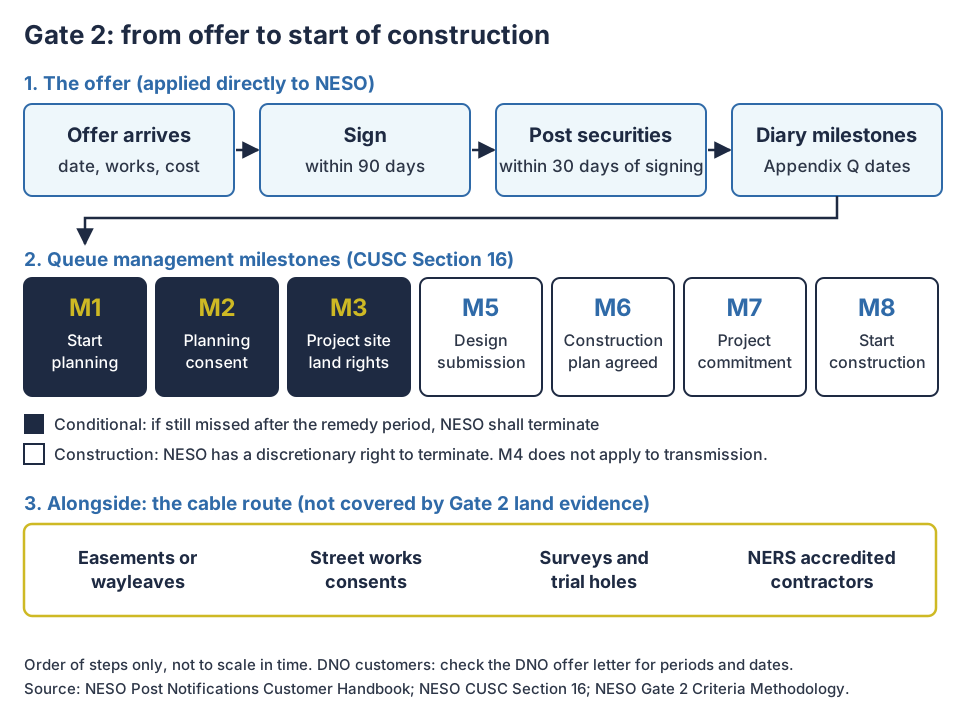
If you applied directly to NESO
- Read the offer and check the connection date, works and cost. Raise questions through NESO's Connections Portal.
- Sign and return it within 90 days. NESO's handbook sets this period for Gate 2 Modification Offers.
- Post securities within 30 days of signing. NESO says the first payment depends on when the transmission owner starts spending. It "may range from zero to several million pounds".
- Diary every milestone date in Appendix Q. Each construction agreement carries a table of milestone dates for that project.
If your project connects through a DNO
NESO's timeline says DNO customers should follow their DNO's own process. The Gate 2 Criteria Methodology says queue milestones and ongoing land compliance for embedded projects "will continue to be managed by DNOs". Your acceptance period, securities and milestone dates are in the DNO's offer letter, so read that letter first.
For context, Ofgem's June 2026 letter notes that under the normal process, offers and their acceptance each typically run to "a period of three months".
If you do not accept
- The Gate 2 offer lapses.
- NESO issues a Gate 1 offer. Ofgem expects that to happen no later than 6 weeks after the Gate 2 offer lapses.
- NESO asks for the Gate 1 Agreement to Vary to be signed within 28 days. It has no confirmed connection date.
What is the Progression Commitment Fee?
The Progression Commitment Fee (PCF) is a security that applies only if NESO activates it.
- NESO activates it only if terminations at M1 pass a cumulative 6.5 GW before 31 December 2030.
- If activated, the security "starts at £2.5k/MW and increases every six months up to £10k/MW".
- At NESO's 3 August 2026 update the metric stood at 0 MW, so the PCF was dormant.
Which queue management milestones apply after you sign?
After you sign, the project must meet user progression milestones M1 to M8, from starting planning (M1) and securing land (M3) to starting construction (M8). Queue management is how the network operator checks your project is moving.
For transmission projects the rules sit in CUSC Section 16. DNOs run an equivalent process for embedded projects.
| Milestone | What you must show | Type |
|---|---|---|
| M1 Initiate planning consent | Planning application submitted, or a declaration that none is needed | Conditional |
| M2 Secure consent | Planning decision notice granting permission | Conditional |
| M3 Secure land rights | Ownership, lease, agreement to lease or a qualifying option for the project site | Conditional |
| M4 | Does not apply to transmission | None |
| M5 Contestable design works submission | Design obligations received by the transmission owner, where you build contestable works yourself | Construction |
| M6 Agree construction plan | A detailed programme with fixed start and end dates, aligned to your completion date | Construction |
| M7 Project commitment | For example a main plant contract, a board decision on final investment, or a subsidy award | Construction |
| M8 Initiate construction | A board letter confirming site construction has started | Construction |
Source: CUSC Section 16 table of User Progression Milestones (NESO).
How are milestone dates set?
Most dates count back from your contracted completion date. M1 is the earlier of two dates: one counted back from completion, and one counted forward from the Gate 2 offer date. The forward period depends on the consent route:
| Consent route | Forward period from Gate 2 offer to M1 |
|---|---|
| Town and Country Planning | 2 years |
| Section 36 or DCO | 3 years |
What happens if you miss one?
You must provide evidence by each due date. NESO then has 10 business days to say whether the project is "On Track" or "Termination". After that:
- If a conditional milestone (M1 to M3) is still missed at the end of the remedy period, NESO "shall terminate" the agreement.
- If a construction milestone (M5 to M8) is missed, NESO has a right to terminate, at its discretion.
- If the issue is exceptional, it can earn a new milestone date if you notify early and supply evidence.
Can you move the site?
Only within limits:
- Whatever capacity you build inside the original red line boundary, only 50% of that figure can be located outside it.
- If that calculation gives less than your installed capacity, the capacity is cut to match.
Does Gate 2 cover the land for the cable route?
No. Gate 2 land evidence covers the project site only, and the cable route needs its own land rights. The documents are clear:
- NESO's Gate 2 Criteria Methodology (12 June 2026) says the site "excludes the cable routes or access roads or land needed for the network substation".
- The same methodology says the red line boundary "does not need to show the project's cable route".
- CUSC Section 16 adds that the M3 land evidence does not cover easements linked to the site.
So a project can hold Gate 2 status with no rights at all over its route to the point of connection. Those rights still need to be secured before anyone can dig.
Who arranges cable route land rights?
It depends on who will own the cable and who is building it.
- Network assets for adoption. UK Power Networks says that on its option B or C, you negotiate any consent that is an interest in land. It must be on UK Power Networks' standard form. Its own solicitors then complete the conveyancing, at your cost.
- SSEN's split. SSEN lists "land rights negotiations with third party landowners" as contestable. It keeps "produce wayleave/easement documentation and enter into agreements with third party landowners" as non-contestable.
- Private wire or customer-owned cable. No network operator completes the land documents, so the developer agrees rights directly with each landowner along the route. Our guide to a cable route across your land covers it from the landowner's side.
Start this early. A route crossing farmland, hedges, verges and the highway may involve several landowners and the highway authority.
What has to be in place before the civils start?
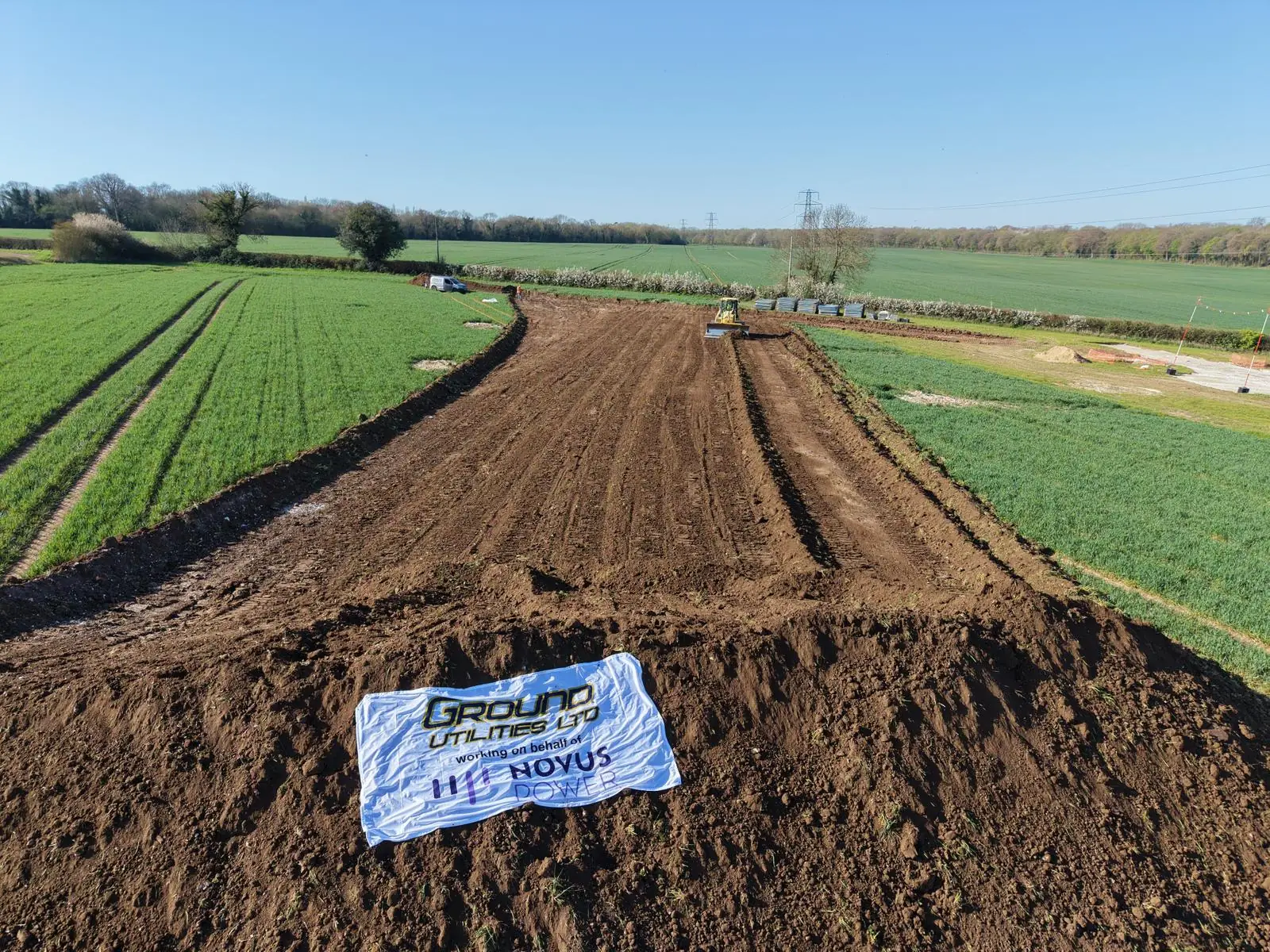
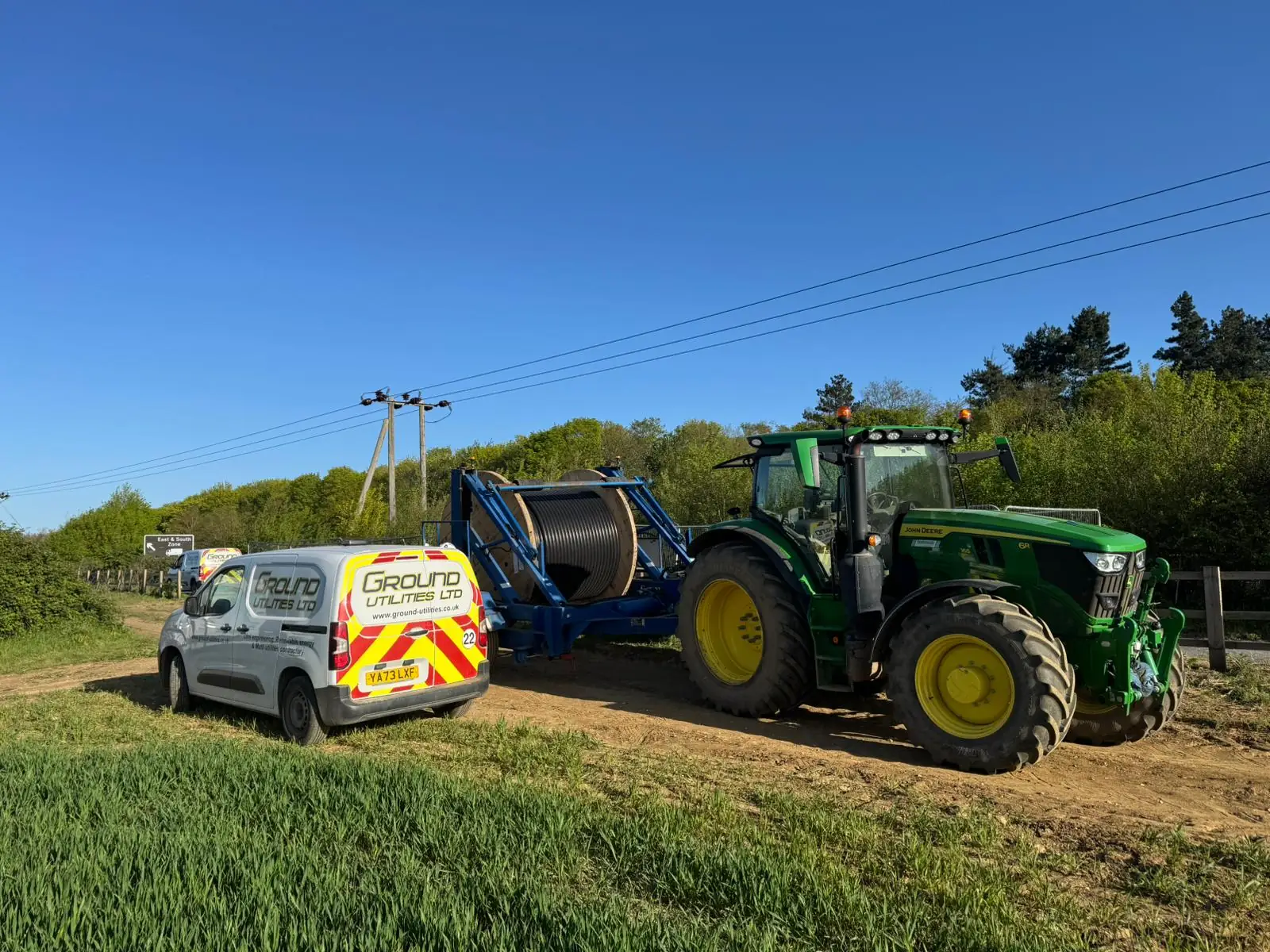
Before the civils start you need the signed offer, land rights for every parcel, consents, street works permissions, surveys and appointed contractors. Use this as a pre-start check for the route.
- ☐ Gate 2 offer signed and securities posted on time
- ☐ Milestone dates from Appendix Q (or the DNO equivalent) entered in the project programme
- ☐ Point of connection and route design approved by the network operator or a design-accredited provider
- ☐ Easements, wayleaves or leases agreed for every land parcel on the route
- ☐ Planning consent for the route and any substation, where needed
- ☐ Section 50 licence for private apparatus in the highway, or permits for the network operator's works
- ☐ Traffic management design and road space booked
- ☐ Utility records gathered and surveys done, with trial holes where needed
- ☐ Cable, ducts and joint materials ordered against the programme
- ☐ NERS accredited contractors appointed for each scope: civils, cable laying, jointing
- ☐ Construction plan agreed with the network operator (M6)
The network operator will also have conditions of its own. UK Power Networks, for example, will not schedule its work until it has a signed acceptance form and payment. It also needs completed legal consents and, for option B or C, an accepted design and programme.
Materials can drive the programme. On the Indian Queens 33kV private wire, cable drums and ducts arrived late and the works were re-sequenced to keep progressing.
Who does what on the cable route?
On a grid connection the cable route is split between several parties. Each needs the right approvals for its part.
| Task | Usually done by |
|---|---|
| Sign the offer, post securities, meet milestones | Developer |
| Point of connection, design approval, inspection, adoption | Network operator (or an accredited ICP where the operator allows self-determination or self-approval) |
| Route design | NERS design-accredited provider or the network operator |
| Land rights negotiation and consents | Developer, ICP or land agent; legal completion by the network operator for adopted assets |
| Highway licence or permits, traffic management | Developer's contractor or the network operator |
| Trenching, ducting, joint bays, cable laying, reinstatement | NERS accredited civils and cable laying contractor |
| Jointing, terminations, final connection | NERS accredited jointing provider, ICP or the network operator |
For definitions of ICPs, IDNOs, NERS scopes and contestable works, see our guide NERS, ICPs and IDNOs explained. For the full sequence on a distribution connection, see how a new HV connection gets built.
How long does the cable route take to build?
A grid connection cable route usually takes months to build. Our own 33kV routes of 6 km to 25 km have run from under a year to about 16 months, depending on length, ground, crossings and how much runs in the highway.
| Route | Length and scope | Dates |
|---|---|---|
| Indian Queens private wire, Cornwall | 7.8 km 33kV private wire, about 46 km of cable, 19 joint bays, Section 50 licence | June 2026 to February 2027 (in progress) |
| HV cable installations, Cambridgeshire | Two 33kV circuits and fibre over about 25 km, 45 joint bays | May 2018 to September 2019 |
| Thetford cable route, Norfolk | 6 km, dual 33kV circuits and fibre, tied into an HDD crossing beneath a river, then primary substation civils | 2023 |
Work back from your connection date. Under CUSC Section 16, construction milestones M6 to M8 fall months before completion. The cable route usually has to be finished before jointing, testing and energisation, so it sits early in that window.
Where Ground Utilities fits
Ground Utilities builds the civils and cable route for grid connections. We hold full NERS approval for civil works, and for cable laying at LV, 11kV, 20kV, 33kV, 66kV and 132kV, with all six distribution network operators. You can check this on the LRQA NERS register.
On a Gate 2 project that means:
- trenching, ducting, joint bays, cable pulling and reinstatement, from 240V to 132kV;
- the site civils on battery storage and solar sites: see battery storage and solar farm civils;
- where a client needs it, applying for and managing the Section 50 licence ourselves, as we did on the Indian Queens private wire.
What we do not do matters here too. We do not make connection applications or respond to network offers, and we do not do design. We do not joint or terminate cables or make the final live connection.
We do no gas work. On a Gate 2 scheme we work for, or alongside, the developer, EPC, ICP or network operator that holds those roles.
See our ICP civils and cable laying service, or call 01223 423918.
Frequently asked questions
How long do I have to accept a Gate 2 offer?
NESO's customer handbook gives 90 days to sign a Gate 2 Modification Offer from NESO. Securities are then due within 30 days of signing. If you applied through a DNO, check the acceptance period in your DNO's offer letter.
When will distribution Gate 2 offers be issued?
Ofgem expects Phase 1 distribution offers to be complete by 30 November 2026 and Phase 2 by 31 March 2027. NESO's timeline gives Phase 2 distribution offers a window of mid October 2026 to mid March 2027.
What happens if I do not sign my Gate 2 offer?
The offer lapses and NESO issues a Gate 1 offer. Ofgem expects that within 6 weeks of the lapsed Gate 2 offer. Gate 1 has no confirmed connection date.
Does my Gate 2 red line boundary include the cable route?
No. NESO's Gate 2 Criteria Methodology says the project site excludes cable routes, access roads and land for the network substation. You still need rights over the route.
What is M1 in queue management?
M1 is "Initiate Planning Consent": submitting the planning application, or declaring none is needed. For Town and Country Planning projects it falls within 2 years of the Gate 2 offer date. It falls earlier if counting back from your completion date gives an earlier date.
Can a missed milestone cost me my connection?
Yes. If a conditional milestone (M1, M2 or M3) is still missed after the remedy period, CUSC Section 16 says the agreement shall be terminated. Construction milestones give NESO a discretionary right to terminate.
Who builds the cable route for a Gate 2 project?
Contractors holding the right NERS scopes. Civils and cable laying contractors build the trench, ducts, joint bays and cable. Jointing providers make the joints, and the network operator or an accredited ICP makes the final connection.
Do I need a Section 50 licence for my grid connection cable?
You need one if you will place private apparatus, such as a private wire, in the street and you are not a statutory undertaker. DfT guidance says any organisation or individual that is not a statutory undertaker or an EV chargepoint operator must apply for one. For a cable that a network operator will adopt, agree with the operator and the highway authority which route applies before you fix the programme. See our Section 50 licence page.
Sources
- Ofgem agreement regarding the timetable for issuing connection offers under the Gate 2 to Whole Queue ("G2tWQ") process (Ofgem, 3 June 2026)
- Ofgem agreement to a further alternative timetable for issuing Gate 2 Phase 1 connection offers under the Gate 2 to Whole Queue ("G2tWQ") process (Ofgem, 2 October 2026)
- Connections reform timeline (NESO, 2026)
- About Connections Reform (NESO, 2025)
- Connections Reform What Next: Post Notifications Customer Handbook (NESO, December 2025)
- Gate 2 Criteria Methodology (NESO, 12 June 2026)
- CUSC Section 16: Queue Management Process (NESO, 2026)
- Progression Commitment Fee (PCF) (NESO, updated 3 August 2026)
- Connections Reform (SSEN, 2026)
- New connections: you have a choice (SSEN)
- 3.28 Land rights for option B or C (UK Power Networks)
- Issuing section 50 street works licences (Department for Transport, 2026)
- 4.1.11 Programming your work (UK Power Networks)