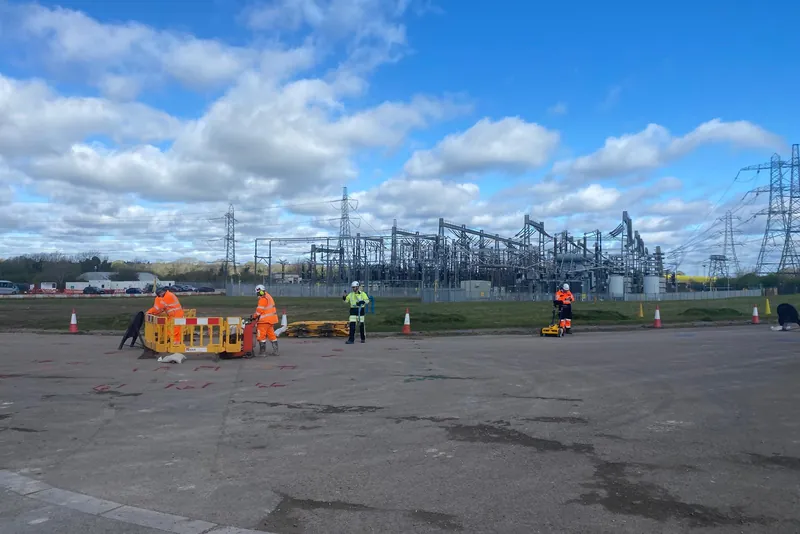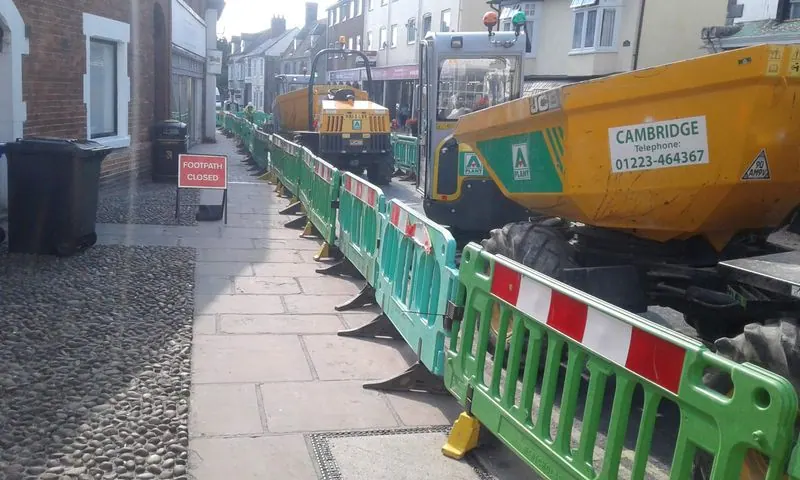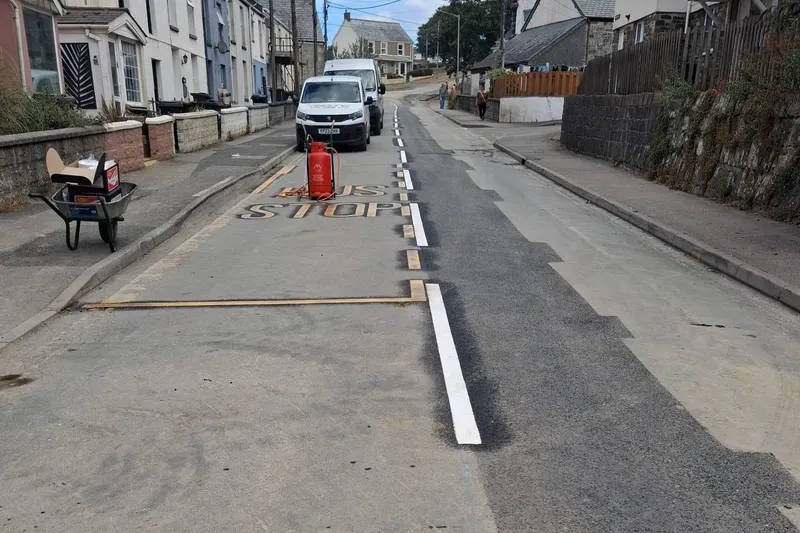
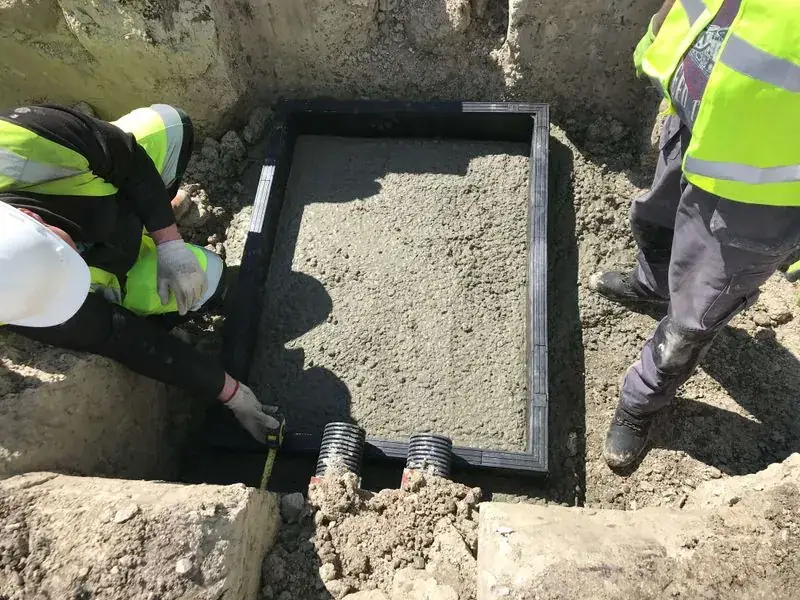
Cable troughing, draw pits and cable chambers are the parts of a cable route that can be opened again without excavation. Most of a route is buried for good. These are the access points.
A cable trough is a channel with removable lids that cables are laid into. A draw pit is a small pit on a duct route where cable is pulled through and ducts change direction. A cable chamber is a larger access pit with a cover and frame, used for joints, link boxes or fibre.
Our cable ducting guide gives the short definitions and the substation trench sizes. This guide goes further: where pits go, how they are built, which covers they need, and how the highway is put back around them.
Key points
- Buried cables with live conductors must be protected or marked, for example by a duct, tiles or tape (ESQCR 2002, regulation 14).
- Covers and frames follow BS EN 124. BSI lists BS EN 124-1:2015 as the current part 1, covering tops with a clear opening up to 1,000 mm.
- On motorways and trunk roads, National Highways' CD 534 (version 0.1.0) asks for at least grade D400 tops where traffic can reach them, and E600 above 1,500 heavy goods vehicles a day in each direction.
- In the highway, ironware must be laid within plus or minus 6 mm of the surrounding surface, and needs intervention if it later differs by more than 10 mm (SROH, S2.3).
- Electricity North West expects 132kV link boxes in buried pits to sit in polluted water for life, with a design life of up to 60 years (ES400CS132).
- HSE says no ground can be relied on to stand unsupported in all circumstances, so pit excavations need support or battering.
In this guide
- Draw pit, chamber, joint bay or link box pit: what is the difference?
- When should you use a trough instead of a duct?
- Where do draw pits go on a duct route?
- What covers and frames do draw pits and chambers need?
- How is a draw pit or chamber built?
- How is cable troughing installed?
- How is the highway reinstated around a chamber?
- What records are needed?
- Where Ground Utilities fits
- Frequently asked questions
- Planning a route with pits or troughing?
- Sources
Draw pit, chamber, joint bay or link box pit: what is the difference?
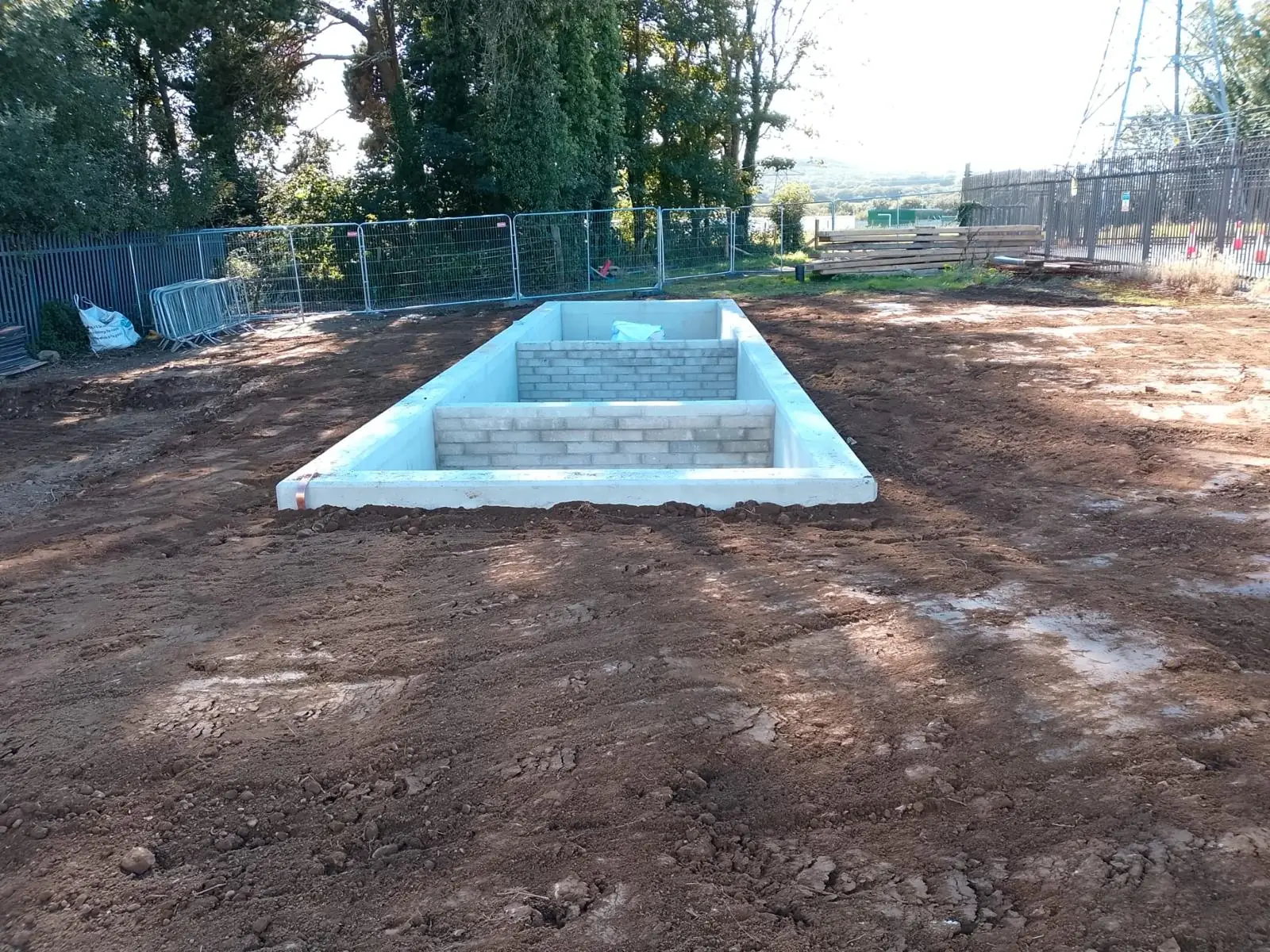
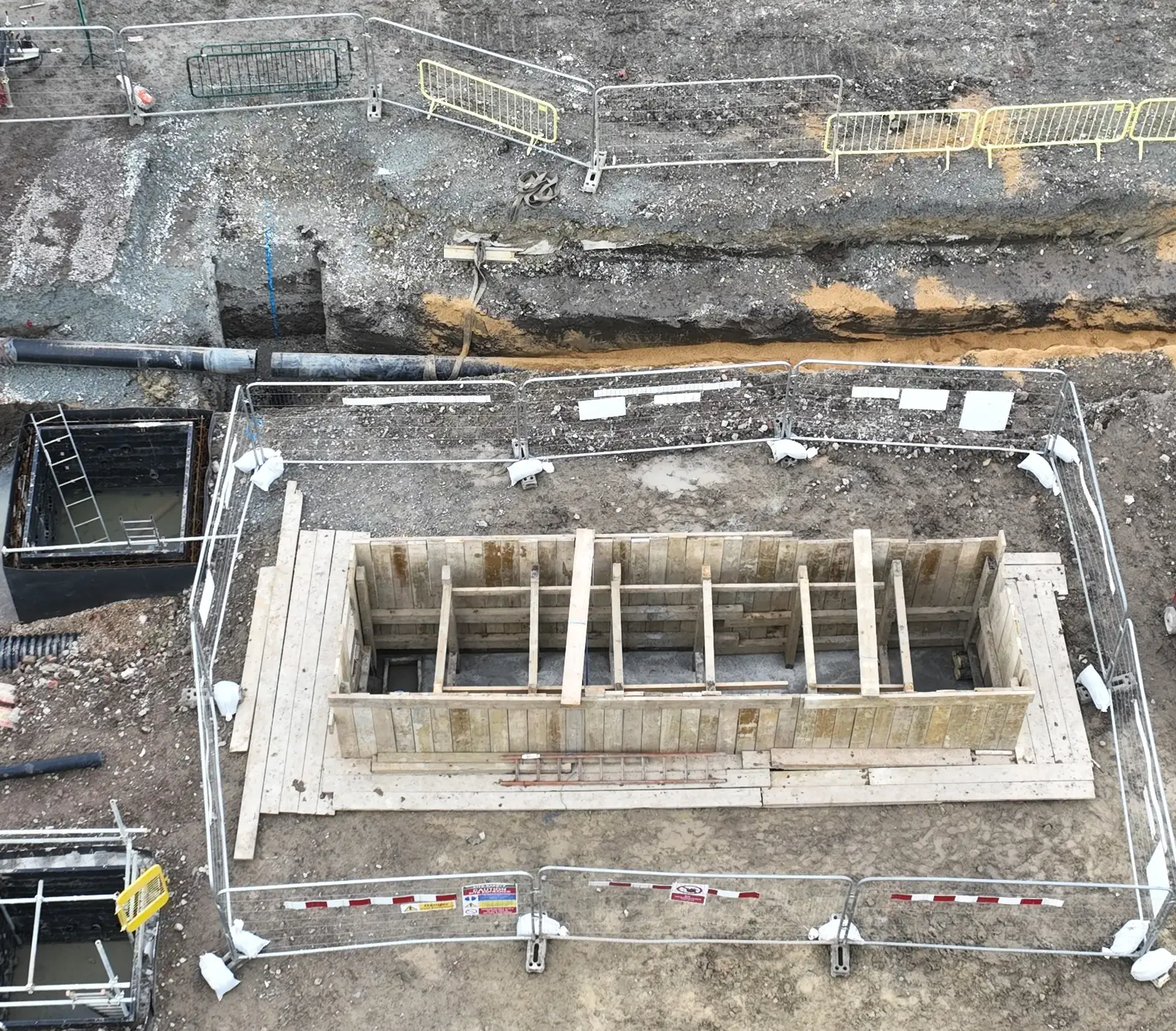
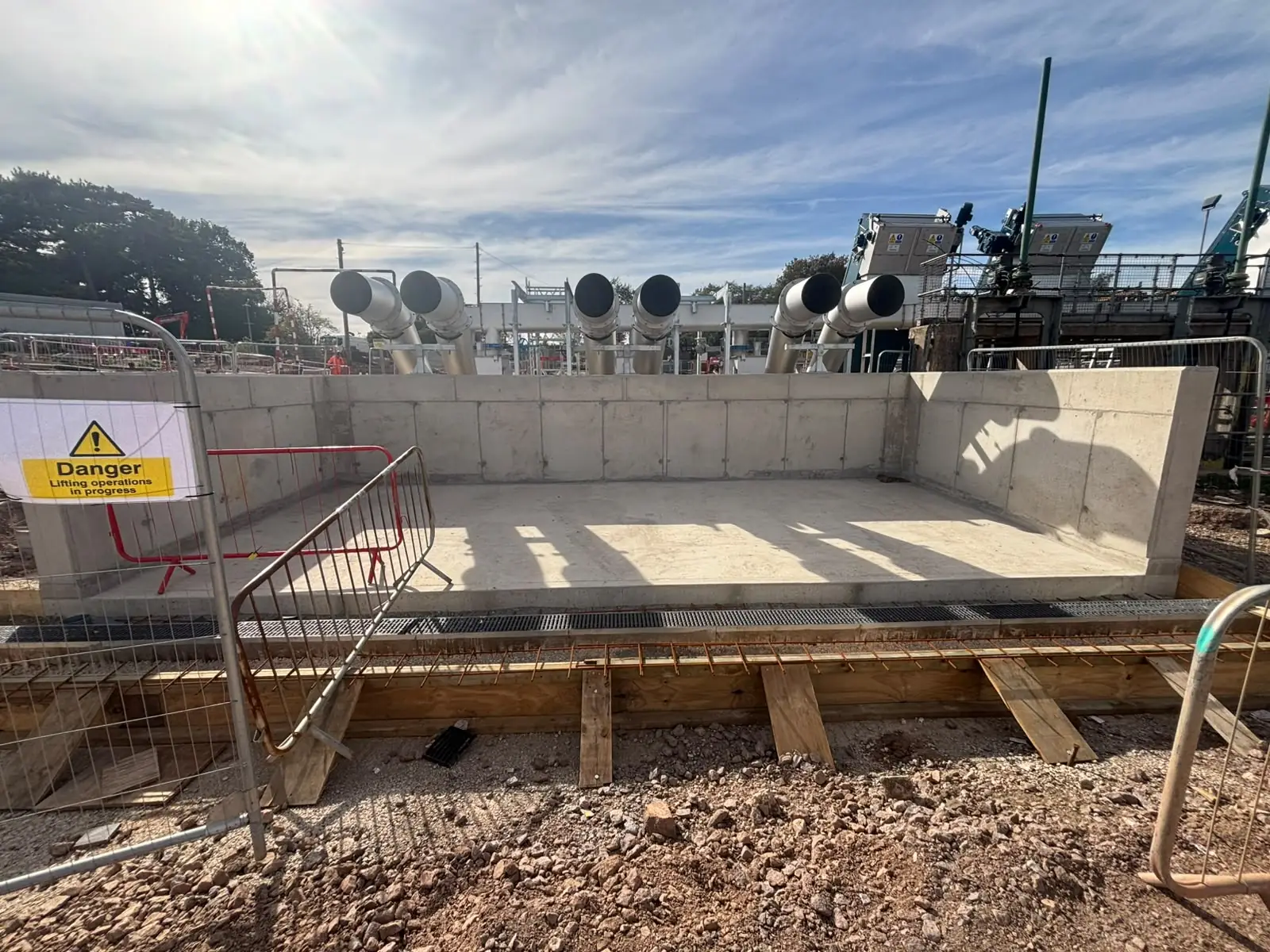
A draw pit is for pulling cable, a chamber is for access to joints or equipment, and a joint bay is a temporary pit that is backfilled after jointing. A link box pit is a permanent chamber for sheath bonding equipment on single-core HV circuits.
The names overlap on site, so agree them on the drawings. This table sets out how they are normally used.
| Feature | What it is for | Permanent or temporary | Typical cover |
|---|---|---|---|
| Draw pit | Pulling cable through ducts; changes of direction | Permanent, small | Grade to suit the location |
| Cable chamber | Access to cables, fibre joints or equipment | Permanent, larger | Chosen to BS EN 124 for the traffic above |
| Joint bay | Space to joint two cable lengths on HV routes | Temporary: backfilled after jointing | None once reinstated |
| Link box pit | Houses sheath bonding link boxes on single-core HV circuits | Permanent | Cover and frame assembly |
| Cable trough | Continuous covered channel for a run of cables | Permanent | Trough lids |
A joint bay is the odd one out. It is dug, used by the jointer, then backfilled with the joints left in the ground. Our guide to cable jointing and joint bays explains how bays are sized and built.
Link box pits matter on 132kV circuits. Electricity North West's 132kV accessories specification, ES400CS132, says buried link boxes go in a pit with a cover and frame. It expects them to sit in polluted water for life, with a design life of up to 60 years.
When should you use a trough instead of a duct?
Use ducts with draw pits for most buried routes, and troughing where many cables need regular access. Troughing is most common beside railway lines and inside substation and plant compounds.
| Option | Best for | Drawbacks |
|---|---|---|
| Ducts with draw pits | Long routes, highways, farmland; adding cables later without excavation | Pulling limits set the pit spacing; ducts can be blocked or crushed |
| Troughing | Rail lineside routes; compounds where many cables need regular access | Lids can be lifted or stolen; surface troughs are exposed to damage |
| Direct burial | Open land where access is rarely needed | Every future change means excavation |
Whatever you choose, the law on marking still applies. ESQCR regulation 14 says a cable whose conductors are not connected to earth must be protected, marked or otherwise indicated. That can be a pipe or duct, tiles or tape, or another device likely to give warning.
Cable rating can change when a cable sits in a duct or trough. The cable designer allows for it, so check the installation method with them before you swap one for another.
What to check when choosing a trough product
Network Rail's troughing specification, NR/L2/TEL/00013, is a performance specification, so products in materials other than concrete can meet it. On rail land, troughing is one of the products that needs Network Rail's product acceptance. Before you buy, check:
- the load the trough and lids must carry, including any vehicle crossings;
- the weight of each section, for manual handling;
- how well the lids fit and stay in place;
- performance in fire, sunlight and frost for the location;
- that transition and crossing pieces exist for the bends, junctions and duct entries on your route.
Where do draw pits go on a duct route?
Draw pits go at bends, junctions and road crossings, and wherever a pull would otherwise exceed the cable's tension limit. There is no single national spacing: the designer sets each pit from the cable size, the pulling calculation and the route geometry.
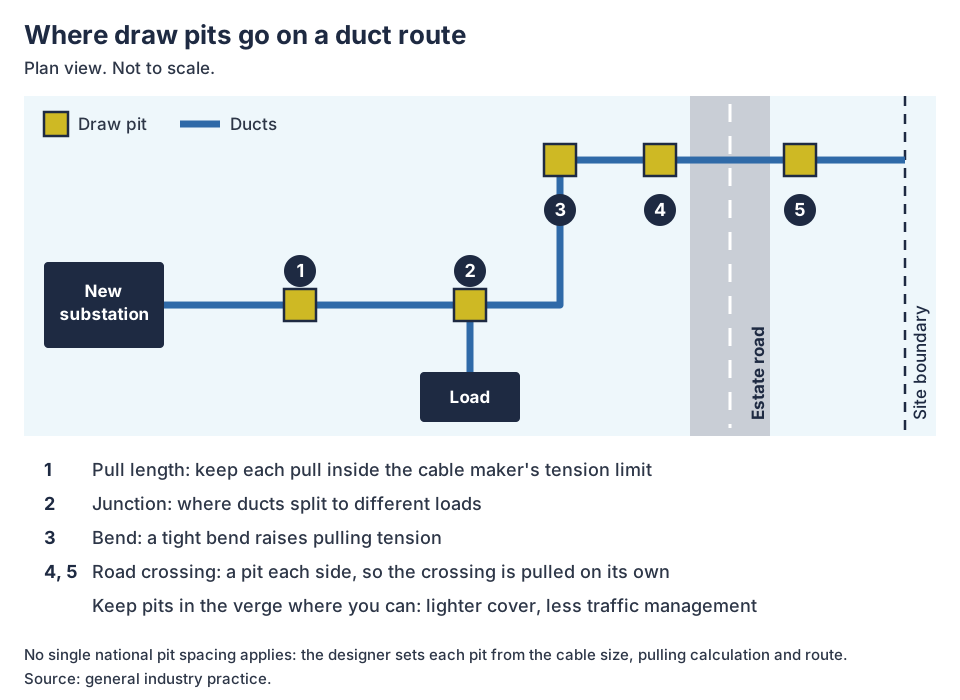
Use this as a working checklist when you review the drawings:
- Bends. A tight bend raises pulling tension. Electricity North West's standard duct bends come with 1,200 mm and 3,900 mm bending radii (ES400D4), so the bend itself helps decide the pit position.
- Junctions. Put a pit where ducts split to different loads.
- Road crossings. A pit each side of a crossing lets the crossing be pulled as its own short length.
- Pull length. Keep each section inside the cable maker's tension limit. Our ducting guide covers pulling tension.
- Access. The pit must be reachable for a winch, a cable drum and later maintenance.
- Water. Avoid low spots, or allow for drainage in the pit base.
- Traffic. Where you can, keep pits out of the carriageway, so the cover can be a lighter grade and later access needs less traffic management.
Ducts entering a pit
Ducts are identified by colour as well as position. Hertfordshire County Council's standard drawing HST-1400-037 uses orange ducts for the council's own power cables, black for the distribution network operator (DNO) and grey for BT.
At the pit wall, UK Power Networks asks for:
- a non-corrosive draw cord or rope in each duct;
- ducts cleared with a mandrel and sealed after laying.
Seal duct ends at the pit wall until the cable is pulled, so silt and water stay out.
What covers and frames do draw pits and chambers need?
Covers and frames for draw pits and chambers in the UK follow BS EN 124, and the load class is chosen from what will drive or stand over the cover. BSI lists BS EN 124-1:2015, "Gully tops and manhole tops for vehicular and pedestrian areas", as the current part 1. It covers tops with a clear opening up to and including 1,000 mm.
On motorways and all-purpose trunk roads, National Highways sets stricter rules in DMRB CD 534. Version 0.1.0 (May 2022) says:
- new chamber tops shall not go in carriageways, including hard strips, hard shoulders and central reserve crossovers (clause 2.3);
- chamber tops with a clear opening over 1 m shall follow BS 9124;
- chamber and gully tops at risk from traffic shall be at least grade D400 (clause 2.7);
- where the carriageway carries more than 1,500 heavy goods vehicles a day in each direction (AADT LGV), chamber tops shall be grade E600 (clause 2.8).
Standards for Highways now marks version 0.1.0 as superseded. Check the current version on Standards for Highways before you specify ironware on a trunk road.
On local roads, footways and private sites, agree the class with the highway authority or the asset owner. The SROH says works to apparatus such as access covers and frames must meet the standard and specification of the apparatus owner.
A worked example
Take a ducted cable route from a new substation to a site boundary, with one crossing of an estate road.
- The pits in the grass verge sit away from traffic. Ask the asset owner which grade it wants there.
- The pit next to the estate road could be overrun by a lorry turning. Treat it as at risk from traffic and agree a heavier grade.
- If the design puts a pit in the carriageway itself, ask whether it can move to the verge. A pit in the road needs a heavier cover, a road closure or lane closure to open it, and more reinstatement.
How is a draw pit or chamber built?
A draw pit or chamber is built in nine steps: set out, excavate and support, base, walls, duct entries, seals, frame, backfill and records. The owner's drawing sets the sizes and materials for each step.
- Set out the pit against the design and the services survey. Our trial holes guide covers proving what is in the ground first.
- Excavate and support. HSE says no ground can be relied upon to stand unsupported in all circumstances. A competent person inspects excavations at the start of each shift (CDM 2015, regulation 22). Our guide to trench support covers the options.
- Form the base. A level, firm base, with a drainage outlet or sump where the design asks for one.
- Build the walls. Precast sections, brick or blockwork, or concrete cast in situ, to the owner's drawing.
- Bring the ducts in. Cut ducts cleanly at the wall, at the projection the owner's detail asks for, so they can be identified.
- Seal the duct ends until cable is pulled, then seal around the cables as the owner specifies.
- Bed the frame level with the finished surface, on the bedding the owner and the SROH allow.
- Backfill and reinstate the surround, then fit the cover.
- Record the position, depth, duct entries and cover type before the ground is closed.
Is a draw pit a confined space?
A deep draw pit or chamber can be a confined space. HSE defines a confined space as an enclosed or largely enclosed space with a foreseeable risk such as asphyxiation, fire, explosion or drowning.
HSE's first rule is to avoid entry where possible. A shallow draw pit can usually be worked from the surface. A deep chamber may need a confined space assessment, gas monitoring and a rescue plan before anyone goes in.
Common mistakes on pits and chambers
- Frame set to the base course. If the frame is set before the final levels are known, it ends up proud or sunk and fails the SROH tolerance.
- Duct ends left open. Silt and water get in, and the duct has to be cleared again before the pull.
- Pit in the low spot. The pit fills with water every time it rains, and the cable sits in it.
- Pit in the wheel path. A pit that could have been in the verge ends up under traffic, with a heavier cover and harder access.
- No record. Without position, depth and duct entries on the as-laid drawing, the next team has to find the pit again.
How is cable troughing installed?
Cable troughing is installed on a level, firm bed, with sections laid end to end and the lids fitted once the cables are in. The base and the joints between sections decide how long it lasts.
- Prepare a level bed. A trough that rocks will crack or shed its lids.
- Lay sections end to end. Keep joints tight and lids in line.
- Plan the lifting. Concrete sections are heavy, so plan lifting aids and a manual handling assessment before work starts.
- Use transition and crossing pieces where the route changes direction, crosses a track or road, or meets a duct.
- Lay and secure the cables, then fit the lids.
- Keep the run clear. Spoil, vegetation and debris on the lids make later access harder.
On rail land, Network Rail's NR/L2/ELP/27224 sets requirements for new and refurbished cable routes on its traction distribution system. Work there follows Network Rail's own standards and approvals.
How is the highway reinstated around a chamber?
The highway around a chamber is reinstated to the Specification for the Reinstatement of Openings in Highways (SROH), 4th edition. It sets the level tolerance for the cover and what bedding and surfacing may go around the frame.
| SROH clause | Requirement |
|---|---|
| S2.3.2 | Fixed features, including ironware, must be laid to the mean level of the surrounding surface, within plus or minus 6 mm |
| S2.3.3 | Intervention is needed where ironware differs from the mean level of the surrounding surface by more than 10 mm |
| S6.5 | Within 350 mm of access chamber covers, a permanent surface course material may be laid at binder course level |
| S11.5.2 | Works to access covers and frames must meet the owner's standard and specification |
| S11.5.5 | Bedding, including C32/40 concrete, may fill to within 100 mm of the road surface and 350 mm of the frame edge |
Bedding that needs to cure must cure before the next layer goes on (S11.5.4). Our guide to road reinstatement covers the rest of the SROH.
What records are needed?
Every pit, chamber and trough run needs a record, made while everything is still visible. For each one, record:
- ☐ its position;
- ☐ its depth;
- ☐ the ducts entering it;
- ☐ what each duct carries.
The network operators' record rules are summarised in our cable ducting guide.
Where Ground Utilities fits
Ground Utilities builds troughs, draw pits and chambers as part of the cable routes and substation civils we deliver. We hold full NERS approval for civil works, and for cable laying at LV, 11kV, 20kV, 33kV, 66kV and 132kV, with all six distribution network operators.
Troughs, draw pits and chambers feature in our recent work:
- Thetford primary substation, Norfolk: after the 6 km dual 33kV route, we built the substation civils, including ducting and draw pits.
- Wanlip STW 11kV substation, Leicestershire, for Kier: trench excavation, troughs and duct installation for the cable routes, with backfill and permanent reinstatement.
- Wanlip STW inlet works: 150mm Class 2 electrical ducting and draw pits from the new inlet MCC, including four road crossings.
- Indian Queens private wire, Cornwall: fibre ducts and nine fibre chambers alongside the 33kV route.
We build the civils and install the cable. We do not joint or terminate cables, make the final live connection to the network, apply for connections, or design the route. The network operator, the client's connection provider or the designer does those.
See our HV and LV cable installation service.
Frequently asked questions
What is cable troughing?
Cable troughing is a run of channel sections with removable lids that cables are laid into. It is common beside railway lines and inside substation compounds, where cables need to be reached again without excavation.
What is a draw pit?
A draw pit is a small access pit on a ducted cable route. It is where cable is pulled through and where ducts change direction, split or cross a road.
What is the difference between a draw pit and a cable chamber?
A draw pit is usually small and used for pulling cable. A chamber is larger and gives access for jointing, link boxes, fibre or equipment. Both are permanent, unlike a joint bay, which is backfilled after jointing.
How far apart should draw pits be?
There is no single national figure. The designer sets the spacing from the cable size, the pulling tension limit and the bends on the route, with a pit each side of most road crossings.
What load class of cover does a draw pit need?
It depends on what will cross it. Covers follow BS EN 124. On trunk roads, National Highways' CD 534 asks for at least D400 where tops are at risk from traffic, and E600 on the busiest carriageways. Elsewhere, agree the class with the highway authority or asset owner.
What are cable troughs made of?
Traditionally reinforced concrete. Network Rail's troughing specification is a performance specification, so troughs in other materials can be used where they meet it and are accepted.
How level must a chamber cover be in the road?
The SROH requires covers and other ironware to be laid within plus or minus 6 mm of the surrounding surface. Intervention is needed if the difference later exceeds 10 mm.
Do ducts need a draw rope?
Yes. UK Power Networks asks for a non-corrosive draw cord or rope in each duct, and for ducts to be cleared with a mandrel and sealed after laying.
Planning a route with pits or troughing?
Settle the pit positions and crossings while they are still on the drawing board. Call 01223 423918 or email info@ground-utilities.co.uk.
Sources
- The Electricity Safety, Quality and Continuity Regulations 2002, regulation 14 (legislation.gov.uk, 2002)
- Catalogue of Network Rail Standards, NR/CAT/STP/001 Issue 129 (Network Rail, 2023)
- How to decide what needs product acceptance, guidance note Issue 1.8 (Network Rail, 2026)
- BS EN 124-1:2015 Gully tops and manhole tops for vehicular and pedestrian areas (BSI, 2015)
- DMRB CD 534 Chamber tops and gully tops for road drainage and services, Version 0.1.0 (National Highways, 2022)
- Specification for the Reinstatement of Openings in Highways, Fourth edition (Department for Transport, 2020)
- HST-1400-037 Duct and pit details, plan 1 (Hertfordshire County Council, 2021)
- 3.2 Ducts, Connections library (UK Power Networks, 2024)
- ES400D4 Plastic Ducts, Conduit and Accessories, Issue 9 (Electricity North West, 2026)
- ES400CS132 Cable Systems, Including Joints, Terminations, Associated Sealants and Components for use on 132kV Underground Networks, Issue 3 (Electricity North West, 2024)
- Excavations (Health and Safety Executive)
- Introduction to working in confined spaces (Health and Safety Executive)