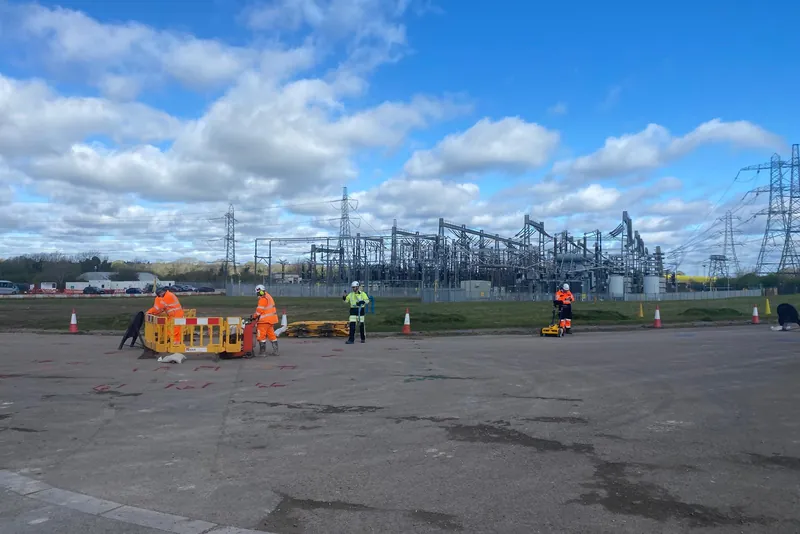
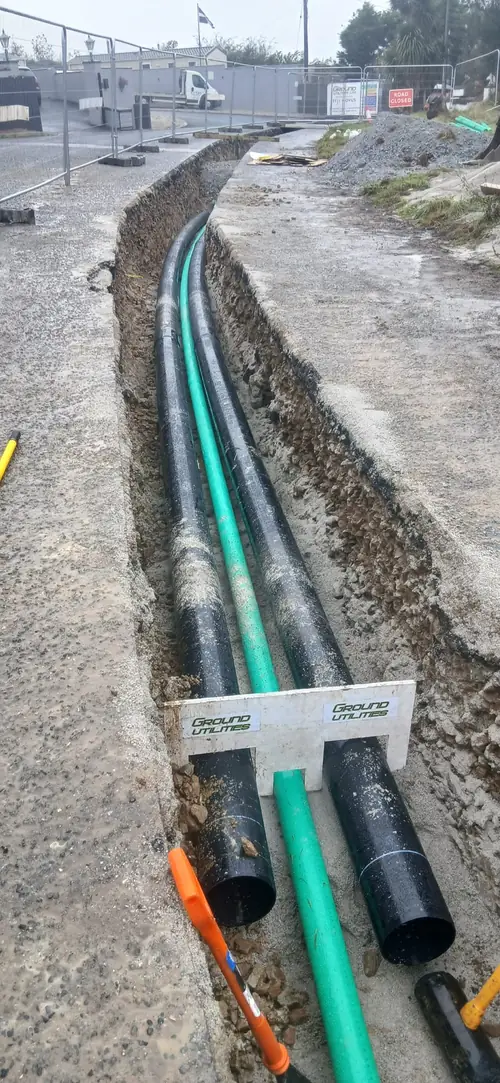
A feeder pillar is the outdoor cabinet that takes a low voltage supply and splits it into outgoing circuits, one or more for each EV charger. On a charging hub it sits between the supply and the chargers. It needs a firm base, the right ducts and safe access for the people who maintain it.
A public EV charging hub looks simple from the car park: a row of chargers and some bollards. Underneath sit a supply cable, often a substation, a feeder pillar, ducts to every charger and a foundation for each one.
This guide covers the civils on a charging hub, from the substation plinth to the bollards. The rules come from the Department for Transport, BSI, the IET and the network operators.
Key points
- The UK had 121,171 public EV chargers on 1 July 2026, including 28,887 rated rapid or above (50kW+), according to DfT statistics.
- The Public Charge Point Regulations 2023 require contactless payment on new public charge points of 8kW or more, and 99% reliability on rapid networks.
- PAS 1899:2022 asks for at least 1,200 mm of clear space in front of a public charger, and between chargers in a row.
- Under PAS 1899, bollards beside a charger are at least 1,000 mm high, and impact barriers no more than 600 mm.
- Where a hub needs a packaged substation, UK Power Networks asks the customer to build the plinth and earthing, and to give 24-hour access.
- Feeder pillars on public networks fall under BS EN 61439-5, the BSI standard for low voltage assemblies for power distribution in public networks.
In this guide
- What is a feeder pillar?
- What does an EV charging hub need in the ground?
- Who does what on an EV charging site?
- How is a feeder pillar base built?
- How should chargers, bollards and bays be laid out?
- What do the Public Charge Point Regulations mean for the civils?
- What changes when the hub needs a substation?
- What about chargers in the highway?
- EV hub civils checklist
- Where Ground Utilities fits
- Frequently asked questions
- Planning an EV charging hub?
- Sources
What is a feeder pillar?
A feeder pillar is a weatherproof steel or GRP cabinet, usually on a concrete base, holding low voltage switchgear. It takes one incoming supply and feeds several outgoing circuits through fuses or circuit breakers.
You see them by roadsides feeding street lights, and on sites feeding lighting, pumps or chargers. On a charging hub, the pillar sits between the supply and the chargers. Each charger gets its own outgoing circuit and its own cable in its own duct.
Which standard covers feeder pillars?
BS EN 61439-5:2015 covers feeder pillars used on public networks. BSI lists it, "Low-voltage switchgear and controlgear assemblies: Assemblies for power distribution in public networks", as current and under review. It covers assemblies that are:
- three-phase, up to 1,000 V AC;
- installed indoors or outdoors;
- built to receive power and distribute it through cables.
The electrical design, the fuse ratings and the earthing of the pillar belong to the electrical designer. The civils team builds what the pillar stands on and the ducts that serve it.
Feeder pillar or distribution board?
A distribution board does the same job indoors. A feeder pillar stands outdoors where the public can reach it. So it needs a strong, lockable enclosure and a base that keeps it stable and dry.
What does an EV charging hub need in the ground?
An EV charging hub needs six civils elements: the supply cable route, a substation if required, the feeder pillar base, charger ducts, charger foundations and surface works. Each one has to be in the right place before the next trade arrives.
| Element | What the civils team builds | Who sets the specification |
|---|---|---|
| Supply cable route | Trench or ducts from the network to the site, joint bays where needed | Network operator or ICP |
| Substation (if needed) | Plinth or building, earthing, cable entries, access | Network operator; G81 for adopted assets |
| Feeder pillar | Concrete base, duct entries, earth electrode position | Electrical designer and pillar maker |
| Charger ducts | Duct runs from pillar to each charger, draw pits at bends | Electrical designer |
| Charger foundations | Concrete base or root, with ducts cast in | Charger maker |
| Surface works | Bollards, kerbs, surfacing, drainage falls, bay markings | Client, PAS 1899, highway authority |
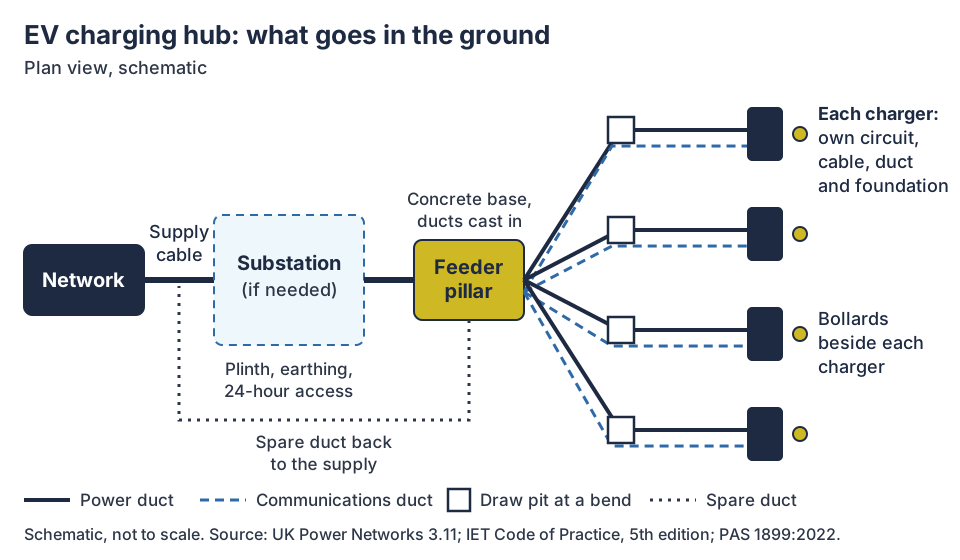
Two ducts are easy to forget:
- A spare duct to each charger position, and a spare from the pillar back to the supply, costs little at the trench stage. It saves an excavation when the hub is upgraded.
- A communications duct. The IET's Code of Practice for EV charging equipment installation, 5th edition, added guidance on telecoms and auxiliary cabling, including Ethernet and RS 485. Plan a separate communications duct to each charger.
Our cable ducting guide covers duct colours, classes, sizes and proving in more detail.
Who does what on an EV charging site?
On a charging hub the civils contractor builds the ground, the network operator or connection provider makes the connection, and the charge point operator fits the chargers. Gaps between these companies cause most of the delays.
| Task | Usually done by |
|---|---|
| Connection application and offer | Client or its connection provider, with the network operator |
| Network design and substation equipment | Network operator, or an ICP or IDNO |
| Groundworks, ducts, bases, cable laying | Civils and cable laying contractor |
| Jointing, terminating, final connection | Network operator or the client's connection provider |
| Charger supply and installation | Charge point operator or its electrical contractor |
| Electrical installation to BS 7671 | Electrical contractor |
| Accessibility and payment compliance | Charge point operator |
The IET's Code of Practice sets out the planning and installation of the charging equipment itself. The 5th edition is written to BS 7671:2018+A2:2022 and references PAS 1899. Its Appendix K gives minimum depths for buried cables on different types of premises.
How is a feeder pillar base built?
A feeder pillar base is a concrete foundation sized by the pillar maker, with ducts cast in to line up with the pillar's gland plate. A civil engineer checks it for the pillar and the ground.
Highway authority standard details show the pattern. Hertfordshire County Council's drawing HST-1400-025, for its street lighting pillars, asks for:
- a concrete foundation to the maker's specification;
- a 900 mm x 600 mm x 50 mm concrete paving flag in front of the door, unless the pillar is in a footway;
- one 100 mm orange duct for the council's own supply and one 50 mm black duct for DNO services;
- ducts that protrude at least 75 mm into the pillar, so they can be identified (HST-1400-037);
- an earth electrode mat to its own drawing.
On a charging hub the same principles apply at a larger scale. A step-by-step build:
- Set out the base against the electrical layout, so duct entries line up with the gland plate.
- Excavate to the depth and size on the drawing, checking for services first.
- Place the ducts in their final positions, with bends formed before the concrete goes in.
- Fix any holding-down bolts or root frame to the maker's template.
- Pour and level the concrete, keeping duct ends sealed.
- Lay the earth electrode or mat where the designer has placed it.
- Finish the surround with a hard, level standing in front of the doors.
- Prove every duct with a mandrel and leave a draw rope in each.
Common mistakes on pillar bases
Most problems come from building before the drawings are fixed. Watch for these:
- ducts set out before the pillar model is chosen, so they miss the gland plate;
- no hard standing in front of the doors, so maintenance staff stand on soft ground;
- duct ends left open during the pour, so concrete or debris blocks them;
- the pillar placed across the access route to a charger, which PAS 1899 warns against.
How should chargers, bollards and bays be laid out?
PAS 1899:2022 sets the layout for accessible public chargers, including 1,200 mm of clear space in front of each one. It came into effect on 31 October 2022, sponsored by the charity Motability and the Office for Zero Emission Vehicles (OZEV).
PAS 1899 is voluntary and free to download. It sets out how to make public chargers usable by disabled and older drivers. In November 2025 BSI published a working group review that recommends updating it.
The civils team builds most of what PAS 1899 measures:
| PAS 1899 requirement | Figure |
|---|---|
| Clear space in front of the points of access to a charger | At least 1,200 mm |
| Space between chargers in a row in car parks or on-street bays | At least 1,200 mm |
| Height of impact protection barriers | No more than 600 mm |
| Gap between an impact barrier and the charger | No more than 220 mm |
| Height of bollards beside a charger | At least 1,000 mm |
| How far bollards may stand forward of or beside a charger | No more than 300 mm |
| Space for a wheelchair to turn (recommended) | 1,600 mm for 90 degrees; 1,800 mm for 180 degrees |
| Fall on the surface at accessible bays (Annex B) | No steeper than 1:50 |
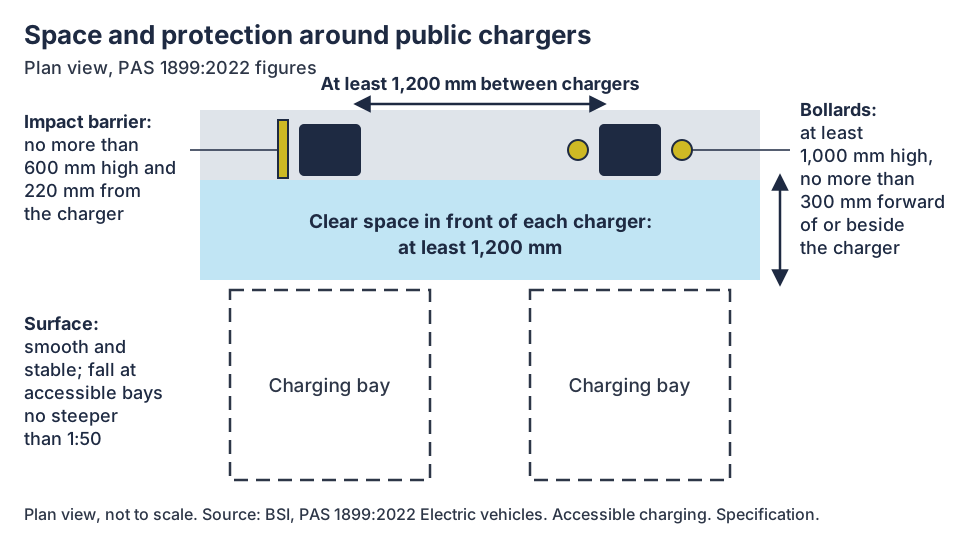
PAS 1899 also asks for:
- a smooth, stable surface around the charger;
- a concrete base that extends at surface level where a charger stands in a planted area, so users can reach it;
- feeder pillars, which it names among the street furniture that should not obstruct disabled people, placed where they will not block the access route to any charger;
- level access to the charging bay where possible, and appropriate tactile paving where a dropped kerb is needed.
What do the Public Charge Point Regulations mean for the civils?
The Public Charge Point Regulations 2023 put duties on charge point operators, and good civils make those duties easier to meet. The regulations came into force on 24 November 2023.
| Regulation | Duty | What it means on the ground |
|---|---|---|
| Reg 2 | A rapid charge point is a public charge point of 50kW or above | Rapid chargers need larger supplies and cables |
| Reg 5 | Contactless payment on new public charge points of 8kW or above | Payment terminals need power and data |
| Reg 7 | Rapid networks reliable 99% of the time on average each year | Protect chargers from vehicle damage and flooding |
| Reg 9 | Free 24-hour staffed helpline, number shown at the charger | Signage positions |
| Reg 10 | Open data on each charger, free and machine readable | Reliable data connection to each charger |
DfT groups public chargers by speed:
- standard: 3kW to under 8kW;
- standard plus: 8kW to under 50kW;
- rapid: 50kW to under 150kW;
- ultra-rapid: 150kW and above.
On 1 July 2026, 12% of the UK's public chargers were ultra-rapid, according to DfT. Higher-powered chargers mean bigger cables, bigger bases and more often a dedicated substation.
What changes when the hub needs a substation?
When a hub needs its own substation, the civils grow to include a plinth or building, its earthing and a permanent access route. Whether a substation is needed is a network design question for the network operator.
UK Power Networks' connection terms for substations on LV connections put these on the customer:
- providing and installing the GRP housing, and maintaining it for good;
- building the plinth for the housing, with the associated earthing, to the specification on the proposal plan;
- or building a brick substation where the proposal plan shows one;
- giving 24-hour unimpeded access for UK Power Networks staff and contractors all year.
Assets that the network operator will adopt are built to its G81 requirements. Our UKPN G81 guide covers what that means for cover depths, ducts and substation bases. Our substation civils page covers the substation work we build.
What about chargers in the highway?
On-street chargers, and any cable route in the public highway, need street works permits and reinstatement to the national specification. Anyone without a statutory right who places private apparatus in the highway also needs a section 50 licence.
Reinstatement follows the Specification for the Reinstatement of Openings in Highways (SROH), 4th edition. In December 2024 DfT added an EV addendum, which:
- covers cable channels that cross public footways so residents can charge from home;
- sets the level tolerances for fixed features, now including cable channels: within plus or minus 6 mm of the surrounding surface, with intervention needed beyond 10 mm.
See our section 50 licence page.
EV hub civils checklist
Check these items before the bases and duct runs are built.
- ☐ Connection offer accepted and the point of connection fixed by the network operator
- ☐ Substation need, position and access route agreed with the network operator
- ☐ Electrical layout issued: pillar position, circuits, duct sizes, earthing
- ☐ Charger maker's foundation drawings for each charger type
- ☐ Services search and survey done, trial holes planned
- ☐ PAS 1899 layout checked: 1,200 mm clear space, bollard and barrier positions
- ☐ Drainage falls and surface finish agreed
- ☐ Spare power and data ducts to every charger position
- ☐ Highway permits or section 50 licence in place for any off-site work
- ☐ Duct proving, draw ropes and as-built records planned before handover
Where Ground Utilities fits
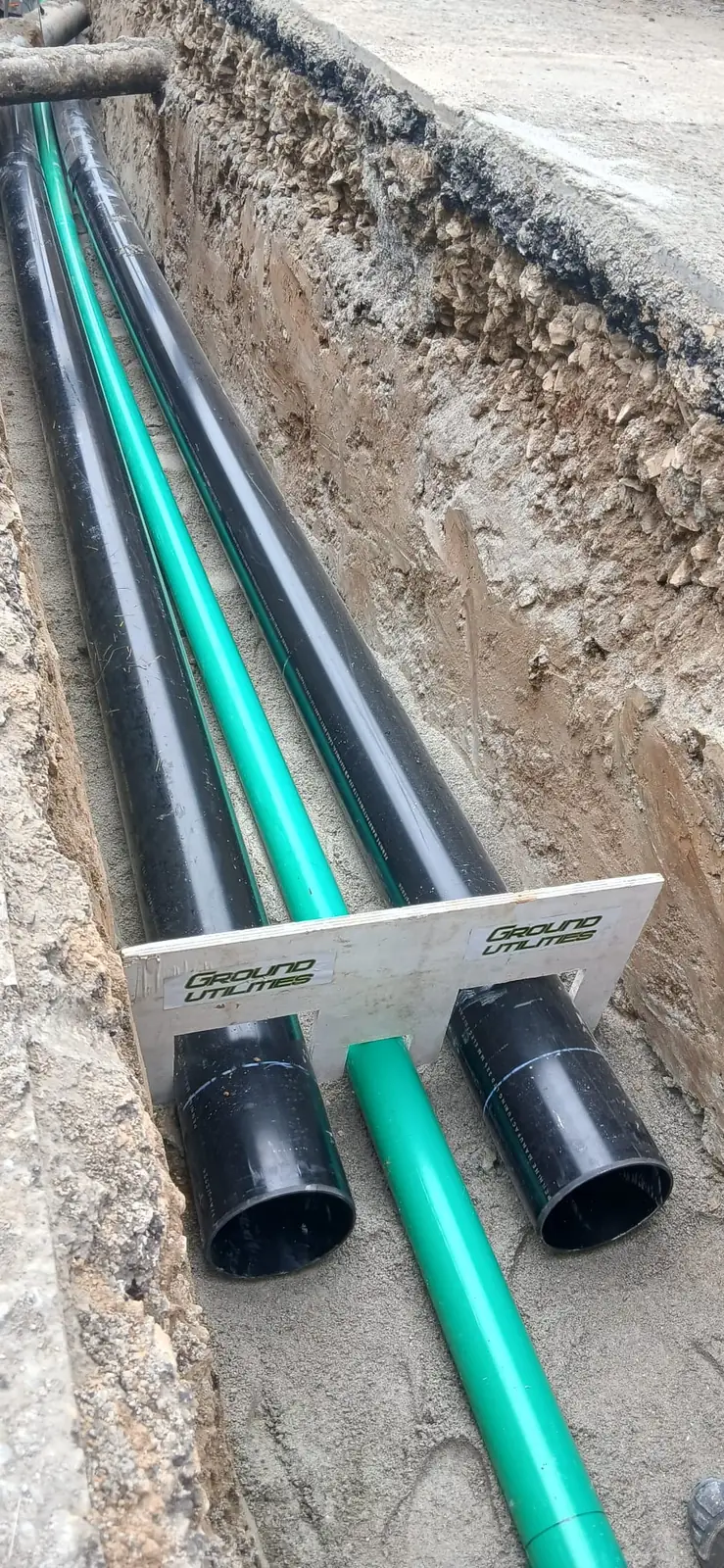
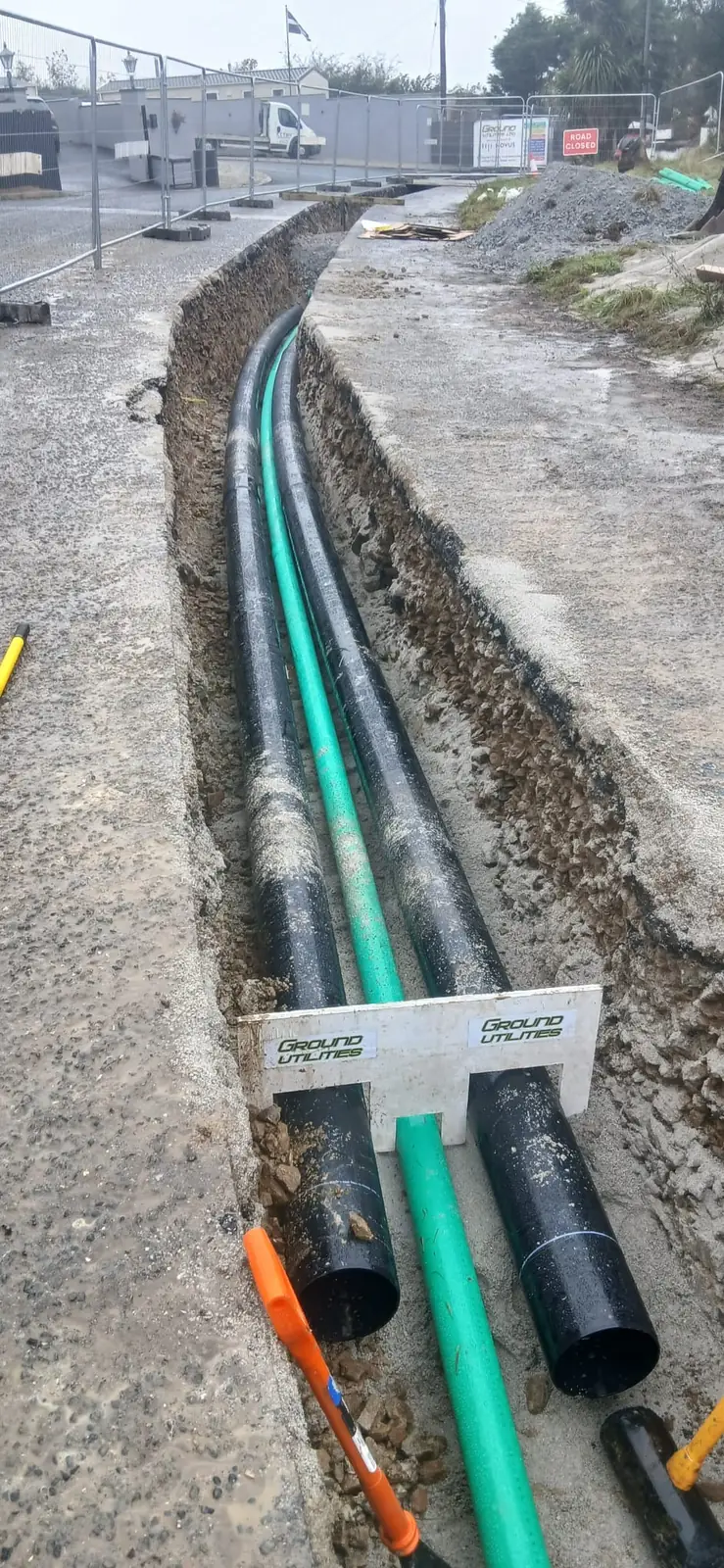
Ground Utilities builds the ground side of EV charging sites: the groundworks, civils, duct installation, joint bays and cable installation. The site is then ready for the chargers to be fitted by others. We are based at Highdrove Farm, Cottenham, Cambridgeshire, and work across England and Wales.
We have carried out the groundworks for an EV charging scheme in Rayleigh, Essex. We hold full NERS approval for civil works and for cable laying at LV, 11kV, 20kV, 33kV, 66kV and 132kV, with all six distribution network operators. The supply cable to a large hub is the same work as our HV and LV cable installation.
The network operator, the client's connection provider, the charge point operator or the designer does the rest. We do not:
- fit chargers;
- joint or terminate cables, or make the final live connection;
- apply for connections;
- design the network or the electrical installation.
See our EV charging groundworks service.
Frequently asked questions
What is a feeder pillar?
An outdoor cabinet, usually on a concrete base, that holds low voltage switchgear. It takes one supply and splits it into several outgoing circuits, for example one for each EV charger on a hub.
What is a feeder pillar used for?
Distributing low voltage power outdoors: to street lights, site equipment and EV chargers. Public network assemblies of this kind are covered by BS EN 61439-5.
How big is a feeder pillar base?
The pillar maker sets it, and a civil engineer should check it for the ground. Hertfordshire County Council's standard detail adds a 900 mm x 600 mm paving flag in front of the door and fixed duct sizes.
Does an EV charging hub need a substation?
It depends on the power the hub needs and the capacity of the local network. The network operator decides as part of the connection offer.
How much space does an EV charger need around it?
PAS 1899 asks for at least 1,200 mm of clear space in front of the charger. It asks for the same 1,200 mm between chargers in a row.
How high should bollards around an EV charger be?
PAS 1899 asks for bollards at least 1,000 mm high, no more than 300 mm forward of or beside the charger. Low impact barriers must be no more than 600 mm high.
How deep should cable to an EV charger be buried?
The IET Code of Practice for EV charging equipment installation gives minimum burial depths by premises type in Appendix K. The electrical designer confirms the depth for each site.
Who connects an EV charging hub to the grid?
The network operator, or the client's connection provider where the work is contestable. Civils contractors such as Ground Utilities build the ground side and install cable, then others make the final connection.
Planning an EV charging hub?
Bring the civils contractor in once the electrical layout is drafted, before the bases and duct runs are fixed. Call 01223 423918, email info@ground-utilities.co.uk, or use our contact page.
Sources
- Public electric vehicle charging infrastructure statistics: 1 July 2026 (Department for Transport, 2026)
- The Public Charge Point Regulations 2023 (legislation.gov.uk, 2023)
- PAS 1899:2022 Electric vehicles. Accessible charging. Specification (BSI, 2022)
- Accessible electric vehicle chargepoints: A review of PAS 1899:2022 summary report (BSI, 2025)
- Fifth Edition of the IET Code of Practice for Electric Vehicle Charging Equipment Installation, Wiring Matters issue 97 (IET, 2023)
- BS EN 61439-5:2015 Low-voltage switchgear and controlgear assemblies. Assemblies for power distribution in public networks (BSI, 2015)
- HST-1400-025 Feeder pillar type 1A and 1B, foundation details (Hertfordshire County Council, 2021)
- HST-1400-037 Duct and pit details, plan 1 (Hertfordshire County Council, 2021)
- 3.11 Substations: associated with LV connections (UK Power Networks)
- Specification for the Reinstatement of Openings in Highways: Electric Vehicle addendum (Department for Transport, 2024)
- Specification for the Reinstatement of Openings in Highways, Fourth edition (Department for Transport, 2020)