A cable route pre-start checklist is the list of checks to close before the first break-out: scope, CDM duties, permits, surveys, cards, materials, excavation safety, the jointer handover, reinstatement and records. Most delays and near misses on a cable route trace back to one of them. Think of a lapsed permit, a plan that missed a gas service, ducts ordered in the wrong colour, or a jointer who arrives to a flooded bay.
This cable installation checklist sets those checks out in the order a route is usually set up. Use it as a pre-start meeting agenda, or print the page and tick it off with the client, the principal contractor and the gang supervisor.
It is written for routes in England. Wales and Scotland have their own street works rules, and each network operator has its own specification, so adapt it to the job.
Key points
- CDM 2015 regulation 5 requires the client to appoint a principal designer and principal contractor in writing, before the construction phase, whenever more than one contractor is involved.
- CDM 2015 regulation 6 requires notice to HSE where work will last more than 30 working days with more than 20 workers at once, or exceed 500 person days.
- The Department for Transport's permit guidance sets lead times of 3 working days for minor works, 10 for standard works and 3 months' provisional advance authorisation for major works.
- HSE's HSG47 says to keep hand-held power tools at least 500 mm from the indicated line of a service where practicable, then dig by hand.
- CDM 2015 regulation 22 requires a competent person to inspect excavations at the start of every shift.
- UK Power Networks wants route drawings at least two weeks before work starts, and final as-built records within five working days of energisation.
In this guide
- How should you use this cable route checklist?
- Stage 1: Is the scope clear?
- Stage 2: Is the CDM paperwork in place?
- Stage 3: Are the permits, licences and consents booked?
- Stage 4: Do you know what is in the ground?
- Stage 5: Do you have the right design information?
- Stage 6: Do the gang's cards match the work?
- Stage 7: Are plant, materials and temporary works ready?
- Stage 8: Is traffic management and community liaison planned?
- Stage 9: Is the dig itself set up safely?
- Stage 10: Are the joint bays and the jointer handover agreed?
- Stage 11: Are reinstatement and the environment covered?
- Stage 12: Are records and emergency arrangements ready?
- What must be in place on the day of break-out?
- What are the most common pre-start mistakes?
- Where Ground Utilities fits
- Frequently asked questions
- Planning a cable route?
- Sources
How should you use this cable route checklist?
Work through the twelve stages in order, starting at least 3 months before the planned start if any length needs a road closure. Give each item an owner and a date. Anything left unticked at the final sign-off is a reason to hold the start, or to record why it is safe to proceed.
The checklist does not replace your risk assessments, method statements or the construction phase plan. It is a prompt to make sure those documents cover the things that go wrong most often on cable routes.
A worked timeline
Take a 3 km 33kV route with 1 km in a B road that needs a road closure, and 2 km across farmland. A sensible order looks like this:
| Weeks before break-out | What to close | Stage |
|---|---|---|
| 16 or more | Scope split agreed, CDM appointments made, records search started | 1, 2, 4 |
| 14 | Section 50 licence application in, if the cable is private, and TTRO requested | 3 |
| 13 or more | Provisional advance authorisation for the road length (at least 3 months ahead) | 3 |
| 8 to 12 | PAS 128 survey, trial holes at crossings, approved design issued | 4, 5 |
| 6 to 8 | Ducts, drums and trench support ordered; cards checked against the programme | 6, 7 |
| 2 to 4 | Route drawings to the network operator, traffic management design, letter drops | 5, 8 |
| 2 | Permit application for the road length confirmed | 3 |
| Day 0 | Final sign-off | All |
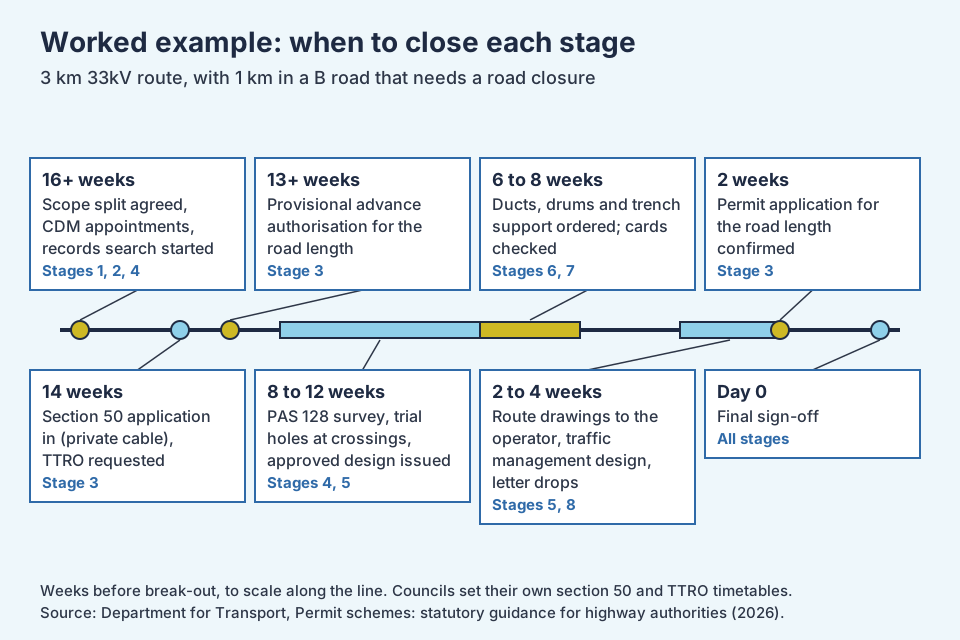
Section 50 licence and TTRO timescales are set by each council, so check its published timetable before fixing these dates.
Stage 1: Is the scope clear?
The scope is clear when every part of the route, from design to the final connection, has a named company against it. On a new connection, design, civils, cable laying, jointing and the final connection can sit with different companies. The NERS register lists cable laying and cable jointing as separate scopes, by voltage, and gaps between contracts surface on site as delays.
- ☐ Write down who does each part: design, trenching and ducting, joint bays, cable pulling, jointing and terminations, testing, final connection and reinstatement.
- ☐ Check each contractor's NERS scopes and voltages on the LRQA register for the network operator's area.
- ☐ Confirm who holds the contract with the network operator for the non-contestable work.
- ☐ Confirm who applied for the connection and holds the point of connection.
- ☐ Confirm who is the undertaker in the street: a utility under its statutory right, or a section 50 licence holder.
- ☐ Agree who applies for and pays for permits, and who carries fixed penalties and overrun charges.
- ☐ Agree hold points: duct proving, interim inspections, cable pull, jointing and energisation.
- ☐ Confirm the network operator's inspection regime and what a failed inspection would hold up.
Stage 2: Is the CDM paperwork in place?
The CDM paperwork is in place when the appointments, any HSE notification, the pre-construction information and the construction phase plan all exist before work starts. The Construction (Design and Management) Regulations 2015 apply to all construction work, including excavation. Where more than one contractor will work on a project, regulation 5 requires the client to appoint a principal designer and principal contractor in writing, before the construction phase begins.
- ☐ Principal designer and principal contractor appointed in writing, where more than one contractor is involved.
- ☐ Notification to HSE made if the work will last longer than 30 working days with more than 20 workers at once, or exceed 500 person days (CDM regulation 6).
- ☐ Pre-construction information received from the client, including utility records and any known hazards.
- ☐ Construction phase plan written and covering the cable route, including street works, crossings and joint bays.
- ☐ Site rules, welfare and first aid arranged for a moving workface along the route.
- ☐ Inductions planned for everyone, including visiting jointers, surveyors and drivers.
- ☐ Any client or asset owner permit to work identified, for example inside a substation or an operational site.
Stage 3: Are the permits, licences and consents booked?
Permits, licences and consents are booked when every street, field and crossing on the route has its permission applied for against the programme. In England, the Department for Transport's permit guidance sets 3 working days' notice for minor works, 10 for standard works, and 3 months' provisional advance authorisation for major works. Section 50 licences and road closures run on each council's own timetable, and missing one date can move the whole programme.
Highway
- ☐ Every street on the route listed, by USRN, with its road category and any traffic-sensitive designation.
- ☐ Each length classified as minor, standard or major. Any road closure makes it major.
- ☐ Section 50 licence applied for, if the cable is private, using the council's published timetable.
- ☐ Temporary traffic regulation orders applied for separately, where closures or turn bans are needed.
- ☐ Provisional advance authorisations submitted at least 3 months ahead for major works.
- ☐ Permit application dates diaried, before 4.30pm on a working day.
- ☐ Permit extension deadlines diaried: 2 days or 20% of the duration before expiry, whichever is longer.
- ☐ Section 58 and 58A restrictions checked on recently resurfaced roads.
- ☐ Protected streets and streets with special engineering difficulties identified.
- ☐ Bus stop suspensions, parking suspensions and portable signal permissions requested.
Our permit and section 50 lead-time guide gives the periods and a worked example.
Land and other crossings
- ☐ Landowner agreements in place for every field, with access routes and compound areas agreed. Whoever holds the consents (often the client or network operator) has confirmed them in writing.
- ☐ Any agreed reinstatement terms for farmland, drains, hedges, fences and gates in writing.
- ☐ Environment Agency flood risk activity permit, where work is within 8 m of a main river (16 m if tidal), unless excluded or exempt.
- ☐ Internal drainage board or council contacted for ordinary watercourse crossings.
- ☐ Network Rail asset protection engaged for any work on or near the railway.
- ☐ Natural England consent where the route touches a Site of Special Scientific Interest.
- ☐ Planning conditions discharged, including archaeology and ecology where they apply.
Stage 4: Do you know what is in the ground?
You know what is in the ground when records from every asset owner have been gathered, the route has been surveyed, and services at each conflict point have been proved by trial holes. HSE's HSG47 says not to rely on utility plans for distances or depths. Regulation 25(4) of CDM 2015 bars work near underground services until suitable and sufficient steps have been taken to prevent the risk.
- ☐ Records requested from every asset owner: LinesearchbeforeUdig, the National Underground Asset Register, and direct requests to owners outside them.
- ☐ Private records obtained on campuses, factories, farms and operational sites.
- ☐ Enough time allowed for the search. The Survey Association's client guide to PAS 128 recommends at least twenty working days.
- ☐ Survey type chosen. For congested or poorly recorded ground, a PAS 128 survey with ground penetrating radar.
- ☐ CAT and Genny sweep planned for every dig location, by trained operators.
- ☐ Trial hole locations marked on the drawings at every crossing and conflict point.
- ☐ High-pressure gas, fuel pipelines, trunk mains and HV cables identified, with the owners' conditions for working near them.
- ☐ Overhead lines identified at compounds, drum delivery points and HDD sites (CDM regulation 25(2)).
- ☐ Ground investigation available for joint bays, deep crossings and drill sites.
- ☐ Existing road and footway condition recorded before break-out.
Our guide to avoiding utility strikes covers records, locators and trial holes in detail.
Stage 5: Do you have the right design information?
You have the right design information when the approved drawings and the network operator's current installation specification are on site, and depths, ducts and joint bay positions are fixed. Each network operator sets its own depths, duct types, colours and materials. Building to the wrong specification can mean a failed inspection and a delayed energisation.
- ☐ Approved design and route drawings issued, at the current revision.
- ☐ The network operator's installation specification for this job downloaded fresh, at its current version.
- ☐ Minimum depth of cover confirmed for footway, carriageway and farmland on this route.
- ☐ Duct size, class, colour and number per trench confirmed, with any double-stacked lengths shown.
- ☐ Circuit spacing and formation (trefoil or flat) confirmed, with the de-rating consequences agreed by the designer.
- ☐ Trenchless crossings designed, with entry and exit points and compounds.
- ☐ Joint bay positions fixed from drum lengths and pulling calculations.
- ☐ Bedding, surround, tile, tape and marker post requirements confirmed.
- ☐ Route drawings sent to the network operator's records team when its specification requires. UK Power Networks asks for them at least two weeks before work starts.
- ☐ Land rights drawings checked against the set-out line, where the operator needs them to match before energisation.
See our guide to cable ducting for depths, duct classes and colours.
Stage 6: Do the gang's cards match the work?
The gang's cards match the work when every supervisor and operative holds in-date qualifications for the tasks and surfaces on the route, for the whole programme. Section 67 of NRSWA requires street works to be supervised by a qualified supervisor, with at least one qualified operative on site. A card that lapses mid-job takes that person out of the count.
- ☐ NRSWA street works cards checked for each supervisor and operative, with the right units for the surfaces on the route.
- ☐ Expiry dates checked against the programme, so nobody's card runs out mid-job.
- ☐ CAT and Genny operators trained, for example EUSR Utility Excavations Category 1.
- ☐ Site cards checked: CSCS or a partner scheme such as EUSR.
- ☐ Supervisors and managers hold site safety training such as SMSTS or SSSTS, if the principal contractor requires it.
- ☐ Plant operators' competence cards checked for each machine on site.
- ☐ Anyone entering a confined space trained for it, where a risk assessment finds one.
- ☐ Jointers' accreditation and the network operator's authorisation confirmed by the jointing contractor.
Stage 7: Are plant, materials and temporary works ready?
Plant, materials and temporary works are ready when ducts, drums and trench support are on site or confirmed for delivery before they are needed. HSE says to decide on trench support before digging, and to have equipment such as trench sheets and props available on site before work starts. Late drums and ducts are a common reason to re-sequence a route.
- ☐ Ducts to ENA TS 12-24 and the operator's approved list ordered, in the right colour and with end caps.
- ☐ Duct delivery and cable drum delivery dates confirmed against the programme.
- ☐ Tiles, tape, marker posts and duct seals ordered.
- ☐ Trench support chosen for each depth and ground type, and on site before digging: trench boxes, sheets, props or battering.
- ☐ Temporary works designed where needed, for example deep crossings and joint bays.
- ☐ Locators, Gennies and gas detectors in calibration.
- ☐ Mandrels, draw ropes, winch with tension display, rollers and cable stockings ready for proving and pulling.
- ☐ Pumps and sumps planned for wet ground.
- ☐ Ground protection or trackway for farmland in wet seasons.
- ☐ Backfill and reinstatement materials sourced, with any alternative materials agreed with the highway authority.
Our guide to trench support and deep excavations covers support choices.
Stage 8: Is traffic management and community liaison planned?
Traffic management and community liaison are planned when the layout is designed to the code, someone owns its installation and checks, and neighbours and services know what is coming. Signing, lighting and guarding in the road follow the Red Book code of practice, and complying with the code is taken as complying with the law it relates to. Traffic management problems are a common cause of permit condition breaches and complaints.
- ☐ Traffic management designed to the Red Book, or to Chapter 8 of the Traffic Signs Manual where that applies.
- ☐ Who installs, checks and removes traffic management is agreed.
- ☐ Pedestrian routes, ramps and barriers planned, including for people with disabilities.
- ☐ Access kept open to homes, businesses and farms, or alternatives agreed.
- ☐ Letter drops and notices to residents and businesses planned.
- ☐ Bus operators, emergency services and schools told where routes or stops are affected.
- ☐ Night or 24-hour working agreed with the authority, if needed.
Stage 9: Is the dig itself set up safely?
The dig is set up safely when a permit to dig records the located services, the digging method is agreed, and support, edge protection and shift inspections are in place. CDM regulation 22 requires all practicable steps to stop excavations collapsing, and inspection by a competent person at the start of each shift. HSE says no ground can be relied on to stand unsupported in all circumstances.
- ☐ Permit to dig system in place, recording the records search, the locate results and the digging method.
- ☐ Services marked on the ground in an agreed, understood marking system. No steel pins over marked lines.
- ☐ Hand-held power tools kept 500 mm or more from the indicated line where practicable, then hand digging (HSG47).
- ☐ No mechanical excavators within 500 mm of a gas pipe or major hazard pipeline (HSG47).
- ☐ Vacuum excavation considered for congested ground.
- ☐ Excavation inspection at the start of each shift and after any event affecting stability, with records.
- ☐ Edge protection, safe access and spoil kept back from the edge.
- ☐ Plant and vehicles kept away from trench edges.
- ☐ Exposed services supported, and never used as steps.
- ☐ A safe system of work and rescue arrangements where a joint bay or chamber is a confined space under the Confined Spaces Regulations 1997.
Stage 10: Are the joint bays and the jointer handover agreed?
The jointer handover is agreed when the bay size, floor, shoring, pumping, shelter and power have been settled in writing with the jointing contractor. The civils team builds the bays and the jointer makes the joints, often for different companies. Electricity North West's ES400E4 says that where the cable installer is not the jointer, the jointer's facilities must be agreed between them.
- ☐ Joint bay sizes taken from the operator's drawings and the joint kit, not guessed.
- ☐ Bay floor, sump, shoring and access agreed with the jointing contractor.
- ☐ Tent, lighting, pumping and power for jointing agreed in writing, with who supplies each.
- ☐ Ducts proved with a mandrel, draw ropes fitted and ends sealed before the cable pull.
- ☐ Pulling tensions, bending radii and cold-weather limits taken from the cable maker's data.
- ☐ Every cut cable end capped against moisture.
- ☐ Backfill near a fresh joint held until any resin has cured.
- ☐ Testing responsibilities (sheath tests, pressure tests) and dates agreed.
- ☐ Link box positions confirmed for cross-bonded circuits.
Our joint bay construction page and cable jointing guide explain the handover.
Stage 11: Are reinstatement and the environment covered?
Reinstatement and the environment are covered when every length has its reinstatement type and standard agreed, and spill, drilling fluid and waste controls are in place. In England, the undertaker must reinstate the street to the SROH and notify completion within 10 working days. Under section 70 of NRSWA, an interim reinstatement must be made permanent within 6 months, and off the highway the landowner agreement governs.
- ☐ Road type and footway category confirmed for every length.
- ☐ Lengths with more than 1.5 m of cover identified, as they carry the 3-year guarantee.
- ☐ Interim or permanent reinstatement decided per length, with second-visit permits planned.
- ☐ Compaction and material testing planned and recorded.
- ☐ Topsoil stripped and stored separately in verges and fields.
- ☐ Field drains, hedges, fences and gates recorded before work and reinstated after.
- ☐ Spill kits on site, and fuel stored away from drains and watercourses.
- ☐ Drilling fluid containment and breakout procedures in place for HDD crossings.
- ☐ Waste and surplus spoil disposal routes arranged.
Stage 12: Are records and emergency arrangements ready?
Records and emergency arrangements are ready when the as-laid recording method and deadlines are agreed, and every gang knows what to do and who to call after a strike. Network operators need accurate as-laid records before they make a circuit live. Electricity North West asks for drawings completed while everything is still visible, before blinding and backfill.
- ☐ As-laid recording method agreed: who measures, the accuracy needed and the format.
- ☐ Record deadlines noted from the operator's specification. UK Power Networks needs final as-built records within five working days of energisation.
- ☐ Cable drum details (batch, manufacture date) captured as the cable goes in.
- ☐ Reinstatement completions registered within 10 working days.
- ☐ Strike response briefed: stop, keep clear, driver stays in the cab, call the asset owner.
- ☐ Emergency numbers on site: 999, 105 for electricity, and the National Gas Emergency number 0800 111 999.
- ☐ RIDDOR reporting responsibilities clear.
- ☐ Wrong or missing records reported to the asset owner, ideally before backfilling.
What must be in place on the day of break-out?
On the day of break-out, the permits, traffic management, service locations, trench support, briefing and a carded supervisor must all be in place. Treat this as the final gate.
- ☐ All permits for the first section issued and displayed on site.
- ☐ Traffic management installed and checked.
- ☐ Services located, marked and recorded on the permit to dig.
- ☐ Trench support on site.
- ☐ Gang briefed on the drawings, the method statement and the emergency plan.
- ☐ Supervisor named for the shift, with a valid street works card.
What are the most common pre-start mistakes?
The most common pre-start mistakes are booking permits too late, treating records as proof, and leaving the jointer's needs until the bays are dug. Each one is cheap to fix before break-out and expensive after it.
| Mistake | What happens on site | Which stage prevents it |
|---|---|---|
| Road closure length booked as standard works | No provisional advance authorisation, so the start slips by up to 3 months | 3 |
| Plans treated as exact | A service sits off its recorded line and is struck or found late | 4 |
| Operator specification from an old job reused | Wrong cover, duct class or colour, and a failed inspection | 5 |
| Card expiry not checked against the programme | A supervisor drops out mid-job and the street works stop | 6 |
| Trench support ordered after the first dig | The gang stands down or digs unsupported | 7 |
| Jointer facilities not agreed | The jointer arrives to a wet, unshored or undersized bay | 10 |
| As-laid records left until the end | Measurements are lost under backfill and energisation waits | 12 |
Where Ground Utilities fits
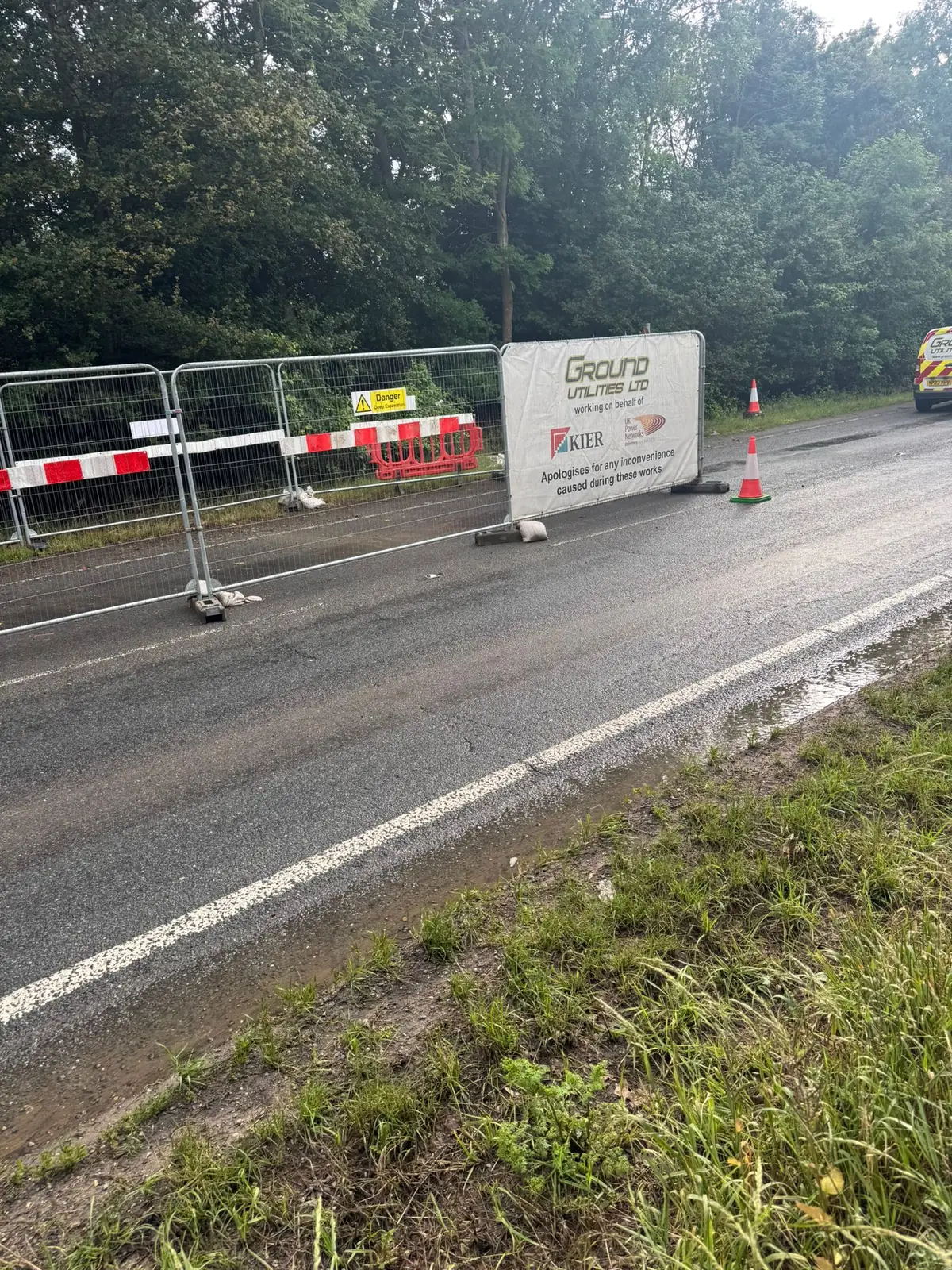
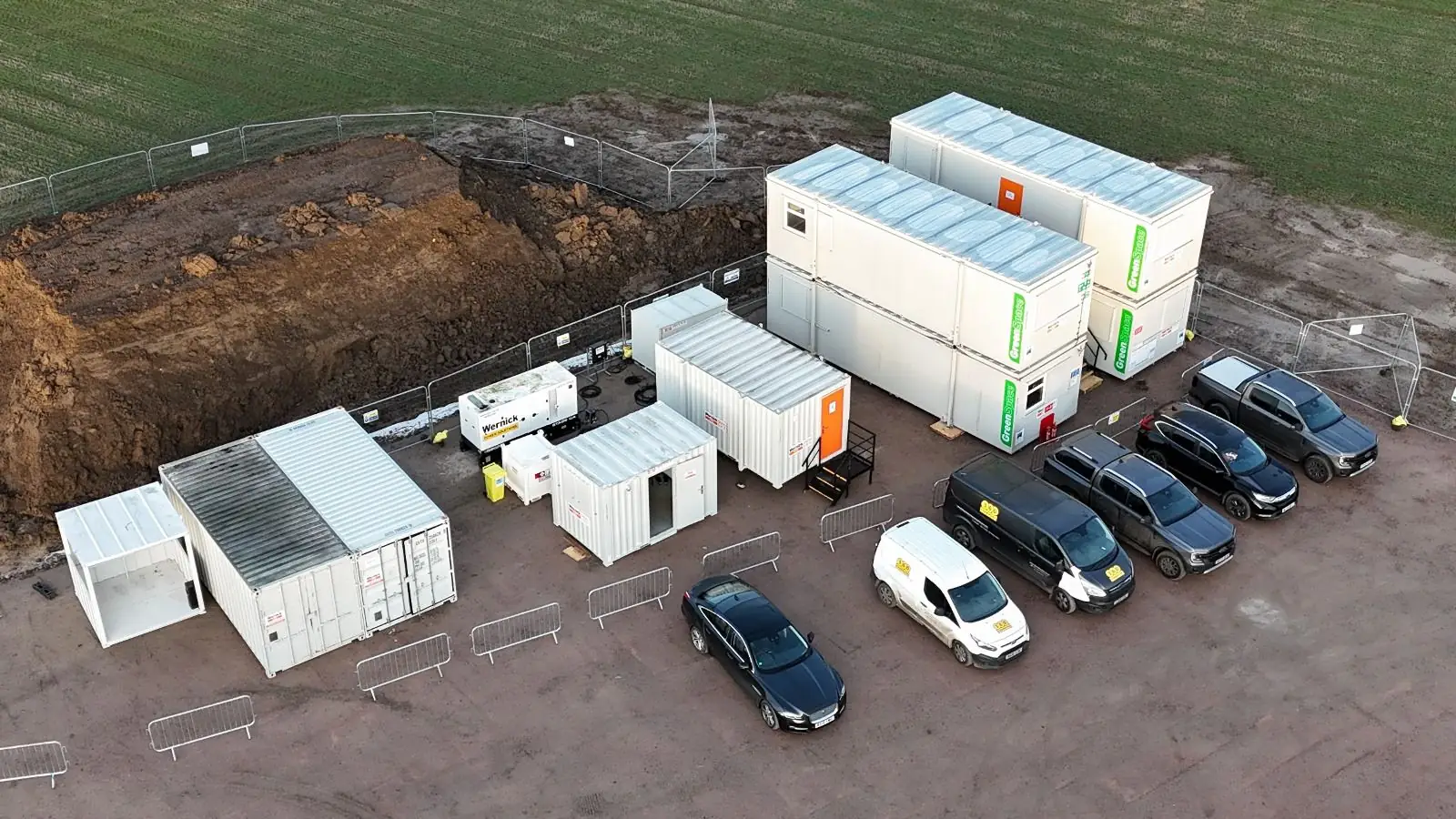
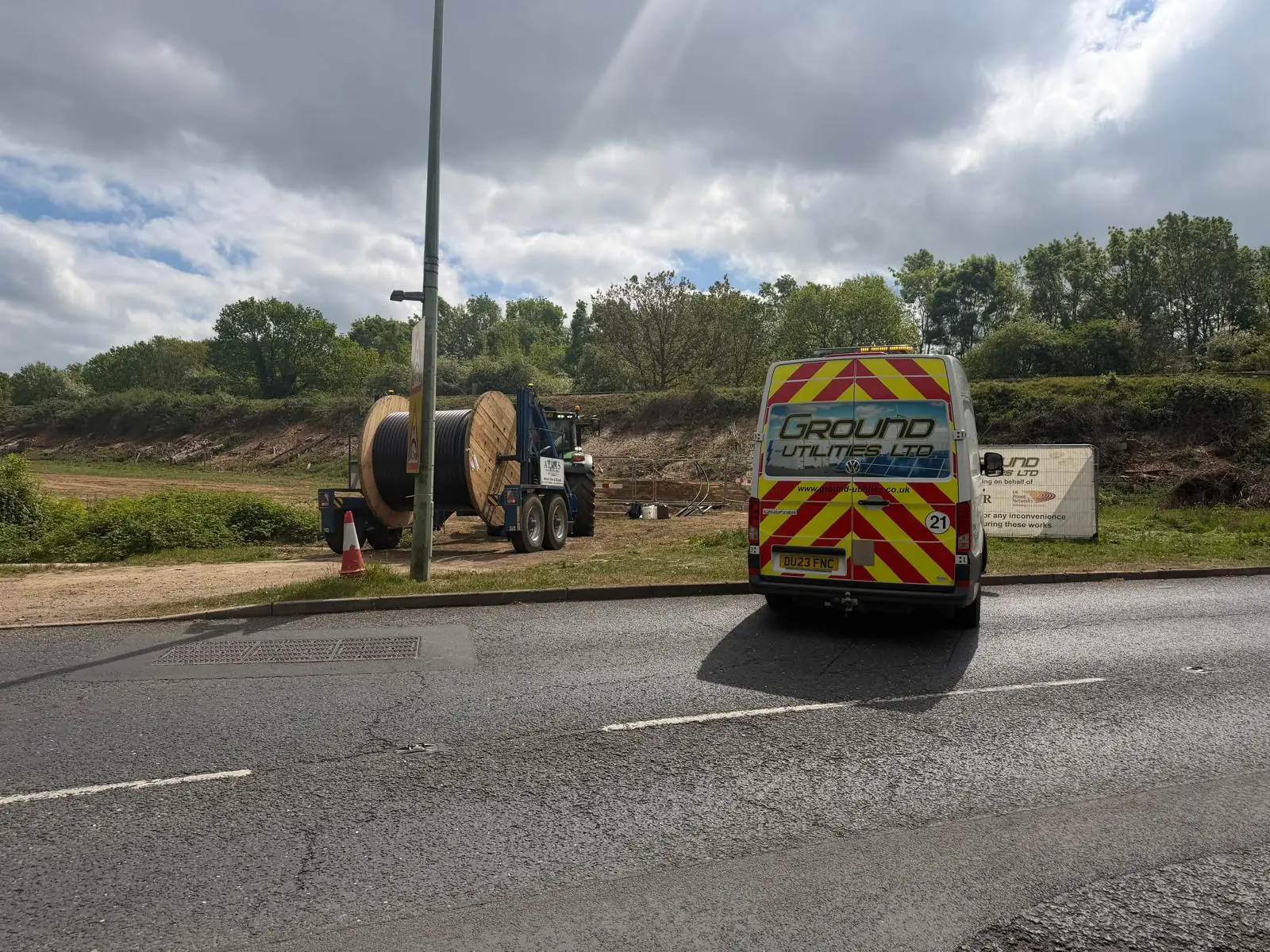
Ground Utilities Ltd is a civil engineering and utility contractor that builds cable routes from 240V to 132kV, working across England and Wales from Highdrove Farm, Cottenham, Cambridgeshire, since 2015. On a route we carry out site investigations, trenching, ducts, joint bays, cable pulling and installation, and reinstatement. We hold full NERS approval for cable laying at LV, 11kV, 20kV, 33kV, 66kV and 132kV, and for civil works, with all six distribution network operators.
On the Indian Queens private wire in Cornwall, our scope started with CDM set-up, traffic management, highway permits, council liaison and the section 50 licence. It included surveys, trial holes and HSG47 hand digging at 22 areas of concern. Across our work:
- as a minimum, all our operatives are CSCS or EUSR registered and all our supervisors are SMSTS qualified;
- our supervisors and operatives hold NRSWA street works cards;
- we have an in-house EUSR approved trainer;
- we are members of the Utility Strike Avoidance Group.
We do no gas work. We do not joint or terminate cables, make final live connections, make connection applications to the network companies, or do design. On any route we work alongside the designer, the jointing contractor and the network operator, which is why Stage 1 comes first.
Frequently asked questions
What should a cable route pre-start meeting cover?
A cable route pre-start meeting should start with scope and who does what, then CDM appointments and permit and licence dates. It should cover utility records, surveys, the design and the operator's specification, then cards, plant, materials, traffic management and excavation safety. It should finish with the jointer handover, reinstatement, records and emergency arrangements.
How far ahead should you start a cable route checklist?
Start a cable route checklist at least 3 months ahead if any street length needs a road closure or will last 11 working days or more. Those are major works, which need 3 months' provisional advance authorisation under the Department for Transport's permit guidance. A section 50 licence can need longer.
Who is responsible for checking for buried services?
Everyone in the chain has a part in checking for buried services. HSG47 says clients must make reasonable enquiries and pass the information on, or give the contractor time and resource to do it. The contractor must take suitable and sufficient steps to prevent danger from underground services before digging, under CDM 2015 regulation 25(4).
How often must a trench be inspected?
CDM 2015 regulation 22 requires a competent person to inspect a supported or battered excavation at the start of each shift. It must be inspected again after any event likely to affect its stability, and after any accidental fall of material.
Does a cable route need to be notified to HSE?
A cable route must be notified to HSE under CDM 2015 regulation 6 if the work will last longer than 30 working days with more than 20 workers on site at any one time, or will exceed 500 person days. The client makes the notification, as soon as practicable before the construction phase begins.
Does the civils contractor joint the cables?
Not always. Cable laying and cable jointing are separate NERS scopes, and on many routes the civils contractor builds the bays and pulls the cable while a separate accredited jointer makes the joints.
Planning a cable route?
If your route is at the pre-start stage, see our HV and LV cable installation service and get in touch about the civils and cable laying.
Sources
- The Construction (Design and Management) Regulations 2015, regulation 5: Appointment of the principal designer and the principal contractor (legislation.gov.uk, 2015)
- The Construction (Design and Management) Regulations 2015, regulation 6: Notification (legislation.gov.uk, 2015)
- The Construction (Design and Management) Regulations 2015, regulation 22: Excavations (legislation.gov.uk, 2015)
- The Construction (Design and Management) Regulations 2015, regulation 25: Energy distribution installations (legislation.gov.uk, 2015)
- The Confined Spaces Regulations 1997, regulation 1 (legislation.gov.uk, 1997)
- Avoiding danger from underground services (HSG47) (Health and Safety Executive, 2014)
- Excavations (Health and Safety Executive)
- Permit schemes: statutory guidance for highway authorities (Department for Transport, 2026)
- New Roads and Street Works Act 1991, section 50: Street works licences (legislation.gov.uk, 1991)
- New Roads and Street Works Act 1991, section 67: Qualifications of supervisors and operatives (legislation.gov.uk, 1991)
- New Roads and Street Works Act 1991, section 70: Duty of undertaker to reinstate (legislation.gov.uk, 1991)
- Safety at Street Works and Road Works: A Code of Practice (Department for Transport, 2013)
- Traffic signs manual (Department for Transport, 2026)
- Specification for the reinstatement of openings in highways (Department for Transport, 2020)
- Client Guide to BS EN PAS 128:2022, Issue 3 (The Survey Association, 2025)
- Flood risk activities: environmental permits (Environment Agency)
- Protected areas: sites of special scientific interest (Natural England)
- Streamlining asset protection and optimisation (Network Rail)
- ES400E4 Installation and Repair of LV and 6.6/11kV Underground Cables and the Restoration of Excavated Areas (Electricity North West, 2024)
- EOS 09-0100 Site Recording of Cables, Plant and Equipment (UK Power Networks, 2024)
- Utility Excavations Category 1: Locate Utility Services (HSG47) (EUSR)
- National Electricity Registration Scheme (NERS) (LRQA)
- About CSCS (CSCS)
- Site Management Safety Training Scheme (SMSTS) (CITB)
- Site Supervision Safety Training Scheme (SSSTS) (CITB)